
Rivian is in talks with Volkswagen Group to bring more of its technology into the vehicles of the German group, including AI capabilities that include the newly launched in-car assistant.
Speaking on the latest episode of The Verge‘s Decoder podcast, Rivian‘s Chief Software Officer Wassym Bensaid detailed the boundaries of the Rivian and Volkswagen Group Technologies (‘RV Tech’) joint venture, its workforce, and the technologies that sit inside and outside its scope.
Rivian and Volkswagen entered a partnership in late 2024, under which the German automaker agreed to invest up to $5.8 billion in the EV maker as it adopts Rivian‘s zonal architecture and software stack across its future electric vehicles.
RV Tech is co-led by Bensaid and VW Group‘s Chief Technology Officer Carsten Helbing.
Bensaid described the deal as the largest licensing arrangement of its kind, framing it as taking “Rivian technology into the second-largest OEM in the world.”
He noted that “as RJ [Scaringe, Rivian‘s CEO] and I started the discussions with [VW Group‘s CEO] Oliver Blume, his number one priority was that they needed to keep the Rivian way of doing things.”
According to Bensaid, they “realized that we are not only bringing software IP and electronics IP but also a different process. We are bringing a different culture, and the VW Group needed that change from the inside.”
JV Workforce Update
Bensaid said RV Tech now employs roughly 1,500 people, all of whom are direct employees of the joint venture rather than of either parent company.
“We started with about 800 or 900 developers coming from Rivian, and then we had about 50 colleagues who joined us from the Volkswagen Group,” Bensaid said. “The rest are developers and engineers that we’ve hired in the past 18 months. So, everybody’s RV Tech.”
Under the structure, the technical team covering software and electrical engineering reports to Bensaid, while Helbing handles operations and serves as the main interface with Volkswagen Group, arbitrating requirements across the German group’s brands.
Bensaid acknowledged that managing competing demands across those brands has produced friction.
“Obviously, in some cases there has been daily tension. There are cases over the past 18 months where, as you mentioned, one brand might request a different requirement than another brand,” he said.
However, “what really helped us to continue is that support from the highest levels of Volkswagen Group leadership to help drive that transformation and cultural change.”
What the JV Includes
The joint venture is responsible for the underlying electrical architecture and the operating system that will power VW Group‘s electric vehicles.
Bensaid noted that RV Tech does roughly 80% to 90% of the work, building a common platform and then providing customization hooks so each brand can express its own identity.
“An Audi drives like an Audi and a Lamborghini has a different UI than a Rivian,” he said. “But what’s happening under the hood, what’s happening behind the scenes, is based on the same platform.”
For now, the joint venture’s scope covers only electric vehicles.
Bensaid said the technology could in principle be applied to hybrids or internal combustion vehicles, but that doing so is not the venture’s current priority.
The remark aligns with earlier comments from Helbing, who told media the architecture is “extremely capable” and could later support ICE applications.
What the JV Excludes
Bensaid confirmed that Rivian‘s autonomy technology and its newly launched Rivian Assistant both sit outside the joint venture’s architecture.
On self-driving, the EV maker has previously clarified that its autonomy platform — including the in-house RAP1 processor and LiDAR hardware unveiled at its December Autonomy & AI Day — is not part of the Volkswagen partnership.
The Rivian Assistant, the AI-powered voice system that began rolling out to Gen 1 and Gen 2 R1 vehicles in May via software update 2026.15, is also excluded.
Bensaid said the system was built on a dedicated in-house orchestration layer, with the company deciding to develop its own AI stack rather than rely on a third-party solution.
Asked directly whether the assistant relies on the RV Tech software stack, and whether Volkswagens might receive Rivian Assistant or something like it, Bensaid drew a clear line — while signaling that talks to widen the partnership are already underway.
“This is special to Rivian. This is an AI stack that is developed uniquely for Rivian. This is Rivian‘s brand priority as we see cars becoming more and more AI-defined,” Bensaid defended. “But we’re in discussions so that we can have similar technologies for the Volkswagen Group.“
The position extends a pattern Rivian executives have set out repeatedly.
CEO RJ Scaringe has described the Volkswagen deal as “the first of what we believe will be many software and electronics deals like that.”
Management has also noted that the partnership opens the door to licensing its stack — potentially including autonomy hardware and software — to other automakers beyond Volkswagen.
First Models Debuting the JV Tech
The Rivian R2 will be the first vehicle to run the new zonal architecture, Bensaid confirmed.
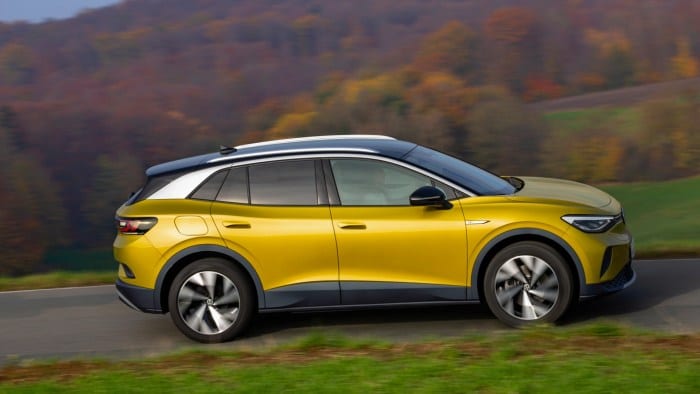
On the Volkswagen side, the ID.1 — an entry-level model expected to sell for less than $25,000 — is among the first products being built with the technology.
Volkswagen, Audi and Scout Motors reference vehicles completed winter testing in the first quarter of 2026, with the program covering the Volkswagen ID.EVERY1 concept that underpins the production ID.1.
The Scalable Systems Platform developed through the partnership is expected to be deployed on up to 30 million vehicles across the group’s brands.
Financial Side of the JV
Rivian receives Volkswagen‘s capital in tranches tied to technical and financial milestones.
The EV maker collected the first two $1 billion equity tranches in 2025 after posting back-to-back gross-profit quarters.
A third $1 billion deployment earlier this year lifted Volkswagen‘s stake to 15.9%, making the German group Rivian’s largest shareholder.
Volkswagen surpassed Amazon for the first time since the EV maker’s 2021 Nasdaq debut.