
Rivian‘s founder and CEO RJ Scaringe disclosed that the company’s headcount has grown to 17,000 employees — a figure that implies the EV maker added roughly 1,800 net positions in the first five months of 2026.
The number marks a sharp reversal from nearly two years of workforce contractions that eliminated thousands of jobs, across five publicly disclosed rounds of layoffs between February 2024 and October 2025.
Scaringe made the disclosure while discussing how Rivian‘s organizational structure has evolved with scale.
“Today we have 17,000 employees and we couldn’t possibly all meet in the same room,” he said in a new episode of the Masters of Scale podcast, published on Thursday.
Scaringe characterized organizational design as inherently imperfect and constantly changing.
“It looked very different at 30 people than it did at 100 people, which looks wildly different than it does at, let’s say, 1,000 people,” he said.
Rivian reported 15,232 employees at the end of 2025 in its annual 10-K filing.
Scaringe’s 17,000 figure, if it reflects the consolidated entity on the same basis as the annual disclosure, represents an approximately 11.6% increase in headcount since the last day of 2025.
The figure includes personnel at Rivian and Volkswagen Group Technologies — the joint venture known as RV Tech — which Rivian consolidates for accounting purposes.
Rivian does not separately disclose RV Tech’s standalone headcount, making it impossible to determine from public information how the approximately 1,800 net new positions divide between Rivian‘s own operations and the joint venture.
The RV Tech joint venture with Volkswagen Group, capitalized in November 2024 under a deal now valued at $5.8 billion, has also expanded its own workforce.
The venture added at least six senior executives during 2025 and hired Manasi Vartak as Vice President of AI and Data in April.
Rivian Chief Software Officer Wassym Bensaid serves as Co-CEO and Chief Technology Officer of RV Tech alongside Volkswagen-side counterpart Carsten Helbing.
A History of Layoffs
The 2026 hiring wave follows a prolonged period of workforce reductions that defined Rivian‘s cost-cutting posture from early 2024 through late 2025.
Rivian executed five publicly disclosed rounds of layoffs between February 2024 and October 2025.
The first, in February 2024, eliminated approximately 10% of the company’s salaried workforce.
Scaringe cited a “challenging macroeconomic environment” including high interest rates and geopolitical uncertainty.
As EV exclusively reported, the second round in April 2024 cut approximately 1% of total staff, concentrated in non-manufacturing functions.
Rivian told Reuters in an email that the move was “a difficult decision, but a necessary one to support our goal to be gross margin positive by the end of the year.”
The combined 2024 cuts produced a net 1,929-employee reduction, with year-end headcount falling to 14,861 from the 2023 peak of 16,790.
Three additional rounds followed in 2025.
In late June, Rivian cut approximately 140 employees — roughly 1% of its workforce — primarily from the manufacturing team, describing the reductions internally as eliminating roles that created “process inefficiencies” ahead of the R2 launch.
A second 2025 round on September 4 affected approximately 150 employees in the commercial team handling sales and service operations.
The largest 2025 cut came on October 23, when the company laid off more than 600 employees — 4.5% of staff — across marketing, vehicle operations, sales and delivery, and mobile operations.
“With the launch of R2 in front of us and the need to profitably scale our business, we have made the very difficult decision to make a number of structural adjustments to our teams,” Scaringe said in an internal memo.
As part of that restructuring, Rivian dissolved its existing marketing organization and created a unified team, with Scaringe himself assuming the role of interim Chief Marketing Officer.
The company named Jenny Lewis as Vice President and Head of Marketing and eCommerce in April — a move that contradicted its earlier statement to EV that it had no plans to hire a dedicated marketing leader.
The combined 2025 layoffs removed approximately 890 to 900 positions.
Despite those cuts, Rivian‘s consolidated headcount still rose by 371 employees during 2025 to reach 15,232 by year-end — the company’s first net headcount gain at the consolidated-entity level since 2023.
Much of that net growth reflected the expansion of RV Tech, which was newly formed in November 2024 and drew personnel from both parent companies.
The Headcount Arc
Rivian‘s workforce trajectory has traced a rapid expansion, a sharp contraction, and now an apparent re-expansion over the five years since the company went public.
When Rivian priced its $13.7 billion IPO in November 2021, the company employed roughly 9,500 people.
By December 31, 2021, the figure had grown to 10,422.
Headcount expanded by 35.5% in 2022 to reach 14,122 as Rivian ramped R1T pickup and R1S SUV production and built out its commercial Electric Delivery Van program with Amazon.
The peak came at the end of 2023, when Rivian reported 16,790 employees — a figure it has only now approached again, and likely surpassed, according to Scaringe’s June 2026 disclosure.
The company then contracted by a combined 1,929 employees in 2024 before posting the modest net gain in 2025.
Scaringe’s 17,000 figure, stated casually during a discussion about organizational design at scale, is the first public indication that Rivian‘s headcount has exceeded the previous 2023 high-water mark.
The disclosure was not made in a regulatory filing or earnings call, and Rivian has not independently confirmed the figure in a formal context.
R2 and Manufacturing Footprint
The hiring surge coincides with the launch of the R2, Rivian‘s most consequential product to date.
Customer deliveries began earlier this week.
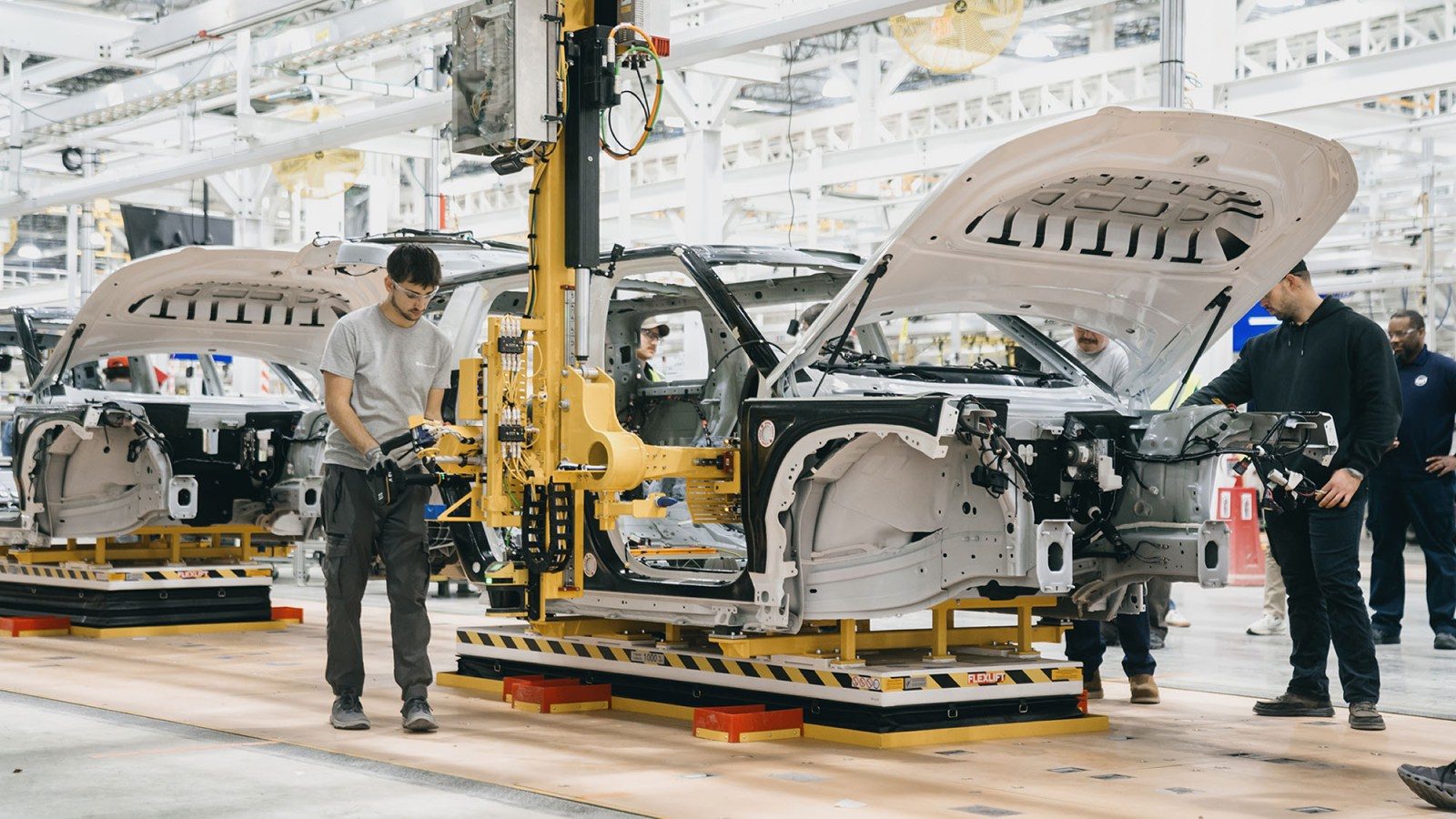
Saleable units of the model are being produced since April at the company’s plant in Normal, Illinois.
A second shift is planned for the second half of 2026, a move that would require additional assembly-line workers, quality inspectors, and support staff at the facility.
Rivian has told investors it expects to deliver between 20,000 and 25,000 R2 units by year-end, alongside total 2026 delivery guidance of 62,000 to 67,000 vehicles.
Reaching those figures from a standing start in June would require one of the fastest production ramps of any new all-electric vehicle in US history.
Scaringe has described the R2 as “the most important thing we’ve launched to date.”
Starting at $57,990 for the Performance, Launch Edition, the vehicle is positioned well below the R1 platform’s average transaction price of more than $90,000.
Rivian plans to offer versions below $50,000 beginning in 2027, and a further stripped-down configuration around $45,000 later that year — the entry price-point promised by Scaringe since the model was unveiled in 2024.
Beyond the Normal factory, Rivian is spending heavily on its second manufacturing facility east of Atlanta, Georgia.
Vertical construction began following a ceremonial groundbreaking in September 2025.
The plant is expected to open in 2028 and will eventually produce the R2 alongside future models including the R3, R3X, and subsequent platforms.
Planning, engineering, and pre-construction staffing for the Georgia site could represent a meaningful component of 2026 headcount additions, though Rivian has not disclosed specific figures.