Rivian‘s founder and CEO RJ Scaringe pushed back on the idea of selling the company in an interview on The Chris Evans Show this week, saying he would “prefer not” to sell the EV maker to Tesla and SpaceX chief Elon Musk.
The comments mark the second time in three months that Scaringe has publicly commented on takeover speculation, after dismissing a similar question involving Volkswagen in March.
The exchange came after the host Chris Evans questioned Scaringe directly on why Tesla‘s CEO Elon Musk would not simply acquire the company.
Evans framed the question around Musk’s new status as the world’s first trillionaire, following SpaceX’s record-breaking initial public offering on June 13 — which valued the rocket and satellite company at roughly $1.8 trillion.
“Why wouldn’t he just come and buy your company? I don’t mean that disrespectfully or facetiously. Because it is, with respect, a small change to him,” Evans said. “Why wouldn’t he just come and snap you up? Because you’re clearly the future.”
Scaringe responded with a brief “I don’t know” before Evans pressed further, asking whether he “would you sell if he did?” — to which the Rivian founder responded with “I’d prefer not.”
Evans then raised whether Musk could present a bid that Rivian’s Board of Directors would be unable to turn down.
Scaringe confirmed by saying, “Well, I mean, we’re a public company, so if an offer came in, we’d have to take it to the Board [of Directors], and ultimately, I have responsibility as shareholders.”
The CEO made his personal stance clear, however.
“Of course, I’m incredibly bullish on Rivian, and so I think that we have a tremendous amount of upside from where we are today,” he noted. “And so I would be, I sort of think it would be like a shame to have the company be sold right now.”
Evans then offered the metaphor that Scaringe expanded on.
“Why not become the next Tesla?” Evans asked. “It just feels like if this is a metaphorical fruit tree, it’s like we’re picking the very first piece of fruit before it’s even partially ripe. So the company’s got so much growth in front of it.”
Deflecting Takeover Questions
The comments extend a pattern that began in March at the Fast Company Grill during SXSW in Austin, where Scaringe was asked directly whether Volkswagen Group should acquire Rivian outright amid the two companies’ software partnership.
After pausing for five seconds, Scaringe responded: “That’s not the outcome we were looking for.”
The Volkswagen joint venture, named RV Tech, has committed up to $5.8 billion to license Rivian‘s electronics and software platform across Volkswagen, Audi, Porsche, and other brands in the group.
Earlier this year, Scaringe has described Rivian and Tesla as the only two automakers that have built fully vertically integrated software and electronics architectures from scratch — a capability that he argues makes the company a technology licensor, not a takeover target.
As of press time, Rivian‘s market capitalisation sits at about $20.6 billion.
At its post-IPO peak in November 2021, Rivian briefly exceeded a $150 billion valuation before shares fell more than 90% over the following years.
The company went public at $78 per share in November 2021 in the largest IPO of that year, raising $11.9 billion. That public offering came on top of approximately $12 billion Scaringe said Rivian raised as a private company.
Scaringe on Musk’s Storytelling
The acquisition exchange came during a broader discussion about Musk and Space X’s IPO, where Evans asked Scaringe for his reaction to the milestone.
“When you have a company, and he’s started multiple companies that are worth multiple trillions of dollars, so by virtue of him having a large ownership stake, it’s just the mathematics,” Scaringe told the host. “It just works out.”
Evans suggested that a chief executive’s primary function is narrative — that the title should stand for “Chief Executive Storyteller” rather than Chief Executive Officer. The Rivian CEO accepted the premise and applied it to the capital-intensive reality of the business.
“If you’re building something that’s hard and building something that’s going to take a lot of capital, you have to inspire people to provide capital to investors and inspire people to work on a problem that hasn’t been solved,” he stated.
Scaringe acknowledged that this was a learned skill, adding that “you need to get supporting companies or suppliers to work with you. And so it does require convincing a lot of people to buy into this bigger vision.”
$12 Billion IPO
Scaringe traced Rivian‘s capital-raising history from its earliest days, offering a personal account of the financial risk involved in launching a car company from scratch. “When I started Rivian, I thought it would take a lot of money. I didn’t have any money, but I thought this is going to take, I think about a billion dollars,” Scaringe said.
“One of the biggest challenges in building a business like this is we’re not designing Rivian to be a small company, we’re designing to be a large company,” Scaringe stated.
The founder highlighted that they’ve “vertically integrated” many of the areas they operate in, including electronics, software, motor design, power electronics.
“We built out our own direct to consumer sales and service channels,” he added, describing all of that investment as having been made in anticipation of the R2 launch, a “much higher volume product.”
Scaringe said that Rivian “had to go in knowing we’re going to invest a ton of money and lose money for a period of time while we get ready to build scale. And so we’re now at the precipice of launching that R2.” The EV maker began delivering the R2 to its first public customers on June 9 — after starting volume production of the midsize SUV on April 22 at its Normal, Illinois plant.
The Road Ahead
Rivian now employs approximately 17,000 people, a figure that represents roughly 1,800 net additions in the first five months of 2026 after nearly two years of workforce reductions.
However, earlier this week the company announced a new layoff affecting hundreds of workers across its service and customer teams.
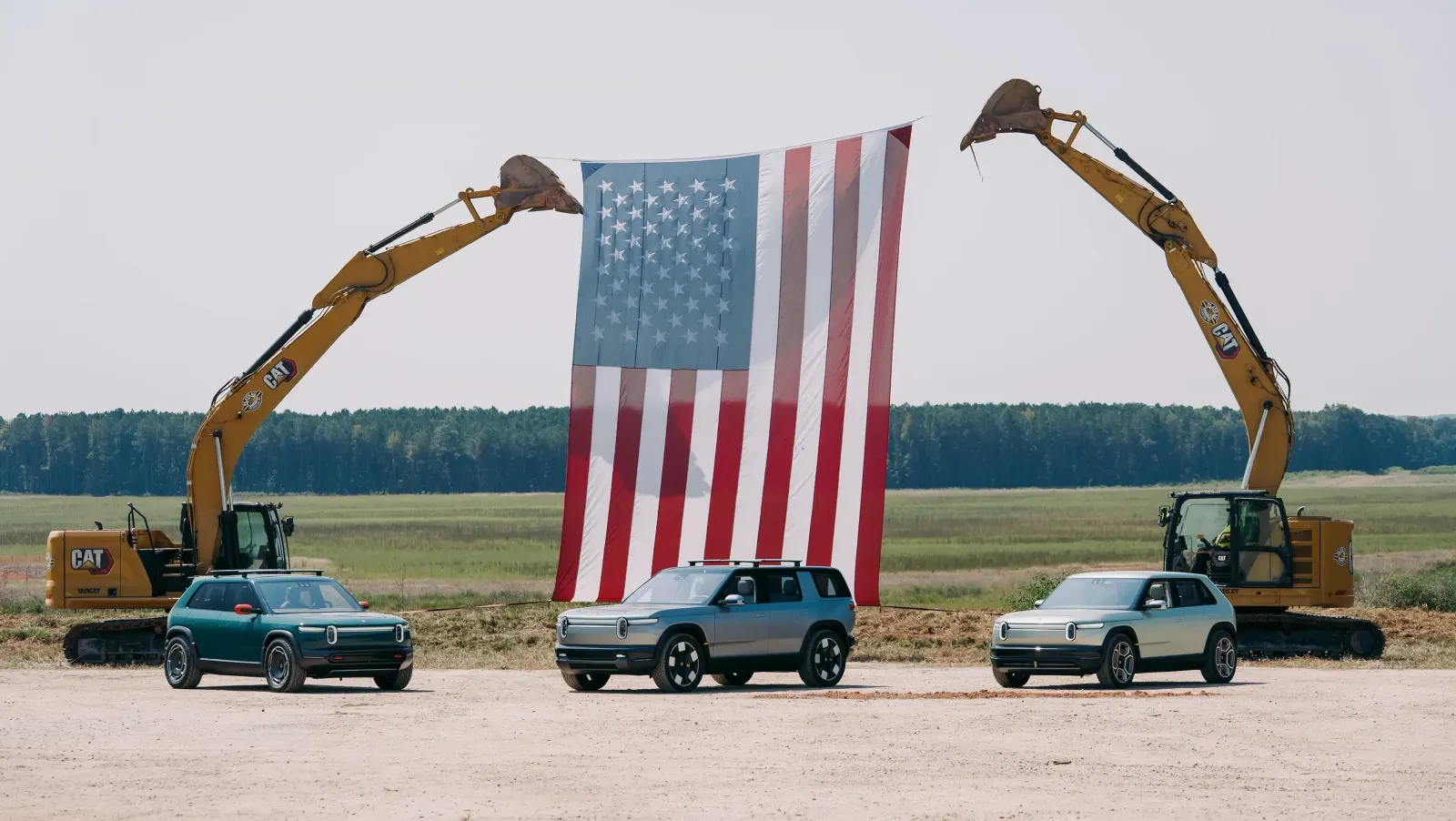
The company has broken ground on a second manufacturing facility in Georgia that Scaringe confirmed will employ around 7,500 workers when it opens in 2028.
The R2, which launched in its Performance configuration at $57,990, is the vehicle Scaringe has consistently described as the model that will transform Rivian into a large-scale, profitable company.
A base version priced at $44,990 is expected to arrive in summer 2027.
The R1, meanwhile, remains the best-selling premium electric vehicle in the United States, with Scaringe telling Evans that “if you buy a premium SUV in California, the most popular vehicle you can buy is Rivian.”
Evans asked directly when Rivian vehicles would be available in the United Kingdom. “We haven’t set the date yet,” Scaringe told him.
“The biggest question for us is just the cadence of growing in the United States, given that the market’s very large.”
Rivian‘s plan is to “accumulate more volume, get closer to profitability and then launch in Europe.” The company guided to delivering between 20,000 and 25,000 R2 units by the end of 2026 within a full-year target of 62,000 to 67,000 vehicles across all models.