Rivian‘s founder CEO RJ Scaringe declared on Wednesday that only Rivian and Tesla have broken free from the fragmented, supplier-driven software architecture that still defines nearly every other vehicle on the road.
Scaringe was interviewed at the ACT Expo in Las Vegas, where he discussed the automotive industry’s move towards software (SDV) and AI-defined vehicles.
Speaking on the shift, the founder contrasted modern centralized software architectures with the fragmented systems used in most cars today.
He described a typical modern vehicle as containing up to a hundred small computers, each built by a different supplier, each running its own software.
“You have, like a modern medium to full-content car, you may have a hundred of these little computers,” Scaringe said. “Each of those little computers is built by a supplier, and each of those suppliers either writes the software or hires another supplier to write the software that is on it.”
Going further, the CEO signaled out Rivian and Tesla as the only two automakers that have broken from this model.
“Every car on the road, outside of a Rivian or a Tesla, consists of hundreds of computers in the car, with hundreds of different little islands of software written by different teams,” he said, describing the result as “an extremely complex architecture” that “wasn’t a designed architecture, it sort of became because of the history of how things evolved.”
Scaringe has defended the idea before.
Last October, Rivian‘s chief executive described legacy software architectures as “a field of weeds” filled with “little ECUs all over the place” that are “all little islands of software” that manufacturers cannot update themselves.
He has been tracing the problem back to decisions made in the 1960s, when the first automotive computers were introduced to control fuel injection systems and automakers outsourced the electronics to third-party suppliers.
Rivian’s Zonal Architecture
Rivian has aggressively moved to a zonal architecture for its second-generation vehicles — the updated R1T and R1S — and is carrying this forward to the midsize R2 and R3 SUVs.
According to Scaringe, software-defined vehicles benefit from reduced complexity, lighter weight, lower costs, and easier over-the-air (OTA) updates.
Gen 1 R1 vehicles started with 17 ECUs — already lower than many legacy vehicles’ 40 to 150 — while Gen 2 R1 models reduced that to 7 ECUs total.
This includes dedicated units for key functions such as infotainment, autonomy, vehicle access, drive units, and battery management, plus three zonal controllers that handle most other vehicle functions based on physical location rather than function.
Rivian says the benefits include better scalability for SDV features and future autonomy, drastically reduced wiring — approximately 1.6 miles less on Gen 2 R1 and up to 2.3 miles less on R2 — with connectors down roughly 60% in some cases.
The company also claims weight savings of approximately 44 pounds (20 kg), 20% lower material costs, a 15% reduction in carbon footprint, and easier manufacturing, diagnostics, and servicing.
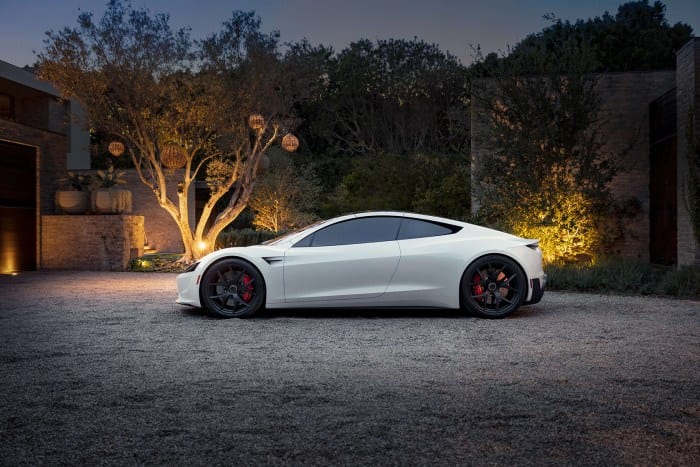
Tesla pioneered the shift to a highly centralized and zonal E/E architecture years ahead of most competitors, starting notably with the Model 3 in 2017.
The Model 3 sedan was cited as using approximately four main control units in some overviews, with broader consolidation into central compute and zonal elements.
Supply Chain Complexity
The complexity Scaringe describes in software architecture mirrors the challenges Rivian faces across its physical supply chain — a topic the CEO has addressed repeatedly over the past year.
Last summer, Scaringe used the example of a single headlight to illustrate the depth of automotive supply chains.
“It has about 20 suppliers into it. And those 20 suppliers, and each have about 10 to 15 suppliers. So there’s hundreds of companies involved with our headlight,” he said.
Rivian assembles about 3,000 parts per vehicle, but as Scaringe noted, “there’s actually more than 10x that in terms of discrete components that are going into the car, because we buy assemblies.”
In March, Scaringe warned that geopolitical disruptions ripple through “tens of thousands of companies, many of which you don’t have contracts with, nor have you ever even met with, that are just in this ecosystem.”
Rivian was forced to dramatically rework its supply chain in the second quarter of 2025 after abrupt disruptions to rare earth metals — critical for the magnets used in every electric motor.
Much of Rivian‘s push toward a simplified zonal architecture is designed to reduce this supply chain exposure.
Fewer ECUs mean fewer suppliers, fewer connectors, less wiring, and fewer points of failure — both in the vehicle and in the logistics chain that delivers its parts.
Lucid Motors
The one major EV maker Rivian‘s CEO left out was Lucid Motors.
Lucid has also pursued architectural consolidation, though its approach has evolved across vehicle generations.
In the second quarter of 2024, then-CEO Peter Rawlinson said the company had “pioneered Ethernet ring architectures in 2021 and incorporated zonal electrical architecture” in the Air sedan.
The EV maker’s first model debuted with 16 in-house, over-the-air updatable ECUs.
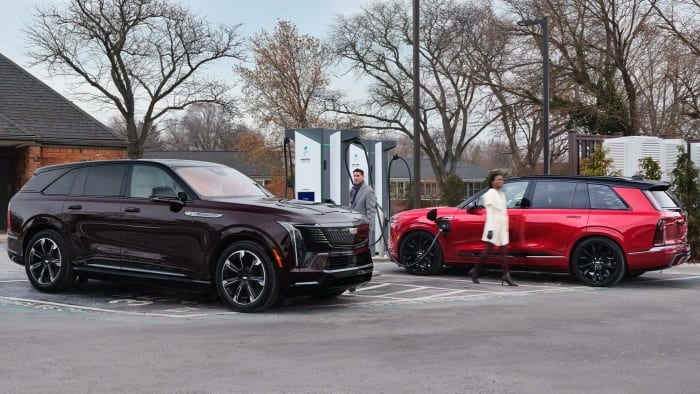
The Gravity SUV, which entered production in late 2024, has around 12 ECUs, including NVIDIA units for ADAS.
Lucid‘s most aggressive move comes with its upcoming midsize platform, expected to debut around 2027 or 2028, which the company says will use just 3 ECUs — two of which are unique — and 1,100 wires.
During its Investor Day presentation in March, Lucid compared this favorably against competitors: a South Korean OEM midsize EV with approximately 10 ECUs and 1,900 wires, a US EV leader’s midsize CUV with 3 ECUs and 1,300 wires, and a Chinese EV OEM with 3 ECUs and 2,200 wires.
Legacy Architectures
Scaringe expanded on why traditional architectures fail in a software-defined world, arguing that even basic user experiences are hampered by the fragmented supplier model.
“And in some ways, it’s almost the exact opposite of what you’d want to have if you’re designing a network architecture from scratch,” Scaringe explained. “It’s very difficult to do over-the-air updates because it’s a coordination effort amongst many different suppliers.”
The CEO illustrated the problem with a simple scenario: the sequence of events that occurs when a driver approaches their vehicle.
“If you are doing an update, it usually has to be just for one ECU. You can’t have cross-ECU collaboration in those updates,” he said. “The door unlocks, that’s another ECU. The HVAC comes on, that’s another ECU. It chimes, that’s another ECU. It’s very hard to coordinate all that activity.”
To Scaringe, the emergence of zonal architecture — combining dozens of distributed ECUs into a much smaller number of computers organized by physical location within the vehicle — solves this coordination problem.
The CEO also noted that this is the same hardware and software platform that Rivian has licensed to Volkswagen through their joint venture, in which the German automaker committed up to $5.8 billion.
The technology will first appear in the Volkswagen ID.1, expected in 2027, followed by models from Audi and Scout Motors in 2028.
The joint venture completed winter testing of its production-intent architecture on March 27 across prototype vehicles from Volkswagen and Audi.
AI-Defined Vehicles
Scaringe framed the zonal architecture as a prerequisite for what he sees as the next phase: AI-defined vehicles.
Rather than treating AI as a superficial addition to the dashboard, the CEO argued that the real opportunity lies in using the entire vehicle’s data to drive intelligent, real-time decisions.
Rivian issues new features roughly every month through over-the-air updates — something the CEO said is only possible because of the underlying architecture.
But the bigger ambition, he argued, is harvesting data from across the vehicle to power AI-driven insights.
“And when you think about AI integration, I think it’s a very narrow view when you think of it just like putting ChatGPT into the screen,” Scaringe said. “When we talk about AI integration to the vehicle, this is using the aggregate knowledge that’s being accumulated across every endpoint in the vehicle.”
To him, this includes data on how often the lights are on or how often the doors open and close, how often people are seated in each seat, among other things.
The information “can link to service, link to predictability around maintenance intervals, link to the need for new features, link to insights around what may be happening, suggestions for, let’s say, lunch, suggestions for applications when they go onto the vehicle.”
Scaringe said this approach is “particularly important for commercial vehicles, where you really have a lot of value in the data.”
Rivian Commercial Offer
Rivian operates a commercial van business that produces electric delivery vehicles (EDVs) for Amazon, its largest commercial customer.
The retail giant ordered 100,000 of the vans as part of a deal struck in 2019 and has deployed thousands across the United States, besides some in its European fleet.
Over 30,000 vans have been delivered so far.
Last year, the company opened its van business to fleet customers outside of Amazon.
The EDV fleet generates continuous operational data — mileage, route patterns, charging behavior, cargo loads — that Scaringe sees as a natural fit for AI-driven optimization.
The CEO distinguished between different commercial use cases, from last-mile delivery to heavy-duty transport, but said the core principle applies across all of them.
“And, of course, depending on what the application is, if it’s a last-mile vehicle or a heavy-duty vehicle, they’re going to have different needs,” he noted.
“But the ability to harvest that data set, to make informed decisions real-time and all the time, meaning not through, like, an analyst off the vehicle, but actually the vehicle on the edge, making informed AI-driven decisions,” Scaringe added.