
Nissan published a social media post on Thursday taking direct aim at Ferrari‘s first fully electric production model, the Luce.
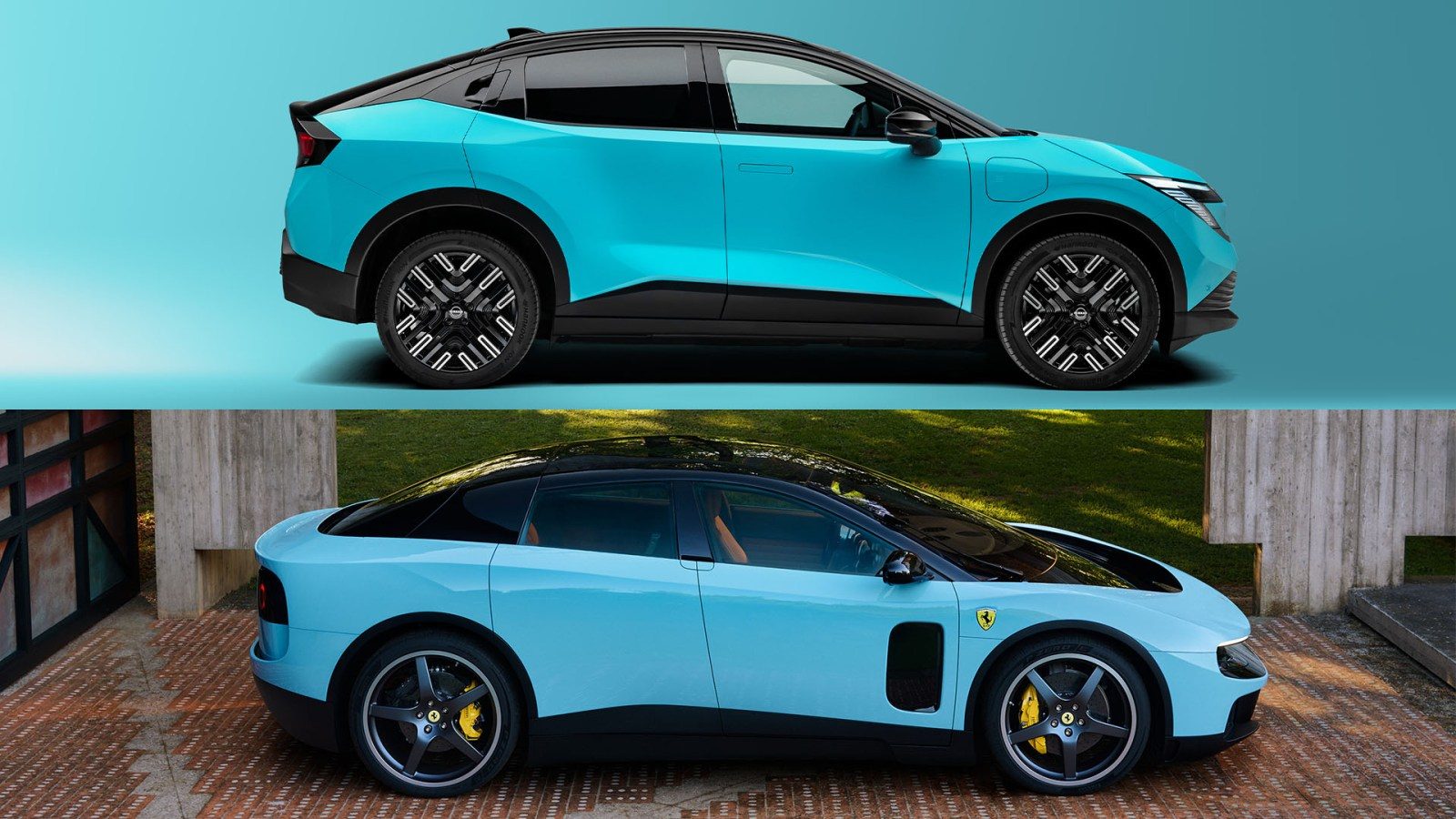
The Irish account of the Japanese automaker placed side-by-side images of the Luce and the Nissan Leaf, suggesting that the Italian supercar brand had drawn inspiration from the Japanese automaker’s long-running electric hatchback.
“They say imitation is the sincerest form of flattery, so thank you Ferrari,” the post read. “Nissan. Always a smart choice.”
The image paired a teal 2026 Nissan Leaf with a light blue Ferrari Luce and carried the caption “We admit, we’re flattered.”
Luce’s Turbulent Launch
The Luce has been at the center of criticism since Ferrari unveiled it in Rome on May 25.
The backlash focused on two points: the design, which many observers said looked nothing like a traditional Ferrari, and the price, which opens at €550,000 — approximately $640,000 — before options.
Social media commentary in the days that followed frequently compared Luce’s silhouette to mass-market models, with the Nissan Leaf among the most cited references.
Ferrari CEO Benedetto Vigna pushed back at an event in Modena on May 28, stating that the Luce “has nothing to do with electric cars you have seen from other players” and that consumers needed to see and drive it to understand it had not been copied.
He also defended the price: “Innovation has to be paid for.”
Former Ferrari chairman Luca Cordero di Montezemolo, who stepped down in 2014, was less restrained.
“I cannot say what I really think: I would harm Ferrari. We risk the destruction of a legend,” he told Italian media outlet Askanews, adding that they should “take the Prancing Horse off.”
Ferrari‘s Milan-listed shares dropped more than 6% on the day of the reveal, closing at €290.80. The stock is now down roughly 25% from its 2025 peaks.
Earlier this year, Reuters reported that Ferrari had also delayed the launch of its second fully electric model to 2028.
The Price Gap
The contrast Nissan Ireland was trading on is stark in numerical terms.
The 2026 Nissan Leaf starts at $28,140 in the United States.
The Ferrari Luce opens at approximately $640,000 — a difference of more than $611,000, or roughly 22 times the cost of the Nissan.
The Luce is Ferrari‘s first four-door, five-seat vehicle, developed in collaboration with the LoveFrom design collective — led by former Apple chief design officer Sir Jony Ive and Marc Newson — working alongside Ferrari Design Director Flavio Manzoni.
It produces more than 1,000 horsepower from a quad-motor, all-wheel-drive layout on an 800-volt architecture with a 122 kWh battery.
Ferrari rates its 0–100 km/h time at 2.5 seconds and its range at 530 km.
At more than 2.2 tonnes, it is heavier than any combustion-engined Ferrari currently in production.
Deliveries are scheduled to begin in the fourth quarter of 2026.
The 2026 Leaf, by comparison, carries a 75 kWh battery — with a 53 kWh option — and a stated range of up to 488 km (303 miles).
Upon the reveal of the first Luce details last month, EV compared the model with Lucid‘s fully spec’d Air Sapphire.
The US EV maker’s sedan outperforms the Ferrari model on every key metric, at less than 40% of the Luce’s price ($250,000).
The Leaf’s History
The irony the Nissan Ireland post was exploiting runs deeper than price.
The Leaf is one of the oldest mass-market electric vehicles in existence.
Nissan launched the first generation in December 2010, describing it as the world’s first mass-market electric vehicle.
Additionally, it held the title of the world’s best-selling EV from 2011 to 2014 and again in 2016, before the Tesla Model S overtook it.
From 2010 to 2024, Nissan sold nearly 700,000 units of the model across Japan, North America, and Europe.
Ferrari, by contrast, has no comparable history in electric vehicles.
The Luce is the brand’s first fully electric production model, arriving more than 15 years after the Leaf went on sale.
The 2026 Leaf marks the third generation of the nameplate, which has evolved from a compact hatchback with a 24 kWh battery and 200 km of range into a crossover SUV.
Automakers’ Own Pressures
The social media moment came against a difficult backdrop for Nissan.
The company reported a net loss of 670 billion yen ($4.5 billion) for the fiscal year ended March 2026.
Last year, it announced plans to cut approximately 20,000 jobs — around 15% of its global workforce — and to close seven of its 17 production facilities.
Newly appointed CEO Ivan Espinosa has framed the current period as a year of transition, with restructuring costs expected to reach an additional 60 billion yen this fiscal year.
Ferrari‘s position is different in character but not without its own pressures.
Vigna acknowledged in Modena that the multi-step reveal process may have amplified the backlash.
The Italian automaker has committed €4.7 billion to electrification through 2030, with battery-electric vehicles expected to account for approximately one-fifth of sales by the end of the decade — a target already revised down from 40% at Ferrari‘s Capital Markets Day last October.
Ferrari‘s order book currently extends through the end of 2027.