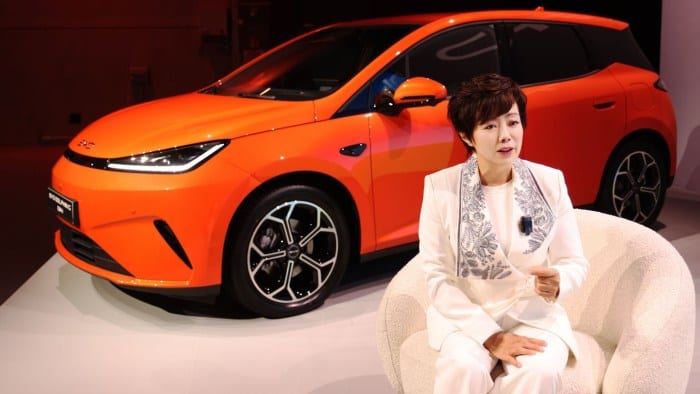

Onvo delivered 8,810 vehicles in August, down 46.4% from a year earlier, despite a refreshed version of its debut model and the launch of a larger five-seat SUV, the L80.
The family-oriented sub-brand of Nio, unveiled in May 2024, offered two models a year ago. Since then, it has launched the L80 in May and refreshed both the L60 and the L90.
Deliveries also fell 13.24% from July, and Onvo’s share of Nio Inc’s monthly volume dropped to 24.6% from 52.5% in August 2025.
The brand accounted for more than half of everything its parent sold a year ago and now accounts for a quarter as Nio brand deliveries doubled in August, driven by the flagship SUVs ES8 and ES9.
Founder and chief executive William Li told staff in mid-April that the L80 and the Nio ES9 were the company’s two most important launches of the second quarter.
The Comparison Month
August 2025 was the strongest month Onvo had recorded at that point, at 16,434 vehicles.
That total came from two models: 10,575 units of the L90, then in its first full month of deliveries, and 5,859 of the L60.
The comparison therefore runs against a launch spike.
Onvo delivered about 5,977 vehicles in July 2025 and 16,434 in August, nearly tripling in a single month as L90 handovers began.
The L90 had launched on July 31, 2025 at 265,800 yuan with the battery included, or 179,800 yuan under Nio’s battery subscription, with deliveries beginning the following day across 44 Chinese cities.
Onvo told local media at the time that production lines for both models were running at full capacity.
The brand went on to peak at 17,342 vehicles in October 2025, then fell to 11,794 in November and 9,154 in December.
Its monthly path this year runs the other way from the product calendar: about 5,352 in April, 12,029 in May as the L80 arrived, 11,743 in June, 10,155 in July and 8,810 in August — three consecutive declines from the 2026 high.
What Was Added Since
The L80 is a five-seat derivative of the L90 sharing most of its components, and it began deliveries on May 16, 2026 at 242,800 yuan for the Pro trim, 259,800 for the Max+ and 279,800 for the Ultra+.
Its arrival was delayed twice.
Executives said in August 2025 that deliveries would slip to 2026 so the brand could concentrate on the L90, and co-founder Qin Lihong later moved the unveiling to mid-April with deliveries in mid-May.
The 2026 L90 launched on April 21 with more than 70 hardware and software changes, adding Nio’s Shenji NX9031 chip and a lidar variant to a lineup that had previously used a pure-vision approach.
The third-generation L60 began nationwide deliveries in June from 192,800 yuan, or 135,800 yuan under BaaS, having reached nearly 100,000 buyers since its September 2024 debut.
So the August comparison sets a two-model lineup, one of which was six weeks old, against a three-model lineup in which every model had been launched or refreshed within the preceding four months.
The Pattern Underneath
Onvo’s volumes have moved in launch cycles rather than a trend, and each cycle has peaked lower.
The original L90 reached 11,722 units in October 2025, three months after launch, then fell to 4,105 by December.
Group-level Onvo volume followed: 17,342 in October, then 3,481 in January 2026, a 62% fall from December and 41% down year over year.
The L80 saw deliveries fall 31% in its second month, the same shape EV has described across the lineup — a post-launch surge driven by backlog clearing, followed by a sharper normalisation.
July, the first month with a settled range and no launch inside the period, showed the split within the lineup: only the refreshed L60 gained ground, reclaiming the top spot by volume, while the L90 posted its weakest non-holiday result since launch and the L80 fell for a second consecutive month.
August was the second such month.
July’s model split shows the three-way division: L60 4,949, L90 1,972, L80 3,232.
The Year-to-Date Figure
Onvo delivered 61,428 vehicles in the eight months to August, up 13.2% year over year.
A month ago the same measure read 39.1%.
Through July the brand had delivered 52,618 vehicles against 37,838 a year earlier; one month later the cumulative growth rate is 26 points lower, because August 2025 entered the base.
The brand delivered 13,339 in the first quarter and 29,124 in the second, a 70.5% year-over-year rise driven by the L80 launch and the two refreshes, before falling to 10,155 in July and 8,810 in August.
Both of the last two months have been below any month in the second quarter.
Onvo delivered 54,272 vehicles in the first eight months of 2025 against 61,428 this year, but the comparison months ahead are September’s 15,246, October’s 17,342, November’s 11,794 and December’s 9,154.
What Onvo Was Meant to Be
Onvo was launched in 2024 as the volume brand that would carry Nio into the mass market, and its targets have been set accordingly.
Li has described a long-term 55-35-10 split across Onvo, the Nio brand and Firefly, with the family brand carrying 55% of group volume — an eventual destination he has framed as a vision rather than a 2026 target.
August’s 24.6% is less than half that share, and the premium marque is at 59.1% against the 35% in the same framework. Reaching 55% would require roughly double Onvo’s current monthly run rate.
Onvo has been above 50% only once, in August 2025, and its highest share since was 42.9% in October that year.
Morgan Stanley reported in February, after meeting Li, that the brand planned two to three further models in the 150,000-to-200,000-yuan segment, targeting 8% to 10% market share, with Battery-as-a-Service used to reach buyers below 150,000 yuan.
None is scheduled for 2026.
Li told analysts on the first-quarter call that Onvo would add new products next year, which leaves the existing three SUVs to carry the brand through the remaining four months, and he has acknowledged brand awareness as a constraint, comparing Onvo’s recognition to the main Nio brand’s in late 2019.
Onvo said at its second-anniversary events in May that its average transaction price had passed 240,000 yuan in 2026, a figure that sits above the L60’s entry price and reflects the mix shift toward the larger models.
Brand chief Shen Fei, a long-serving Nio Vice President focused on the company’s battery swap business, took over in April 2025 after weaker-than-expected L60 sales.
The Group Consequence
Nio Inc delivered 35,836 vehicles in August, up 14.47% year over year, with the Nio brand up 101.18% to 21,174 and Firefly up 34.65% to 5,852.
The group grew while its designated volume brand halved, which inverts the structure the company described when it created Onvo.
The premium brand now carries 59.09% of volume against 33.62% a year ago, a mix that helps margin and works against the 40% to 50% delivery growth Li has targeted for the year.
Onvo subtracted 7,624 units from the year-ago month on its own, which is most of the reason group growth fell from 71.0% in July to 14.5% in August.
The brand’s model-level breakdown will come next week from China Passenger Car Association data.
The group needs between 48,277 and 56,527 vehicles a month from September through December to land inside Li’s range, above its own record month, and it has missed its annual target in each of the past three years.