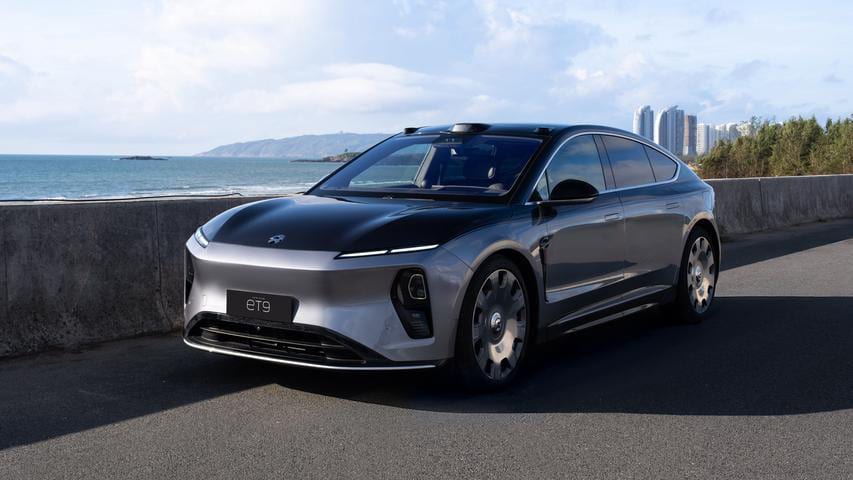

Nio Inc. says the insurance claims it pays out have fallen about 40% since 2023, a figure the company offered as evidence that its driver-assistance system is making its cars measurably safer.
On kilometres driven between serious accidents, the company is targeting a tenfold rise as it continues improving its assisted driving software named ‘Nio World Model.’
The claims came from Ren Shaoqing, the Senior VP who leads Nio‘s autonomous-driving research, at a briefing on the company’s intelligent-driving engineering.
Ren cautioned that the underlying data is drawn from Nio‘s own internal monitoring, and that specific figures would be released only after verification with insurers.
The figure lands days after Nio pushed a new version of its Nio World Model assisted-driving software to more than 700,000 vehicles in China, an upgrade that founder and CEO William Li had flagged on the first-quarter earnings call as bringing improvements across “driving, parking, and active safety scenarios.”
That framing matters, because the number, if it holds, points to the metric the industry is now circling: not how fast a system drives, but whether it reduces crashes.
Safety Becomes the Yardstick
Ren framed safety as the measure that now decides driver assistance, displacing earlier contests over which system could roll out city driving fastest or feel the most human.
What comes next, he said, returns to “a harder metric: whether it has actually reduced accidents.”
By Nio‘s account, its active-safety system currently averages one serious accident every 6.79 million kilometers, a figure the company wants to push past 8 million in a software version due in the second half of 2026.
Ren said the longer-term goal is to “add a zero,” reaching one serious accident every 100 million kilometers.
The Shanghai-headquartered also said its active-safety functions are validated across more than 40 million kilometers of driving each week, with total weekly validation mileage above 100 million kilometers.
On the road, the company said the upgraded model leads the industry on two measures that usually pull against each other: false braking and risk intervention, the trade-off between a car that stops too readily and one that reacts too late.
Hardware redundancy follows the same logic.
Ren likened the extra side-facing lidars on some Nio models to fitting “two extra airbags,” sensors whose value shows up not on the daily commute but in the long-tail risks that cause crashes.
Ren described a paradox in that effort: the better a system gets, the harder it becomes to test, because a car that already handles routine driving throws up fewer mistakes for engineers to catch.
“Testing is more and more of a grind — more of a grind than playing video games,” he said.
A test engineer might drive all day and surface only a handful of useful failures, which is why Nio leans on data from cars already on the road rather than a dedicated test fleet.
One Model, Many Cars
The safety claims rest on the scale of last week’s rollout, in which a single world model reached three software platforms at once: Cedar, Cedar S and Banyan on the Nio brand, alongside the Coconut system on the value marque Onvo.
The update went out simultaneously to cars running four Nvidia Orin-X chips and to those using Nio‘s own Shenji NX9031 processor, which the company called the first time an automaker has released in parallel across both third-party and in-house silicon.
The largest share reached Banyan, the platform behind more than 460,000 older cars built on the NT 2.0 architecture, some bought as long as four years ago.
Nio has repeatedly held that up as proof its early spending on spare hardware capacity is paying off, letting safety gains reach cars years after they were sold.
Nio said it built its own deployment framework and AI compiler instead of using Nvidia’s general-purpose tools, cutting the development cycle for a new model by one to two months, lifting inference performance by 20%, and compressing the model-quantization cycle from weekly to within two hours.
That speed feeds back into safety, because fixes can reach the fleet faster.
The company said it validates new versions on its existing cars rather than a test fleet, with older NT 2.0 vehicles helping to prove out software that also runs on the newer platforms.
To harden the system, it deliberately stages rare scenarios, such as changing lanes within metres of a line or steering into the wrong lane, so the model learns to recover from situations a human driver might not meet once a year.
Ren made the point that selling large numbers of cars is not, on its own, an advantage, a pointed contrast with the argument long made for Tesla‘s fleet.
“The essence of data is compute,” he argued, because the data that improves a model is not raw footage but the rare case that catches it out, which only emerges by running the model across real roads.
Without an organising layer, he said, a large fleet is just sales; arranged so it can be scheduled and mined for the rare “corner cases” that expose a model’s weaknesses, it becomes the data infrastructure that intelligent driving runs on.
Insurers Start to Price It In
Nio‘s pitch reflects a wider shift in which real-world claims data, not demonstration videos, is becoming the proof point for driver-assistance safety.
The same logic is already reaching insurers in other markets.
In the US, as EV has reported, Lemonade has moved to significantly lower insurance costs for drivers using Tesla‘s Full Self-Driving, an early sign that carriers are beginning to treat assisted-driving data as a rating factor.
With insurers increasingly pricing cover around how safely a system drives, automakers that can show falling claims stand to gain a commercial edge, not just a marketing one.