
Nio‘s Legal department on Friday warned of a growing market for counterfeit and copycat versions of NOMI — the EV maker’s in-vehicle voice assistant launched nearly a decade ago.
In a statement published on Weibo this Friday, the company noted that unauthorized replicas pose direct risks to driving safety.
The Shanghai-based EV maker said it has “completed notarized preservation of evidence and has initiated legal actions — including civil lawsuits and administrative complaints — against relevant entities, including companies based in Zhejiang, Guangzhou, and Shanghai.”
Nio described three categories of infringement: unauthorized hardware replicas sold online, unauthorized copying of NOMI’s core software design elements for use in other vehicles, and misleading content published by social media accounts.
The premium brand has also targeted online content creators, saying “a small number of self-media creators and online accounts have deliberately fabricated misleading comparison content, disparaged NOMI, and created fictitious interaction scenarios to mislead consumers.”
What Is NOMI
NOMI is Nio‘s in-vehicle voice assistant, first introduced in December 2017 alongside the original ES8.
Nio describes NOMI as “the world’s first mass-produced in-vehicle AI interaction system.” Its development began in 2015.
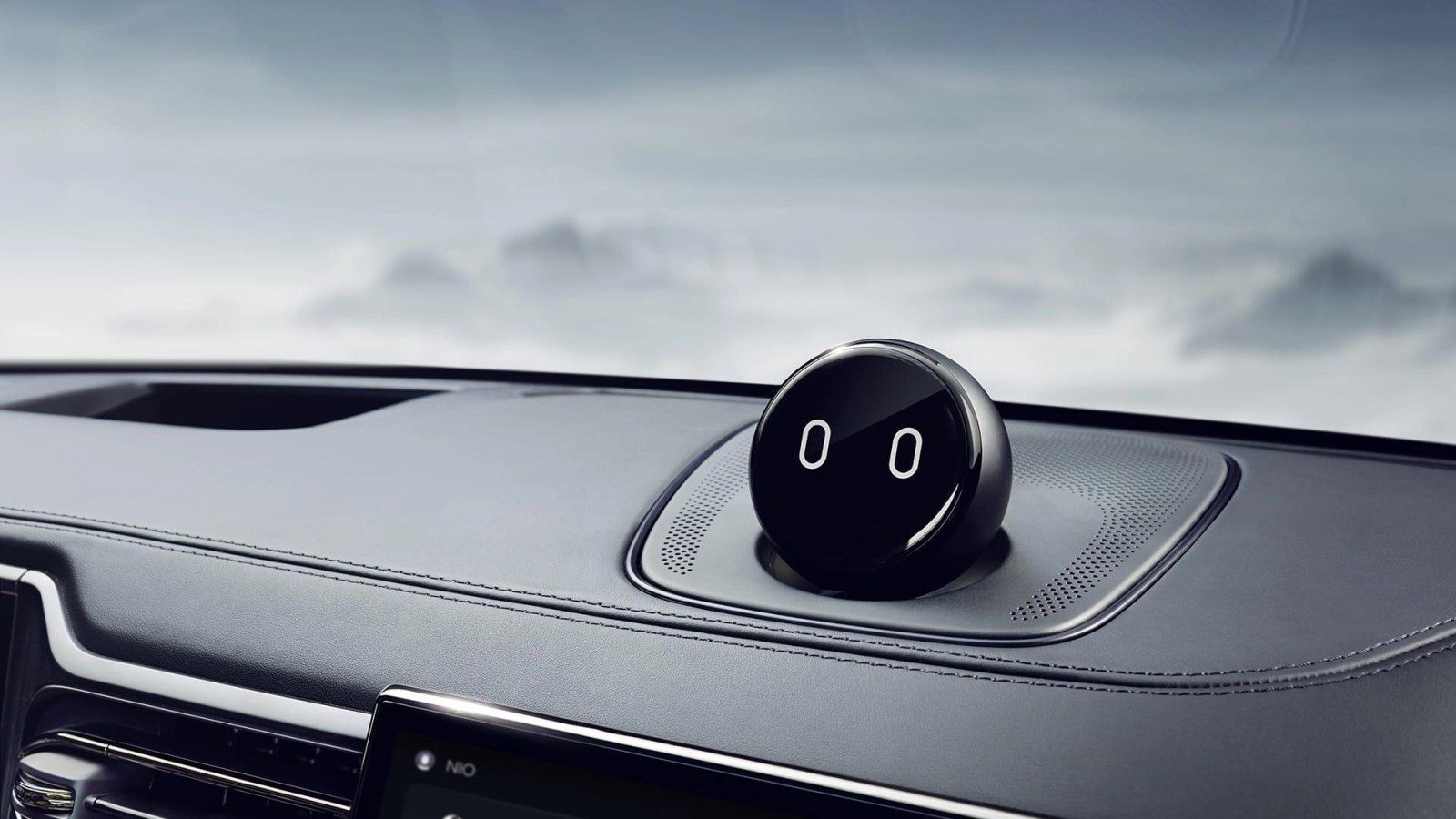
The system takes the form of a small spherical device with a circular AMOLED display, mounted at the center of the dashboard.
NOMI rotates horizontally and vertically using two motors to face whoever is speaking, displays animated expressions, and responds to voice commands. Functions range from climate and navigation control to selfies and window operation.
Nio said in Friday’s statement that NOMI has delivered “nearly 50 industry-first or industry-leading emotional interaction experiences and technological breakthroughs” since launch.
NOMI is standard equipment on every Nio vehicle — including the ES8, ES9, ET9, ET5, and EC6 — across every market where the brand operates, from China to Europe to the Middle East.
The company emphasized that NOMI’s “safety performance has been validated as part of NIO vehicle certification through authoritative safety assessment programs such as C-NCAP and Euro NCAP, ensuring stable operation even under extreme conditions.”
Hardware Counterfeits
Nio said merchants have manufactured and sold electronic products that “closely resemble NOMI” through online channels without authorization.
The company warned that “such products have not undergone automotive-grade validation and are prone to failure under challenging conditions such as high temperatures, electromagnetic interference, and vehicle vibration.”
Potential hazards include “electrical short circuits and component detachment,” Nio said.
The statement described a specific crash scenario in which untested dashboard accessories could “detach due to inertia, shatter, or become airborne,” turning into what Nio called the “projectiles inside a vehicle” frequently cited by safety authorities.
Accessories installed near airbag deployment zones could also “directly compromise the vehicle’s safety protection,” the company added.
Software and Design Copying
A second category of infringement involves merchants who have “copied and reused NOMI’s core design elements, including its visual expressions, interaction logic, and interface layouts, for use in other vehicle cabins,” Nio said.
Beyond the intellectual property violation, the automaker argued such imitations create safety concerns.
“Without the underlying safety architecture that supports NOMI, these imitations may be prone to accidental activation, delayed responses, and other issues in real-world driving scenarios,” the statement read.
Such shortcomings “can increase driver cognitive load and negatively affect driving safety,” Nio added.
The complaint arrives less than two months after SAIC–Volkswagen revealed a NOMI-like in-car companion on its ID.ERA 9X flagship SUV for China.
Branded “大众精灵” (Volkswagen Elf), the dashboard-mounted device displays animated facial expressions, reacts to driving events and music, and supports voice and gesture interaction — a feature set closely mirroring capabilities Nio pioneered nearly a decade ago.
SAIC-Volkswagen classified the Elf as an “intelligent IoT accessory.”
Friday’s statement from Nio did not name Volkswagen or any specific automaker.
Nio’s Legal Enforcement
The post marks the latest in a series of increasingly aggressive legal actions by Nio‘s legal department.
In April, the company disclosed that Chinese police had arrested a suspect who operated more than 4,000 social media accounts to publish fabricated content about Nio using AI-powered article spinning.
The related content had accumulated over 80 million views, Nio said at the time. Police took criminal coercive measures against the suspect.
Alongside that criminal case, Nio disclosed outcomes in multiple civil defamation lawsuits against individual content creators.
Courts ordered compensation and public apologies from the operators of accounts including “Baolijie New Energy,” “Stock Market Reflections,” “Auto Exposure Platform,” and “Electric Car Talk.” Two of those cases reached final rulings after failed appeals.
The enforcement actions are part of a broader crackdown on illegal profit-seeking, exaggerated advertising, and malicious defamation targeting automakers in China, launched last summer by the Ministry of Industry and Information Technology and five other agencies.
Multiple Chinese automakers — including Nio, XPeng, BYD, and Li Auto — have since opened dedicated legal social media accounts to disclose court rulings and have offered bounties of up to 5 million yuan ($737,800) for evidence identifying those behind coordinated disinformation campaigns.
Nio said it “will continue to protect the legitimate rights and interests of both the company and its users through legal means and will provide updates on enforcement actions as appropriate.”
Nio’s Domestic Push
The statement closed with a note on Nio‘s product momentum.
The company said its flagship technology SUV, the ES8, is expected to reach 120,000 cumulative deliveries this month.
The ES9 — Nio‘s technology executive flagship SUV, launched on May 27 — is expected to hit 10,000 deliveries in June, the company reaffirmed.
The model registered 3,108 units in its first 96 hours of availability, according to data from China’s Passenger Car Association.
On the Onvo side, the sub-brand’s third-generation L60 SUV officially launched on June 11 with pricing starting at 192,800 yuan, undercutting the previous generation.
The refreshed model adds a LiDAR-equipped variant for the first time, aligning the entry-level SUV with the hardware already deployed on the 2026 L90 and the L80, which logged 5,949 deliveries in just 15 days from its May 15 launch.
Onvo surpassed 150,000 cumulative deliveries during May, roughly two years after the brand’s unveiling.
Nio Group delivered 37,705 vehicles globally in May across its three brands — Nio, Onvo, and Firefly — a 62.3% increase year-over-year.
Firefly contributed 5,663 units, its second-best month of 2026, while the group’s fifth-generation battery swap stations — the first to support all three brands — are expected to begin deployment in late June ahead of large-scale rollout in the third quarter.