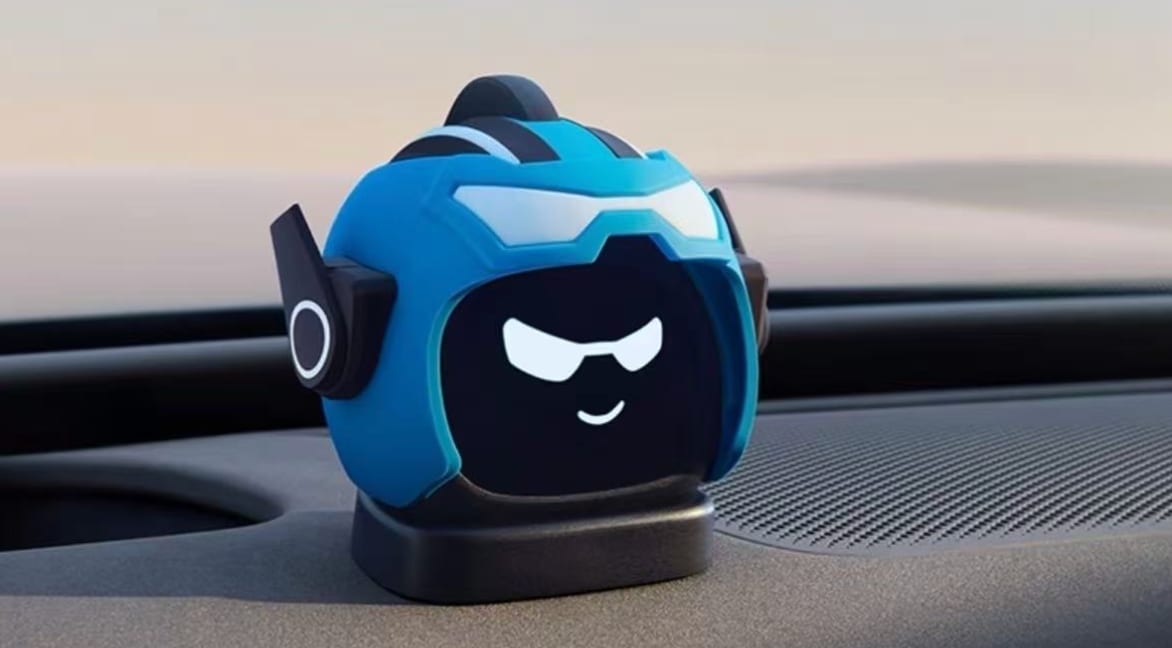

SAIC–Volkswagen‘s new flagship SUV for China features a physical in-car companion that sits on the dashboard, reacts to driving, nods to music, and asks to be charged when the battery runs low — a concept the Chinese brand Nio unveiled nearly a decade ago.
The companion, branded “大众精灵” (Volkswagen Elf) and is part of the ID.ERA 9X’s cabin system.
The model began pre-sales on March 30 and will make its debut at the upcoming Beijing Auto Show.
Promotional materials shared ahead of the vehicle’s debut on April 25 show a small robot-like device mounted on the dashboard with animated expressions, described by SAIC–Volkswagen as supporting “voice and gesture interaction, making travel more relaxed and fun.”
What the VW Elf Does
SAIC–Volkswagen said in the official press release for the ID.ERA 9X
“The intelligent WHUD can automatically track the driver’s eye position and adjust the projection to accommodate drivers of different heights; the ‘Volkswagen Elf’ supports voice and gesture interaction, making travel more relaxed and fun.”
Promotional images describe the companion’s behaviour in detail: it gasps and “holds its breath” during sharp turns, nods its head and bobs to the rhythm when music plays, displays a relaxed face while stargazing in camping mode, and looks at the driver with a sad expression when the battery is low, saying “Hurry and charge me!”
The device supports voice and gesture interaction and is classified by SAIC-Volkswagen as an “intelligent IoT accessory” alongside items like smart stickers and an intelligent humidifier.
It is positioned as a core element of the cabin’s “human-centric technology” philosophy.
The Volkswagen Elf works alongside a nine-screen layout — dual 15.6-inch front displays, a 21.4-inch fold-down ceiling screen for rear passengers, three hidden SmartSurface screens using in-mould display technology, and an eye-tracking head-up display.
Nio’s NOMI:
Nio introduced NOMI in December 2017 with the launch of the ES8, its first production vehicle. Development began in 2015.
The company describes it as the world’s first mass-produced in-vehicle artificial intelligence system.
NOMI is a small spherical device with a circular AMOLED display mounted at the centre of the dashboard.
It rotates horizontally and vertically using two motors to face whoever is speaking, displays animated expressions, and responds to voice commands. It can adjust climate settings, take selfies, select music, navigate, open windows, and control dozens of vehicle functions.
The system runs on what Nio calls an “emotion engine” — software that synchronises facial expressions, head movements, and voice responses with millisecond accuracy.
The design was developed in collaboration with Munich-based design consultancy Star, which described NOMI as “the absolute benchmark for emotional in-car AI.”
As of mid-2020, NOMI had conducted over 70 million interactions with users, averaging more than 200,000 conversations per day.
Nio has since released multiple hardware iterations — the original NOMI Mate, NOMI Halo (a simpler ring-and-sound format), and the current NOMI Mate 2.0.
NOMI is standard equipment on every Nio vehicle — including the ES8, ET9, ET5, EC6, and all other models — and is offered in every market where Nio operates, from China to Europe to the UAE. It is not an optional accessory.
Side-by-Side Comparison
Both devices are physical robots mounted on the dashboard. Both display animated facial expressions. Both react to driving events, music, and vehicle status.
Both support voice interaction. Both are positioned as emotional companions rather than purely functional assistants.
The key difference is maturity. NOMI has been in mass production for over eight years, across hundreds of thousands of vehicles, with a continuously evolving software stack and deep integration into every vehicle function.
The Volkswagen Elf is launching as an IoT accessory on a single model in a single market.
The Broader Context
The ID.ERA 9X is SAIC-Volkswagen’s first range-extended electric vehicle and, at 5,207 mm, the largest SUV the Volkswagen Group has ever produced globally.
It is priced from 329,800 yuan ($47,700) across three all-wheel-drive trims — Pro, Max, and Ultra — with a market launch scheduled for April 25 at the Beijing Auto Show.
Mass production began in early March at SAIC-Volkswagen’s Ningbo plant.
The vehicle competes directly with Chinese flagships including the Li Auto L9, the Huawei-Seres AITO M9, and the Nio ES8/ES9.
SAIC-Volkswagen calls the ID.ERA 9X the first product of its “Joint Venture 2.0” era — a shift from adapting global platforms for China to designing vehicles purpose-built for Chinese consumers.
The Volkswagen Elf is one expression of that strategy: a feature that would be unusual on a Volkswagen sold in Europe or the US but is expected in a Chinese premium cabin, where Nio set the standard nearly a decade ago.
The vehicle was developed by SAIC-Volkswagen — not through Volkswagen’s separate partnership with XPeng, which produced the ID.UNYX 08 under a different joint venture.
However, the interior bears visible design similarities to XPeng models, reflecting the broader influence of Chinese EV design language across the Volkswagen Group’s China operations.