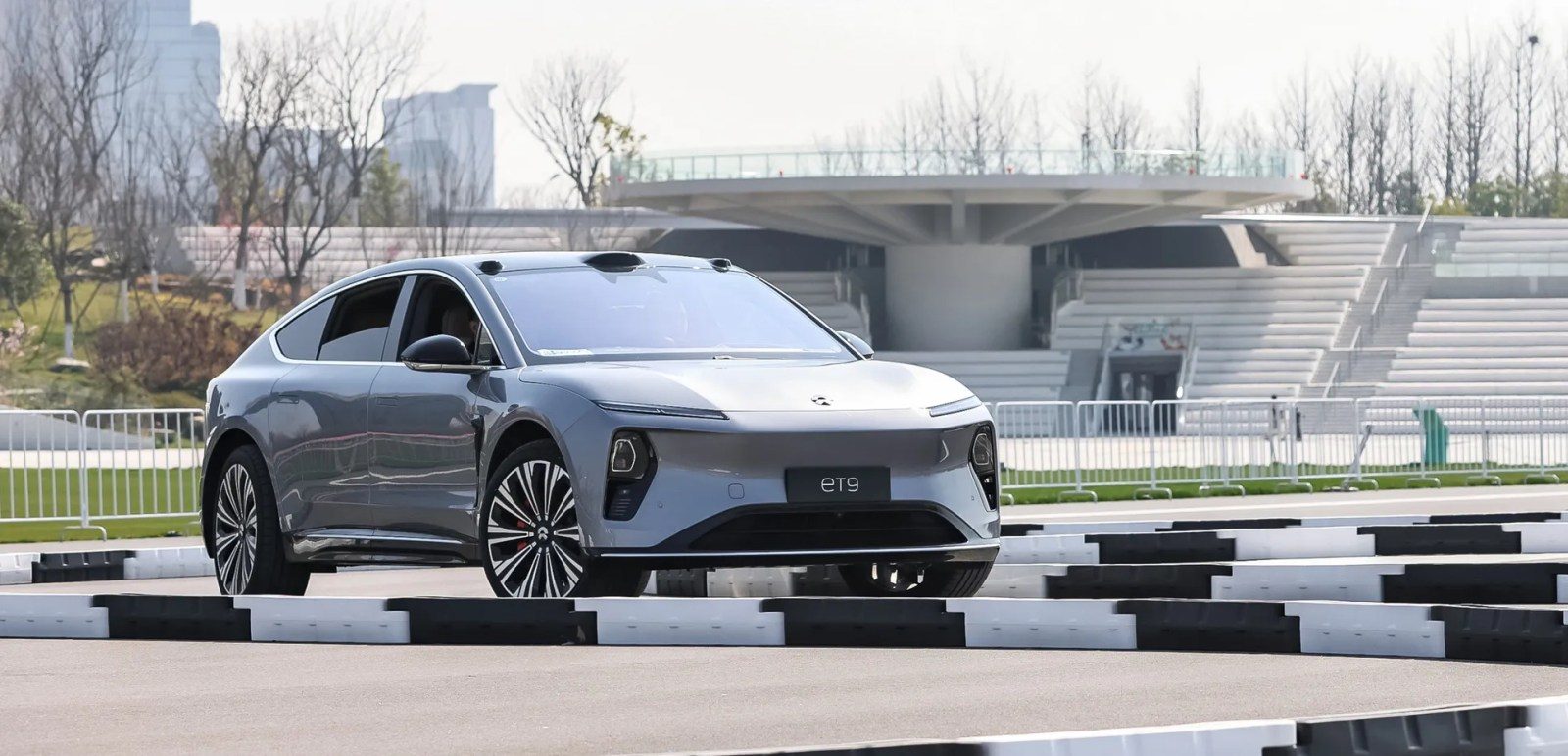

Shanghai-based EV maker Nio registered 97 ET9 vehicles in July, according to data from the China Passenger Car Association (CPCA) published on Tuesday.
One unit was exported, bringing the flagship sedan’s total for the month to 98.
Last month marked the ET9’s first year-over-year growth in deliveries since they began in March 2025.
However, July 2025 was also when monthly deliveries fell below 100 units for the first time since the model’s launch — apart from its debut month — suggesting that the initial launch frenzy had begun to fade.
Domestic registrations rose 14% from the 85 units recorded a year ago, when the model was in the middle of a three-month stretch below 100 units that lasted through September of that year.
On a month-to-month basis, July’s 97 units fell 22.4% from June’s 125 and 36.6% from May’s 153 — the sedan’s best result of the year.
A five-month streak of sequential gains from January through May has now reversed.
The sedan accounted for just 0.5% of the Nio brand’s 20,008 deliveries in July, down from 0.57% in June and 0.76% in May.
Cumulative domestic registrations since launch stand at approximately 3,294 units across 17 months of availability.
Demand Efforts
The ET9 is priced from 768,000 yuan ($113,800) with the battery included, or 660,000 yuan ($97,800) under Nio‘s Battery-as-a-Service subscription.
At more than twice the cost of the ES6, the brand’s entry-level SUV, the ET9 occupies a narrow price band in China’s luxury sedan market.
Nio has deployed a series of limited-edition releases to sustain interest in the flagship sedan.
Since the model’s December 2024 launch, the company has released a 999-unit ‘First Edition’ that sold out within 12 hours, a ‘Signature Edition’ without a strict cap, and a nine-unit ‘One-Millionth Vehicle Commemorative Edition’ in January 2026.
Most subsequent releases have been limited color themes added to the dual-tone Horizon Edition platform, which debuted in September 2025.
In June alone, Nio released two new themes within nine days, each capped at 99 units.
Founder and CEO William Li has also personally delivered vehicles to prominent business figures — including CATL founder Robin Zeng and XPeng CEO He Xiaopeng — in an effort to raise the ET9’s profile among China’s executive class.
Despite the sustained campaign, monthly volumes remain well below the roughly 1,500-unit pace that Deutsche Bank analyst Wang Bin had forecast at the time of the model’s debut.
ES9 Cannibalization
Nio‘s most recent flagship SUV has absorbed much of the brand’s executive segment attention.
The ES9 is the first model beyond the ET9 to carry several of the sedan’s luxury and technology features, which include the SkyRide fully active suspension and the steer-by-wire system debuted in the sedan.
Priced from 498,000 yuan ($73,800) with the battery — 35.2% below the ET9’s 768,000 yuan starting point — the SUV offers much of the same technology stack in a body style that has historically resonated more strongly with Chinese premium buyers.
During the Beijing Auto Show in May, Nio‘s Head of User Operations Yang Bo addressed concerns that the ES9 might cannibalize ES8 demand.
“Despite initial concerns that the newly pre-sold flagship SUV, the ES9, might cannibalize sales of the existing ES8, the reality has been quite the opposite,” he stated. “The ES9 has successfully attracted a new demographic to Nio showrooms, resulting in a notable boost in orders for both the ET9 and the ES8.”
The ES9 recorded 6,315 wholesale units in July, its first sequential decline since customer deliveries began on May 28.
Cumulative ES9 wholesale volume reached 18,018 units through July — roughly five times the ET9’s entire 17-month domestic tally — across just 65 days of availability.
120-kWh Battery
One of the flagship sedan’s original selling points remains undelivered.
Nio first announced a 120-kWh battery pack alongside the ET9 at its annual Nio Day event in December 2023, built on in-house 46105 large cylindrical cells with an energy density of 292 Wh/kg and 5C charging on the sedan’s 925-volt architecture.
The capacity appeared in the ET9’s regulatory filing in October 2024, but when the production sedan launched two months later, the specification had settled at 100 kWh and 650 km of CLTC range.
The pack was re-promised at the third-generation ES8’s debut in September 2025 and still carries no defined launch timeline.
Nio‘s founder William Li recommitted to the project last week at a user event in Quanzhou, confirming the pack will fit all Nio-brand models through the company’s standard swappable battery dimensions rather than remaining exclusive to the ET9.
Li gave no date, pricing, or production details.
The ET9 currently ships with a 100-kWh pack, while the ES9 and ES8 use a 102-kWh CATL unit — a ceiling that stands out against six-figure-yuan rivals advertising longer range.