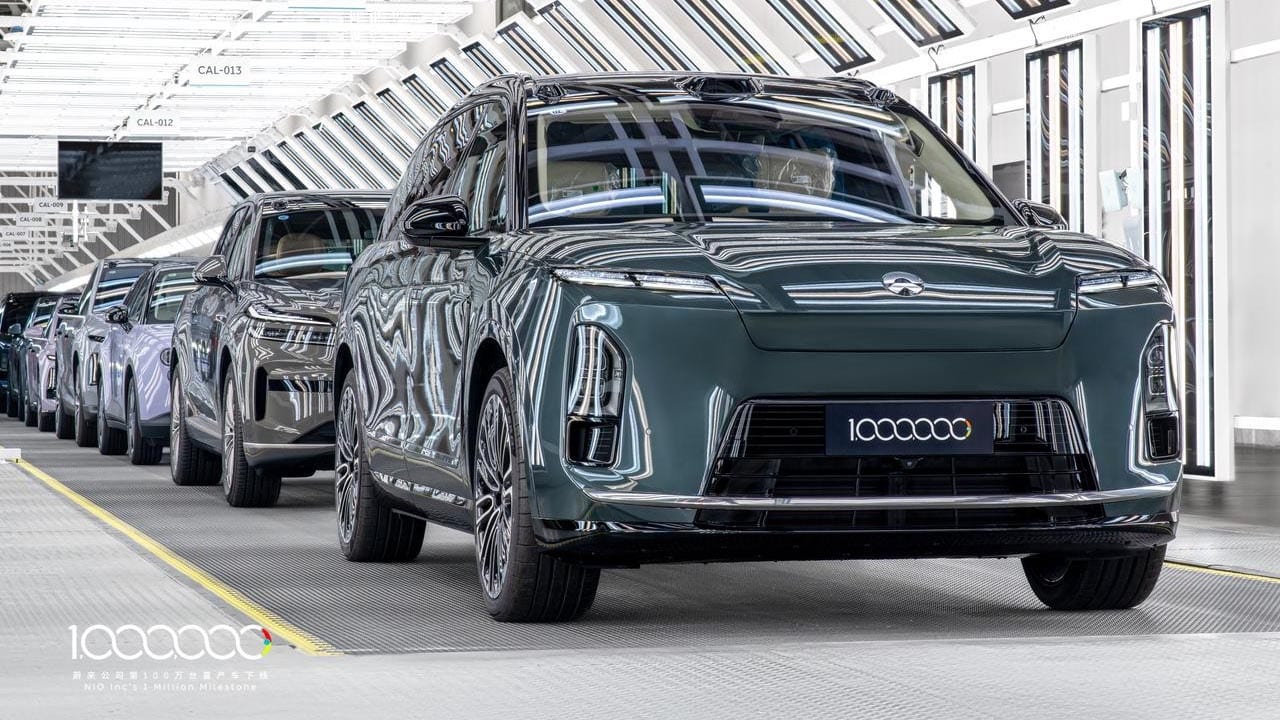

Nio‘s research and development (R&D) spending has become more efficient even as the budget has contracted, a VP said on Saturday, citing the company’s decision to design its own smart-driving chips as the clearest example.
Ma Lin, the EV maker’s Associate VP of Brand and Communications, made the remarks at the 2026 China Automotive Chongqing Forum, held on June 12 and 13.
“Even though our quarterly R&D spending now is actually a little lower than before, overall R&D efficiency is far higher than it used to be — even exceeding the value produced by the larger investments of the past,” Ma said.
He said he agreed with the case for reducing R&D costs and identified semiconductors as the area where the savings were most apparent.
Nio previously spent more than $300 million a year buying chips from Nvidia for its vehicles, according to Ma Lin.
That figure echoes earlier disclosures by founder, chairman and chief executive William Li, who said last year that Nio had spent more than $300 million on Nvidia Orin-X chips and that the cost could be reduced by switching to its own silicon.
Li has also put a per-vehicle figure on the savings, telling investors that each Shenji-equipped Nio vehicle saves about 10,000 yuan in component costs compared with the four Nvidia Orin chips the in-house processor replaces.
After the company began using its in-house Shenji smart-driving chip, the cost reduction became clear, Ma said.
“This chip is used not only in the Nio brand — we also began deploying it in the Onvo brand this year,” Ma said, adding that cost reduction of this kind across the whole system was “extremely important.”
The deployment marks a change from mid-2025, when Li ruled out using the chip in Onvo for the time being, citing production constraints, and restricted it to the main Nio brand.
Nio began licensing the chip to external customers in late 2025, its first commercialization of semiconductor technology it has developed since 2021.
A Spending Trend Already in the Numbers
Nio‘s reported financials illustrate the trend Ma described.
R&D expenses fell to 1.885 billion yuan in the first quarter of 2026, down 40.7% from a year earlier and the company’s lowest quarterly total in at least three years.
Full-year R&D spending declined 18.7% to 10.61 billion yuan in 2025, from 13.04 billion yuan in 2024 and 13.43 billion yuan in 2023.
Nio has attributed the reduction primarily to lower personnel costs following organizational restructuring and to lower design and development costs as projects moved through different stages.
Shenji, the Nio subsidiary that develops the company’s intelligent-driving chips, raised 2.257 billion yuan from Chinese investors in a transaction announced last February.
That investment gave the unit external capital to expand a chip program that the company has moved to control internally rather than source from third-party suppliers.
Chinese automakers have increasingly developed core components such as chips and software in-house, a strategy intended to reduce reliance on foreign suppliers and to lower per-unit costs as production volumes rise.
Nio introduced the Shenji processor for assisted and intelligent driving as part of that effort, replacing units it had previously procured externally.
All-Employee Operating Discipline
Ma Lin described an “all-employee operating” mechanism, introduced over the past two years, as a third element of Nio‘s cost strategy.
The framework is the company’s Cell Business Unit, or CBU, mechanism, which Nio began implementing last year as part of a broader restructuring aimed at curbing losses.
Li described the program on the company’s fourth-quarter 2024 earnings call as an “all-employee comprehensive cost reduction initiative” spanning research and development, supply chain, sales and service.
Under the system, Nio‘s operations are divided into non-overlapping units, each assigned its own return-on-investment targets, budget and accountability for financial results.
The model shifts the company from a budget-driven structure to a performance-oriented one, with research and development among the highest-spending units.
Nio has since asked engineering staff to log their working hours, given that the bulk of R&D costs stem from personnel.
Li has pressed the discipline internally, telling employees that no project would proceed without clear financial justification, even one he had personally approved.
Ma cited the company’s founder and CEO, who he said had argued that competition in the industry could come down to one or two percentage points.
“We still need to learn from many strong-performing brands — companies like Toyota and Hyundai — on how to raise overall operational quality,” Ma said.
Internal scrutiny of the program is strict, he said.
Li regularly reviews the return on investment of Nio‘s published content and requires that it be calculated precisely, according to Ma, who offered his own work as an example.
“Recently he gave me an assessment that this year I’ve roughly passed — just a passing grade,” Ma said.
He said Nio had spent freely in the past but now placed a high priority on capital efficiency across every function.
The mechanism forms part of a wider cost-reduction drive at Nio, which has cut headcount and reorganized parts of its operations over the past year as it works toward sustained profitability.
The Chongqing forum is one of China’s larger annual gatherings of automotive executives and policymakers.
Margins and Guidance
Nio reported a vehicle margin of 18.8% in the first quarter of 2026, a fourth consecutive quarterly increase, and a non-GAAP operating profit of 66.8 million yuan.
Net loss narrowed to 332.1 million yuan in the period, from 6.75 billion yuan a year earlier.
Cash and cash equivalents, restricted cash, short-term investments and long-term time deposits totaled 48.2 billion yuan as of March 31.
Chief financial officer Stanley Qu said at the time that the company would continue to improve cost and operational efficiency.
Nio has guided to non-GAAP R&D spending of about 2 billion to 2.5 billion yuan a quarter for 2026, a range that would hold outlays below the levels of 2023 and 2024.
Management has also set a target of positive non-GAAP operating profit for the full year.
Test in the Product Cycle
Ma’s comments came as Nio entered what Li has described as an intensive product cycle.
Nio began deliveries of its ES9 executive SUV in late May, and Onvo launched the L80, a large five-seat SUV, in mid-May.
In total, the company delivered 83,465 vehicles in the first quarter of 2026, a 98.3% increase from a year earlier, comprising 58,543 units from the Nio brand, 13,339 from Onvo and 11,583 from the compact Firefly line.
Nio has guided to second-quarter deliveries of between 110,000 and 115,000 vehicles, a year-over-year increase of as much as 59.6%.