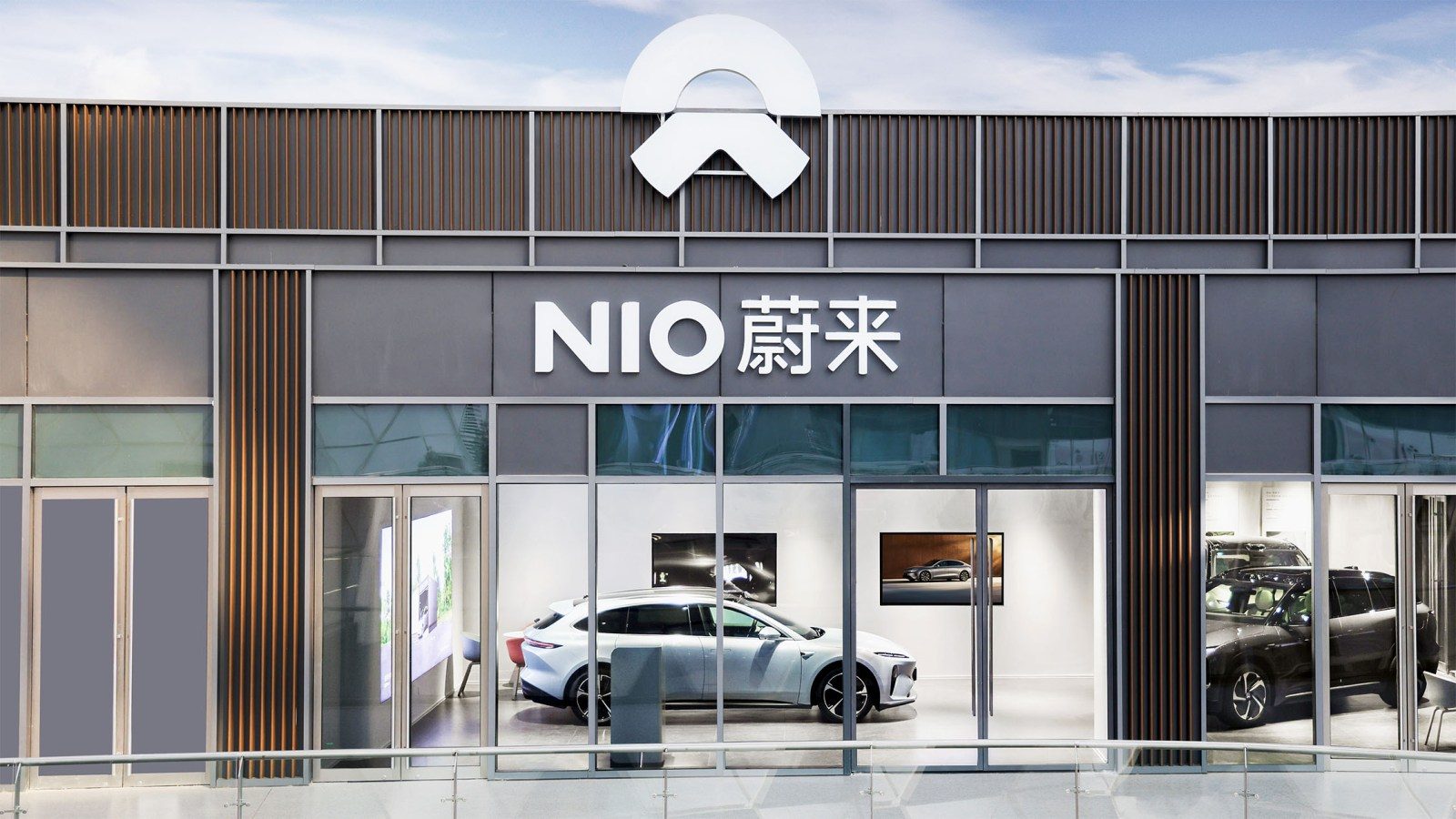

Nio ranked first in two segments of JD Power’s 2026 China Purchase Experience Index, scoring 827 out of 1,000 points in both the luxury NEV and domestic NEV categories.
Li Auto, founded in 2015 and headquartered in Beijing, led the mainstream NEV segment with 816 points.
Nio topped all 47 new energy vehicle brands evaluated in the study released this Thursday.
“Thank you all for your recognition and support,” founder and CEO of the Shanghai-based EV maker William Li wrote on Weibo after the results were published.
He added that “China’s automotive market is transitioning from a period of brand fragmentation to one of brand consolidation and clarity. We will keep working hard and continue to power forward together.”
Firefly — Nio‘s compact sub-brand — scored 806 in both the mainstream and domestic NEV rankings.
Onvo, the family-oriented sub-brand that Li has targeted to eventually carry 55% of Nio Inc.’s total vehicle sales, did not appear in the results.
Purchase Experience Index
The Purchase Experience Index replaces JD Power’s longstanding Sales Satisfaction Index.
The new study shifts focus from traditional satisfaction measurement to what the firm called “transaction experience” — evaluating how effectively brands convert showroom visits into completed purchases.
The data analytics company surveyed 9,093 vehicle owners who bought new cars between June 2025 and January 2026 across 81 Chinese cities, collecting data between December 2025 and March 2026 from owners with two to six months of ownership.
The study covered 47 brands producing new energy vehicles (NEV) — 42 with sufficient sample size — and 36 which manufacture typically internal combustion engine (ICE) cars.
Seven weighted factors were evaluated on a 1,000-point scale: information gathering (15.2%), store visit experience (13.4%), in-store vehicle viewing (12.2%), test drives (12.1%), customer follow-up (15.9%), purchase proposal negotiation (15.1%) and delivery process (16.1%).
“The rules of experience competition have been rewritten,” Xie Juan, General Manager of Automotive Service Solutions at JD Power China, said in the report. “Customers no longer pay for brand halo — they vote for perceivable experience.”
Xie added that China’s car purchase experience has cumulatively improved by 25 points over the past four years and that basic services have universally reached standard.
“The key to future success lies not in whose product specs are higher, but in who can make customers feel ‘worth it’ at every touchpoint,” the manager stated.
Winners Across All Segments
Nio‘s 827 points gave the brand a 13-point lead over second-place Aito, the Huawei-backed marque that scored 814 in the luxury NEV segment.
In the domestic NEV category, Nio again took first, followed by Li Auto at 816 and a three-way tie at 814 among Aito, Deepal and XPeng.
Li Auto led the mainstream NEV segment at 816 points. Deepal and XPeng again tied for second at 814.
Tesla scored 798 in the mainstream NEV full rankings, slightly above the segment average of 796.
The result follows the 2026 JD Power Appeal study released in March, in which the Elon Musk-led company failed to win a single segment — with Chinese brands sweeping all 15 categories.
Land Rover led the luxury ICE segment with 815 points, ahead of Volvo at 802 and Porsche at 796; while Dongfeng–Honda topped the mainstream ICE category at 818, followed by giants Chery at 810 and Geely at 808.
Chery also led the domestic ICE segment.
Luxury NEV brands averaged 811 points overall, while mainstream NEV brands averaged 796 — already surpassing the luxury ICE average of 788.
Among domestic brands, new-force NEV makers led at 810, followed by new-creation brands at 801.
Traditional domestic brands scored 786 and international brands 784.
NEV Customers on Experience
NEV brands outscored ICE brands by 13 points overall.
JD Power said the advantage concentrated in three conversion-critical touchpoints: in-store vehicle viewing, test drives and customer follow-up.
ICE brands retained a slight edge in store visit reception but showed what the firm called an “execution gap” in follow-up and purchase proposal negotiation.
Service has risen to 64.1% as a stated reason for choosing a brand among NEV buyers, while brand reputation and product quality declined by 6.7% and 9.1% respectively.
Xie described NEV customers as operating on a binary, stating that “there are no ‘neutral customers’ in new energy — only promoters or detractors.”
The manager noted that the word-of-mouth cost of a poor experience among NEV buyers runs two to three times higher than among ICE customers.
When test drive experience fell short, NEV customer’s Net Promoter Score dropped to -76 compared with -25 for ICE customers.
Omitting smart feature demonstrations during the product experience pushed NEV NPS to -24 versus +8 for ICE.
A delivery ceremony that failed to meet expectations produced an NPS of -13 among NEV buyers versus +5 for ICE.
JD Power also found that NEV and ICE buyers diverge on the pace of the purchase process.
NEV customers whose in-store wait exceeded 10 minutes saw NPS plummet from 45.6 to -7.2 — a 52.8-point drop, compared with 33.8 points for ICE buyers.
Yet NEV buyers with a one-to-two-week decision cycle recorded the highest NPS at 41.7, while ICE buyers scored highest when deciding within a single week, at 42.2.
“The essence of experience efficiency is not uniformly speeding up, but being fast where it should be fast and slow where it should be slow,” JD Power stated.
The firm also found that the economics of luxury have shifted.
Traditional ICE luxury brands achieved only a 0.64% experience improvement at 2.8x the price of mainstream models, while NEV luxury brands delivered a 1.88% experience uplift at 2.1x the price — amplifying the experience premium by roughly three times.
Nio’s Community-Oriented Service
Nio‘s first-place finish reflects a retail strategy built around community-oriented flagship showrooms, an integrated service ecosystem and direct customer engagement.
As of the end of the first quarter, the company operated 168 Nio Houses — large-format spaces combining vehicle displays with cafés, libraries, co-working areas and event spaces — alongside 389 smaller Nio Spaces dedicated to sales.
Nio has been reducing its Nio House footprint since mid-2025 as the company pursues its first full year of profitability.
Nine flagship locations closed in the second half of last year and a further three in the first quarter of 2026.
Simultaneously, Nio has been expanding through a new multi-brand format called the ‘Sky Store’, bringing its main premium brand and sub-brands Onvo and Firefly under a single roof.
Each location integrates pre-sales, after-sales and delivery, reducing per-brand fixed costs while pushing into lower-tier cities.
Management said earlier this year that Nio plans to roll out Sky Stores across roughly 210 prefecture-level cities in China.
Since early 2025, Nio offers a “Worry-Free Service” package covering more than 20 scenarios — including insurance, repair, maintenance, accident rescue, car wash, chauffeur service and valet parking.
Onvo’s Absence
Onvo‘s absence from the PXI rankings stands out given the scale of ambition Li has placed on the sub-brand.
Under a long-term 35-55-10 brand-mix target, Onvo is expected to account for 55% of Nio Inc.‘s total vehicle sales, with the namesake brand at 35% and Firefly at 10%.
Through five months of 2026, Onvo contributed 30,720 of the group’s 150,526 global deliveries — a 20.4% share, well short of the 55% destination.
Li acknowledged the gap on Nio‘s first-quarter earnings call.
“Right now, for the Onvo brand, the major challenge is still its overall brand awareness, since Onvo has only been delivering for around 20 months,” the CEO said.
He added then that Onvo‘s current awareness is “on par with the awareness of the Nio brand in 2020” — a period when the company was recovering from near-bankruptcy.