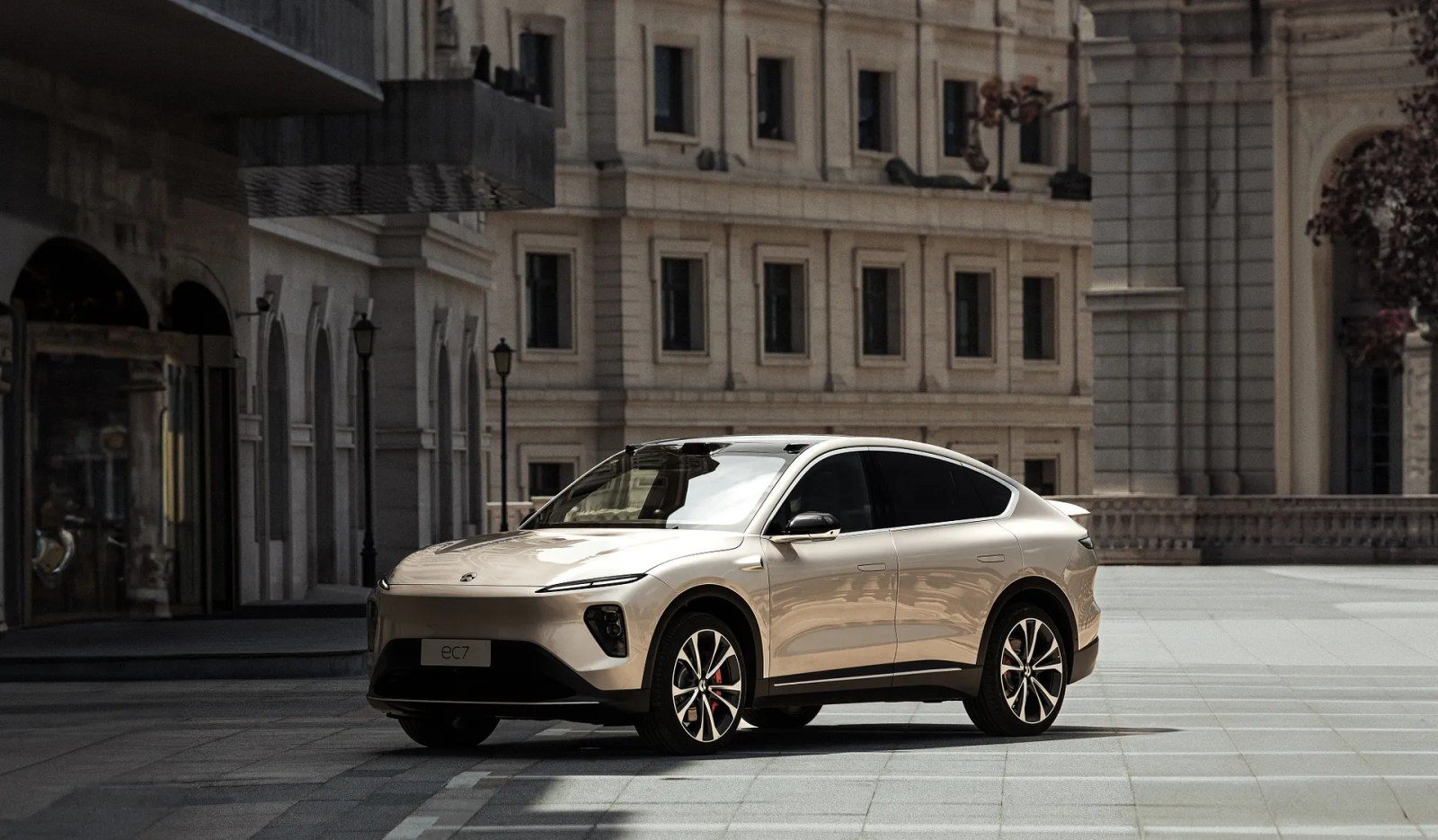

Nio delivered no EC7 coupe SUVs in June across China, the first month the model has recorded zero deliveries since its 2023 launch.
The Shanghai-based EV maker’s website offers the model only as a fixed-price 2024 model-year listing with no configurator, as Nio looks to sell down remaining stock.
Model-level data the China Passenger Car Association published on Wednesday put the EC7’s June deliveries at zero, against 84 a year earlier, the low point of a decline that has run for more than a year.
Founder and CEO William Li unveiled the EC7 on December 24, 2022, at Nio Day in Hefei, alongside an all-new ES8, presenting the pair as the opening act of a product “super cycle” built on the company’s second-generation NT2.0 platform.
On Nio‘s Chinese website, the EC7 no longer has a build-to-order configurator, its page resolving instead to a static “detailed configuration table” that lists two 2024 model-year trims at fixed prices.
The 2024 EC7 is priced at 458,000 yuan and the EC7 Signature at 490,000 yuan, with assisted-driving features offered as monthly subscriptions.
The company has not proactively announced that it is canceling the EC7 model in China.
A Familiar Playbook
The pattern closely mirrors how Nio retired the EC7’s sibling, the ES7, months earlier.
As EV reported, Nio pulled the ES7 from sale in China in early 2025 and removed it from its configurator by late February 2026, without ever issuing a discontinuation statement, leaving customers unable to configure or buy it as a new unit.
The ES7 has since disappeared from Nio‘s website altogether, and the company is due to launch a five-seat version of its all-new ES8 on Thursday, July 9.
The model is set to take over as the group’s flagship five-seat SUV and absorb the role the ES7 once filled.
The EC7, the coupe counterpart to that boxier ES7, now faces a similar scenario.
Nio‘s older EC6, its first coupe SUV, remains fully configurable on the same website, with three trims from 358,000 yuan and live delivery estimates.
The EC7 arrived as the EC6’s more advanced successor, yet it is the newer car that can no longer be ordered.
A Collapse in Slow Motion
The zero-delivery month is the endpoint of a decline that has been steepening for more than a year.
The EC7 moved 1,222 units across the whole of 2025, an average of about 100 a month, with a mid-year peak of 254 in July before tailing off to single digits by December.
The fall accelerated sharply into 2026.
Nio delivered just four EC7s in January, seven in February, nine in March, three in April and two in May, before the model reached zero in June.
Every month of 2026 has been down between 94% and 98% from the same month a year earlier, a run of declines that leaves first-half deliveries at 25 units, against 747 in the first half of 2025.
Set against the model’s earlier trajectory, the drop is stark: the EC7 delivered a reported 3,661 units in its first full year of 2023 and about 2,865 in 2024, before the 2025 total of 1,222 and this year’s near-total disappearance.
By the final quarter of 2025 the model was already delivering in single and double digits, a sign the collapse now complete had begun well before 2026.
A Collapse in Slow Motion
The zero-delivery month is the endpoint of a decline that has been steepening for more than a year.
The EC7 moved 1,222 units across the whole of 2025, an average of about 100 a month, but the slide was already under way by then: after a mid-year peak of 254 in July, deliveries fell to 25 in September and into single digits, ending on nine in December.
The fall accelerated sharply into 2026.
Nio delivered just four EC7s in January, seven in February, nine in March, three in April and two in May, before the model reached zero in June.
Every month of 2026 has been down between 94% and 98% from the same month a year earlier, leaving a first-half total of just 25 cars, a 96.7% drop from the 747 the EC7 delivered in the first six months of 2025.
Averaged across the first five months, the model sold about five cars a month before June wiped even that out.
The Fade
The EC7 sat in Nio‘s most contested territory, the premium segment above 400,000 yuan, where it came to compete against the company’s own newer and refreshed models.
Nio has pushed its product cycle forward with the five-seat version of the all-new ES8 and the new ES9 flagship anchoring its large-SUV lineup, drawing buyers and attention toward the higher-volume parts of the range and leaving the two-row coupe EC7 with a shrinking share of showroom traffic.
The EC7 had received no significant hardware update since a modest 2024 model-year refresh that adjusted trims, pricing and colors, and was sustained since largely through over-the-air software updates rather than new metal.
The Car Nio Built It to Be
The EC7’s quiet exit is a notable turn for a model Nio launched with considerable fanfare.
The EC7 was the more technically loaded of the two, carrying the platform’s fuller assisted-driving hardware, with a roof-mounted lidar and camera suite and Nvidia Orin compute, along with an upgraded digital cockpit.
Measuring 4,968 mm long, 1,974 mm wide and 1,714 mm tall on a 2,960 mm wheelbase, the EC7 was Nio‘s second coupe SUV after the smaller EC6, built on an aluminum and high-strength-steel hybrid structure, and it leaned hard on performance and aerodynamics.
The dual-motor all-wheel-drive powertrain produces 480 kW and 850 N·m for a 3.8-second sprint to 100 km/h, and Niomarketed the car’s 0.230 drag coefficient as the lowest of any production SUV.
Battery options ran from 75 kWh to a headline 150 kWh semi-solid-state pack rated at up to 940 km on China’s CLTC cycle, though that flagship battery reached only limited production before being wound down.