
Emad Dlala, Lucid’s departing Senior Vice President of Engineering and Software, publicly said goodbye to the company on Tuesday, posting a personal farewell on LinkedIn that closed a tenure of nearly 11 years.
By EV‘s count, Dlala’s was the 14th departure of a top Lucid executive since the churn began in late 2023, a turnover rate that has rattled investors as the shares trade near record lows.
The senior executive had stepped into that role only in November, after the ouster of chief engineer Eric Bach, who has since sued the company for wrongful termination in a claim Lucid has called baseless.
Dlala wrote that he had decided to resign from the Saudi-backed EV maker after nearly 11 years, calling the moment the close of “a chapter that has defined my life.”
The message arrived almost a week after a source close to the matter told EV about the SVP’s departure — confirmed by Lucid to TechCrunch.
He extended thanks to the company’s customers, partners and investors, casting the Lucid brand as one built around innovation and performance.
In His Own Words
Dlala traced an arc from a rural desert town in Libya, where he grew up, to building what he described as world-leading products in California.
When the team first set out to make the most efficient electric vehicle on the planet, he wrote, sceptics called the targets impossible.
He leaned on the records that defined Lucid‘s early engineering, citing the 5 miles per kWh and 520 miles of range achieved in the Air sedan as milestones he said remained unbeaten years later.
Beyond the hardware, Dlala pointed to the embedding of artificial intelligence and simulation into Lucid‘s design and development, a shift he credited with accelerating the company’s engineering cycles.
Most recently, he wrote, he led the software turnaround behind the Lucid Gravity and the groundwork for the company’s future Midsize and Robotaxi platforms.
He also claimed a hand in what he called the most power-dense drive unit in the world and a next-generation platform built for efficiency.
Dlala singled out former CEO and CTO Peter Rawlinson for thanks, crediting him for the chance to join early as an individual-contributor engineer and for widening his remit over the years to all of engineering.
The post closed on a personal note, with Dlala saying he would take time to recharge and be with his family before exploring his next move, signing off with a single word: “Onward.”
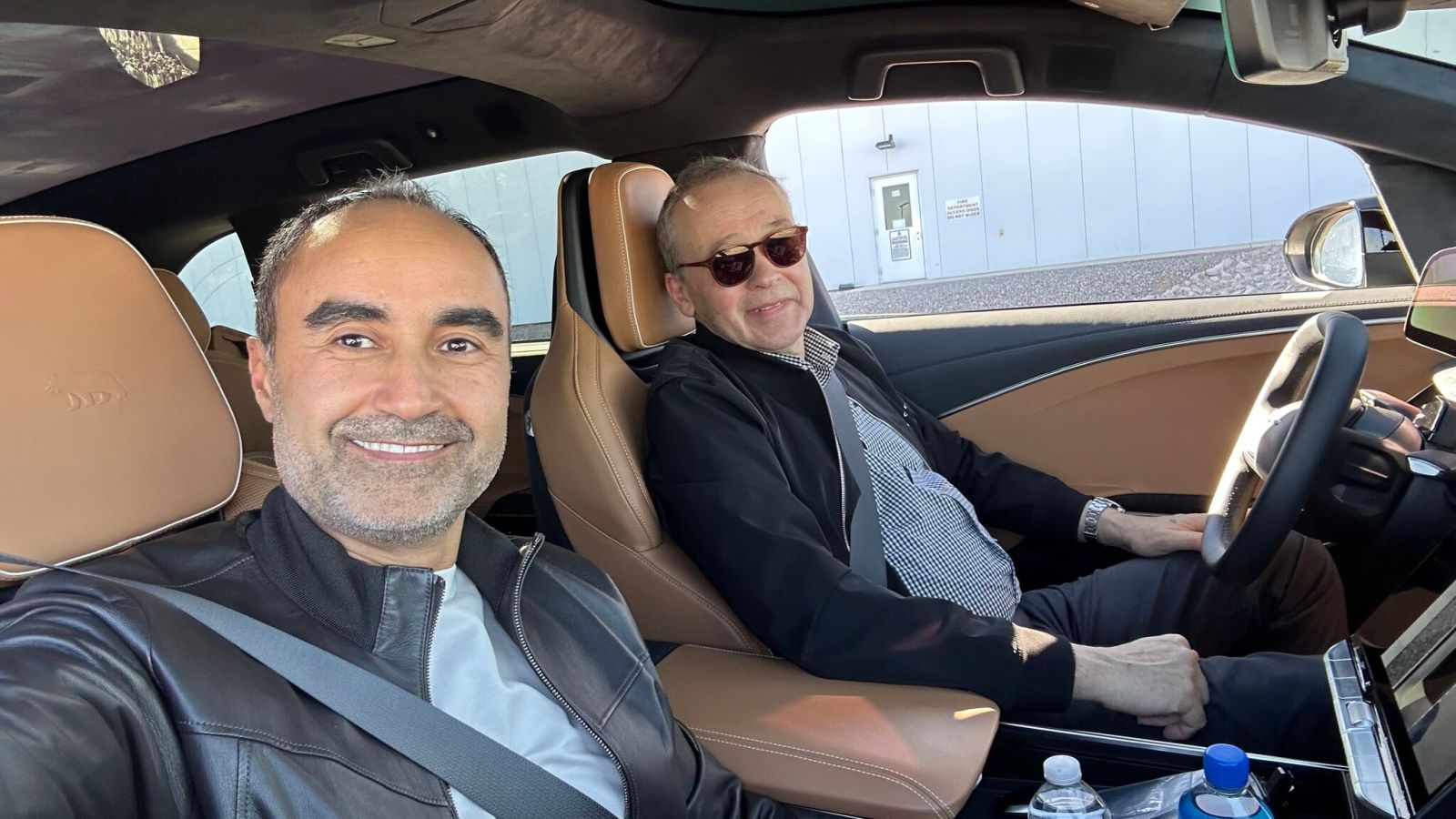
An accompanying photograph showed Dlala alongside Rawlinson — who hired him — inside a Lucid Air sedan.
Rawlinson, who led the Model S programme at Tesla before joining Lucid as chief technology officer and later chief executive, left the role in February 2025 and moved to a senior advisory role.
A Week After the Company Confirmed It
Dlala’s farewell formalised a departure that had already been reported and confirmed.
In a statement last week, Lucid said Dlala had “elected to leave the company to pursue other opportunities,” thanking him and framing the move within a wider reorganisation.
The company said it was restructuring to sharpen execution under Napoli, and that vehicle-engineering head Vivek Attaluri and software head Marc Solsona Palomar would now report directly to the chief executive.
Dlala’s own message struck a markedly warmer tone than the corporate language, recasting an abrupt-looking exit as a milestone reached on his own terms.
The First Exit Under a New CEO
The departure carried weight well beyond a single résumé.
Dlala was one of only two members of Lucid‘s original leadership still in place, alongside design chief Derek Jenkins, after a clear-out that has removed the company’s former chief executive, chief financial officer, general counsel and chief engineer since late 2023.
His was the first senior exit since Napoli, the former head of Swiss lift maker Schindler, took over as permanent chief executive on June 1.
Napoli inherited the role from interim leader Marc Winterhoff, who had run Lucid since Rawlinson stepped down in early 2025, and who returned to the chief operating officer post on Napoli’s arrival.
From Motor Design to All of Engineering
Dlala’s farewell underlined how far he had climbed inside the company.
He joined Lucid in August 2015 as a senior staff engineer responsible for motor design, the individual-contributor role he pointed to in his goodbye.
From there he rose through technical fellow, senior director of efficiency and energy technology and vice president of powertrain, before being named senior vice president of powertrain in February 2025 and then senior vice president of engineering and software that November.
That final step handed him Lucid‘s entire engineering organisation, spanning powertrain, vehicle and digital, just eight months before he chose to leave.
His route to California had run through three countries.
Dlala began his career in Libya at the National Association for Scientific Research, training in Germany to design programmable logic controllers, then spent seven years as a researcher at Finland’s Aalto University and four more as an application engineer at simulation-software firm ANSYS in Michigan.
That arc, from a research post in North Africa to the leadership of a Silicon Valley automaker’s engineering, is the journey he distilled in his farewell.
What He Leaves Behind
Dlala’s parting message put the Lucid Gravity’s software at the centre of his legacy, a claim the record complicates.
In early February he had said an update resolved as much as 95% of the SUV’s software faults, yet owner complaints persisted through the spring, and a securities class-action suit later cited that very assurance.
His departure also lands months before Lucid starts building the vehicle meant to save it.
The Cosmos, a midsize SUV priced below $50,000, is due to enter production at the company’s Saudi Arabian plant by year-end, pitched directly against the Tesla Model Y and the Rivian R2.
Lucid has guided for 25,000 to 27,000 vehicles this year, and Uber, which has lifted its purchase commitment to at least 35,000 cars and taken a stake above 11%, sits at the heart of that plan.
A seat-belt-anchor recall of every Gravity built before mid-February had already dragged first-quarter deliveries to 3,093 units, well under Wall Street’s expectations, underscoring how much execution still rests on the software and quality work Dlala oversaw.
That same midsize platform underpins Lucid‘s robotaxi programme with Uber and Nuro, the partnership the company is counting on for scale, and the one Dlala named on his way out.
Both are now in the hands of the lieutenants who inherited his reporting lines, under a chief executive who assumed the CEO role two weeks before the engineering chief left.
For a business leaning on its next platform to reach the mass market, losing the executive who oversaw its development is a complication Napoli must manage as the Cosmos nears the line.
Dlala, for his part, said he remained driven by the same mission that drew him in, to build teams and scale technology that benefits people, and left it there.