
Two driver assistance faults surfaced on the same Lucid Gravity within a single trip, one affecting an unspecified number of vehicles and the other confined to one drive, according to Kyle Conner, founder of the automotive channel Out of Spec, who drove the premium model for over 1,000 miles in the last few days.
Conner wrote that “a few cars” carry a bug that does not allow hands-free operation, that a Gravity Grand Touring loaned to his channel by Lucid is among them, and that the cause is “some issue with the eye tracking.”
Lucid has not commented publicly on the bug as of early Monday, has not said how many vehicles are affected.
What Affected Owners Lose
Eye tracking is the mechanism the feature depends on, since hands-free operation requires interior driver-monitoring cameras to confirm the driver is watching the road.
Without that confirmation the system cannot legally or technically release the driver’s hands, which leaves the hands-on version of lane centering that ships on every Gravity as the only steering assistance available.
“Our Lucid Gravity has been highway lane centering decently the whole trip (~1000 mi),” he wrote.
Conner judged the loss survivable on those grounds, writing that the Gravity has a capacitive steering wheel and that the limitation is “not a huge deal” — the wheel registers a driver’s hands directly, without the cameras needing to verify attention.
“Apparently there’s a few cars that have a software bug that doesn’t allow hands-free and ours is impacted 😅 – some issue with the eye tracking – but it has a capacitive wheel and it’s not a huge deal,” Conner wrote.
“However, as soon as we crossed into Colorado today, our lane centering decided to go haywire and did this the entire drive into Aspen,” the reviewer added.
Hands-free driving is the capability that justifies DreamDrive 2 Pro, a $6,750 option available from the Touring trim upward that adds LiDAR, a 32-sensor array and 14 cameras against six, and owners of affected cars are paying for a package whose defining function will not turn on.
Lucid delivered the feature to the Gravity on June 8, in the UX 3.6 over-the-air release, two months before Conner’s account.
The Car Came From Lucid
Conner took delivery of the Gravity at Lucid‘s headquarters on July 30, nine days before the drive in question.
“Lucid is loaning us this car for a long-term test,” Conner wrote at the time, adding that the channel planned to run the SUV through summer adventures and winter expeditions.
He said he had specified the vehicle a few months earlier with the full advanced driver assistance package, the Dynamic Handling Pack, range wheels and the upgraded sound system, a configuration that places it in the affected tier.
A Second Fault, Confined to One Drive
The same post reported a separate problem, and Conner was careful to bound it.
Lane centering had been working “decently the whole trip,” he wrote, across roughly 1,000 miles of highway.
The behaviour changed as the SUV crossed into Colorado, at which point, in his account, the system “decided to go haywire” and continued to do so for the entire drive into Aspen.
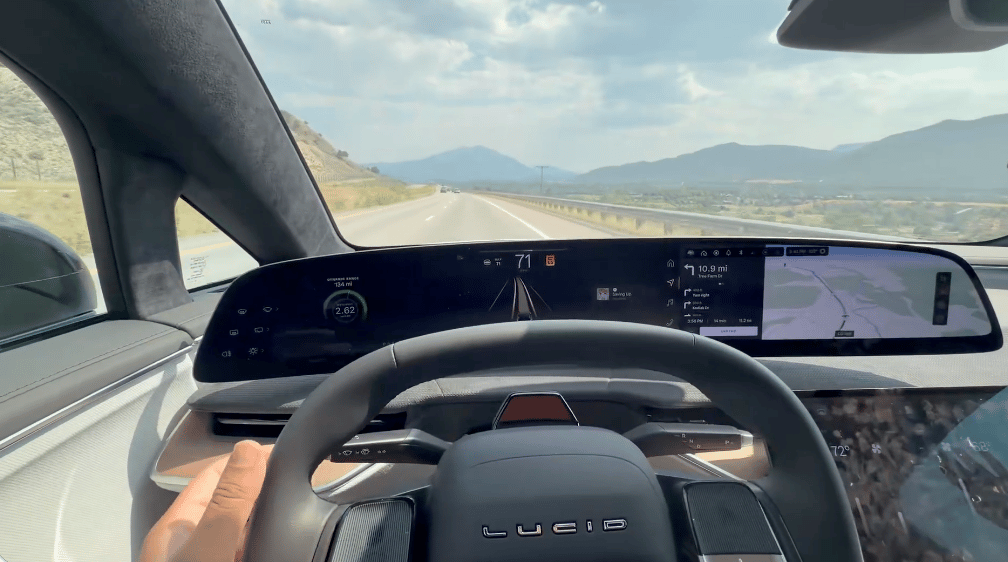
Footage attached to the post shows the vehicle at 71 miles per hour with the driver’s hand off the wheel and the steering graphic active on the instrument display, and Conner narrating the failure in real time.
“Why did it all of a sudden decide to just stop lane centering properly?” he asks over the clip, before noting that the feature is engaged and that the car knows where it sits in the lane.
His description of what follows is that the system tries to steer and then drives out of the road, which he calls crazy.
Conner wrote that he would let the car sleep overnight to see whether it stopped being insane, and that failing that he would have the vehicle looked at and ask Lucid to explain what was happening.
Neither step proved necessary.
About six hours later he posted a second video of the same SUV driving at night with the system working normally, writing that the car was well rested after being allowed to sleep and closing with “Just Lucid things I guess.”
Conner x Lucid
Conner is not a bystander to Lucid‘s software record, having conducted the interview in which the company made its central claim about fixing it.
Out of Spec published a 5,000-mile Gravity review in December that identified software problems undercutting the hardware, one of several reviews preceding interim Chief Executive Marc Winterhoff’s email to Gravity customers that month conceding the company had missed its own standard.
Then-Senior VP of Engineering and Digital Emad Dlala then told Conner in an interview released in early February that the 3.4 update had resolved “90% — or even close to 95%” of known issues, saying the release had been built to remove the robustness problems seen in customer vehicles.
Complaints continued regardless, both after the 3.3.20 release and through the spring, and EV reported in April that software and service problems were persisting despite months of promised fixes.
Dlala left the company on June 10, two days after the hands-free rollout, in the first senior departure under Chief Executive Silvio Napoli, who had taken over days earlier.
Lucid said Dlala had “elected to leave the company to pursue other opportunities” and that Vice President of Vehicle Engineering Vivek Attaluri and Vice President of Software Marc Solsona Palomar would report directly to Napoli.
Conner posted the same day that “Lucid is now no longer the company we’ve known,” praising Dlala’s engagement with products and customers and saying the channel would have to work out what the company had become.
The Feature’s Delays
Lucid had delivered hands-free driving to the Air sedan in July 2025, telling owners then that the Gravity would follow later that year.
That deadline passed, and Vice President of Communications Nick Twork acknowledged the slip on X in January, writing that the company had “ended up prioritizing other software updates, hence a later delivery time.”
In April the 2027 model-year configurator showed a third-quarter target, which Lucid then told EV was a mistake and corrected to the second quarter, after EV had reported the delay.
The June release landed roughly eleven months behind the Air and nineteen months after Gravity deliveries began.
Lucid confirmed to WardsAuto in June that the system operates on approximately 125,000 miles of roads across the United States and Canada, against more than 600,000 for General Motors‘ Super Cruise and roughly 130,000 for Ford‘s BlueCruise.
Hands-free driving has not been enabled outside North America.
Conner has criticised the packaging of the feature set since before deliveries began, arguing when the Gravity configurator opened in November 2024 that lane centering should have been standard equipment rather than bundled into paid options.