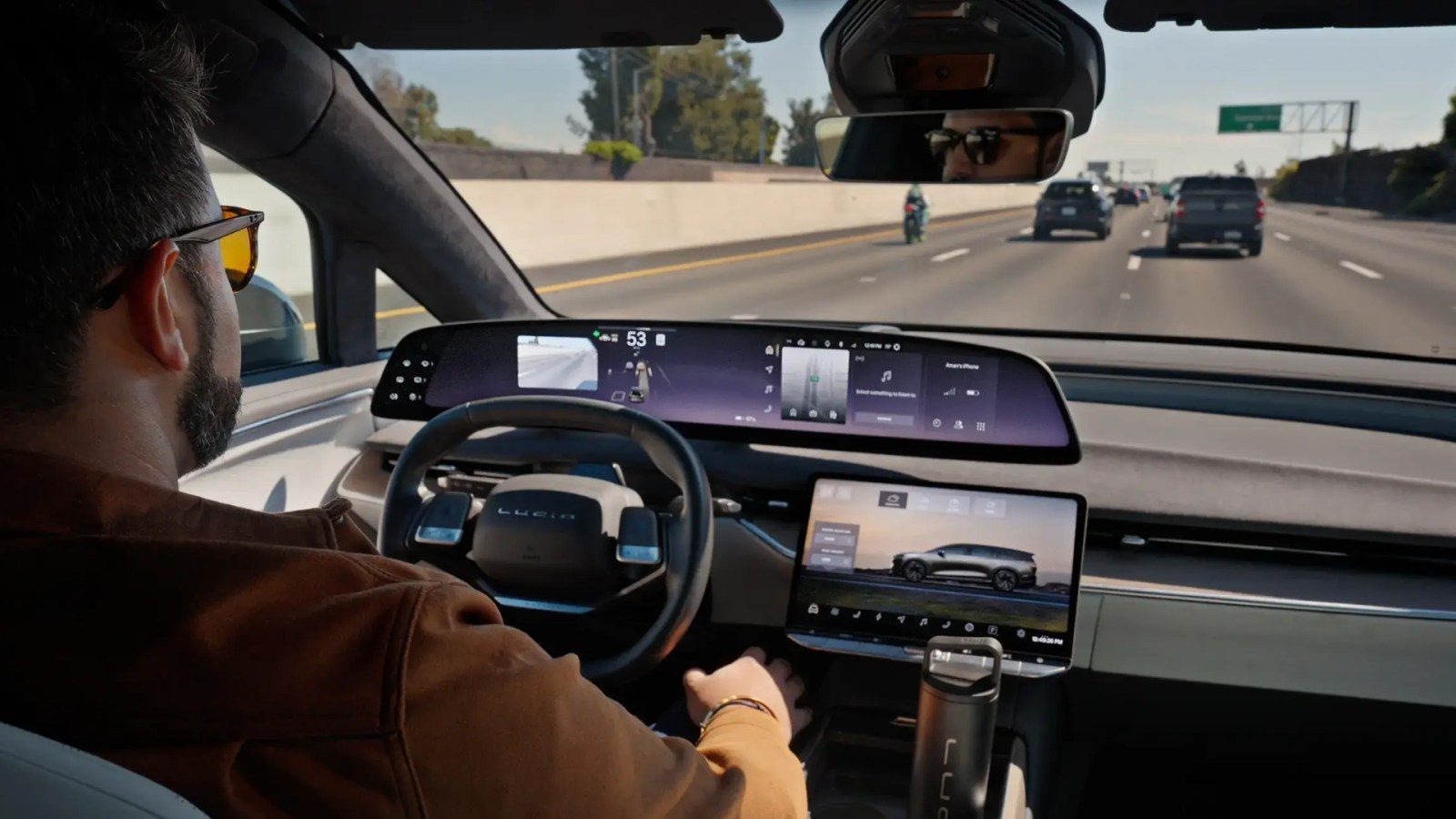

Lucid Motors has begun rolling out a major over-the-air software update for the Gravity SUV on Monday — improving navigation, charging, headlight, and driver-assist capabilities to its second model in North America.
The UX 3.6 update includes the long-awaited Hands-Free Drive Assist and Hands-Free Lane Change Assist, which are available to Gravity vehicles equipped with DreamDrive 2 Pro in North America.
The features were first promised for 2025 and slipped repeatedly through multiple missed deadlines and public timeline revisions.
Hands-Free Driving
The main feature of this release is hands-free highway driving.
On compatible divided highways, the system handles steering, acceleration, and braking while allowing the driver to remove their hands from the wheel.
When the driver activates the turn signal, Hands-Free Lane Change Assist evaluates surrounding traffic and steers into the adjacent lane when conditions permit.
An Automatic Lane Change function can also initiate passing maneuvers independently to overtake slower vehicles.
Lucid said drivers can select between two driving styles in the settings — ‘Conservative,’ which reduces lane changes in heavy traffic, and ‘Assertive,’ which takes a more active approach to passing.
The Clearview Cockpit display now renders a real-time, five-lane visualization of surrounding traffic and more accurately depicts vehicle types including SUVs, pickup trucks, and buses.
A vehicle blocking an intended lane change is highlighted in the display.
Lucid emphasized in its press release that the feature “is not a replacement for safe, attentive driving or a driver’s judgment” and that drivers “should remain focused on the road and their surroundings at all times.”
DreamDrive 2 Pro, the hardware package required for hands-free capability, is an optional add-on.
The Lucid Air sedan received the same hands-free capability in July 2025.
At the time, Lucid said Gravity owners would get the feature “later this year.”
That deadline passed without delivery.
A Feature That Slipped Repeatedly
The arrival of hands-free driving on the Gravity caps a protracted series of delays that added to the EV maker’s software struggles.
In January, VP of Communications Nick Twork acknowledged the delay on X, writing that Lucid had “ended up prioritizing other software updates, hence a later delivery time.”
Twork added: “Agree we need to deliver and the team is focused on it.”
During its inaugural Investor Day in New York three months ago, Lucid placed hands-free highway driving for the Gravity on a 2026 software roadmap slide without specifying a date.
Days later, former interim CEO Marc Winterhoff narrowed the window at Bank of America’s 2026 Global Automotive Summit, telling attendees that hands-free highway driving was “a few weeks” from deployment.
“We did this completely in house without any partners,” the chief noted.
Three weeks passed without deployment.
In early April, Lucid‘s 2027 model-year configurator briefly listed the feature as arriving in the third quarter — a further delay beyond Winterhoff’s statement.
Lucid told EV the third-quarter listing was a mistake and corrected the configurator to reflect a Q2 2026 timeline.
UX 3.6 now fulfills the target, roughly 11 months after the Air received the same capability and approximately six months behind the original promise to Gravity owners.
Other Features
Beyond hands-free driving, UX 3.6 brings a meaningful upgrade to the navigation system through integration with Google Maps Places API.
Lucid said search results now include more up-to-date business hours, user ratings, photos, and parking information.
Charging station listings display recent imagery and improved real-time charger availability.
The system now shows true driving distances rather than estimates and supports natural-language queries — the company cited the example of typing “Vietnamese restaurants near me” to surface local results.
New energy management tools aim to give owners more clarity around fast-charging sessions.
An Advanced Preconditioning View shows a battery readiness indicator tracking progress toward the optimal temperature range for DC fast charging.
A Predictive Charging Power feature displays real-time estimates of peak charging power, helping drivers decide whether to precondition longer or plug in immediately.
Energy Saver Mode receives more flexibility in UX 3.6.
Owners can now adjust temperature, toggle HVAC, and switch AC on or off while the mode remains enabled.
Restricted settings trigger a tooltip explaining the limitation, with a one-click option to disable Energy Saver Mode entirely.
Efficiency readings across the Trip Meter and Efficiency Widget are now more consistent, Lucid said, and long regenerative braking sessions display a high efficiency value rather than the previous 0 mi/kWh reading.
The Lucid mobile app now fully supports Rated, Percentage, and Dynamic range display settings.
Adaptive Driving Beam, available on vehicles equipped with DreamDrive Premium or DreamDrive 2 Pro, keeps high beams engaged while dynamically reshaping the light pattern around other vehicles to reduce glare.
Lucid described the feature as allowing drivers to maintain maximum forward illumination without manually toggling between high and low beams.
UX 3.6 also addresses several everyday usability requests.
System startup is smoother, with displays, controls, and driving features ready when the driver sits down.
Proactive Auto Lock and Unlock extends door handles earlier as the owner approaches and sends the vehicle into sleep mode faster when left unlocked and unoccupied with no key nearby.
Mirror Tilt Control allows the driver to configure automatic downward tilting of one or both mirrors when reversing.
Halo Secure drive recorder footage now features straightened curved lines and corrected edge distortion.
Software Overhaul and Staff Firings
The hands-free delay unfolded against a broader backdrop of software problems that have dogged the Gravity since customer deliveries began in late 2024.
Owners reported key fob recognition failures, frozen screens, navigation malfunctions, and climate control glitches in the months following launch — with software the company itself later admitted was not ready for production.
In December 2025, Winterhoff sent an email to Gravity customers acknowledging the company had failed to meet its standards on software quality.
“Lingering software problems have unfortunately affected our customers’ experience and satisfaction,” he wrote.
Weeks later, at CES 2026 in January, Winterhoff confirmed he had replaced the entire software leadership team.
“I basically replaced the whole software leadership team,” he told media.
A Lucid spokesperson said the number of departures was “more than a handful,” though the company declined to provide an exact figure.
The firings followed the November 2025 ouster of Senior VP of Product and Chief Engineer Eric Bach, as first reported by EV.
Emad Dlala, one of the company’s longest-serving executives, was elevated to Senior VP of Engineering and Digital to oversee all product development and software.
In early February, Dlala guaranteed Lucid‘s 3.4 software update — pushed in late January — had resolved 90 to 95% of the Gravity’s issues.
However, owner complaints on social media persisted through the spring.
An April report found that software and service problems continued despite months of promised fixes and multiple over-the-air updates, with new rounds of complaints surfacing nearly six months after Winterhoff first acknowledged the issues.
Lucid‘s shares plunged to a new recorded low of $5.09 late last week, extending losses of the past months.
The company reported a 42% quarter-over-quarter decline in deliveries to 3,093 vehicles in the first quarter — mainly driven by a nearly month-long delivery halt linked to a Gravity recall affecting nearly all units produced at the time.