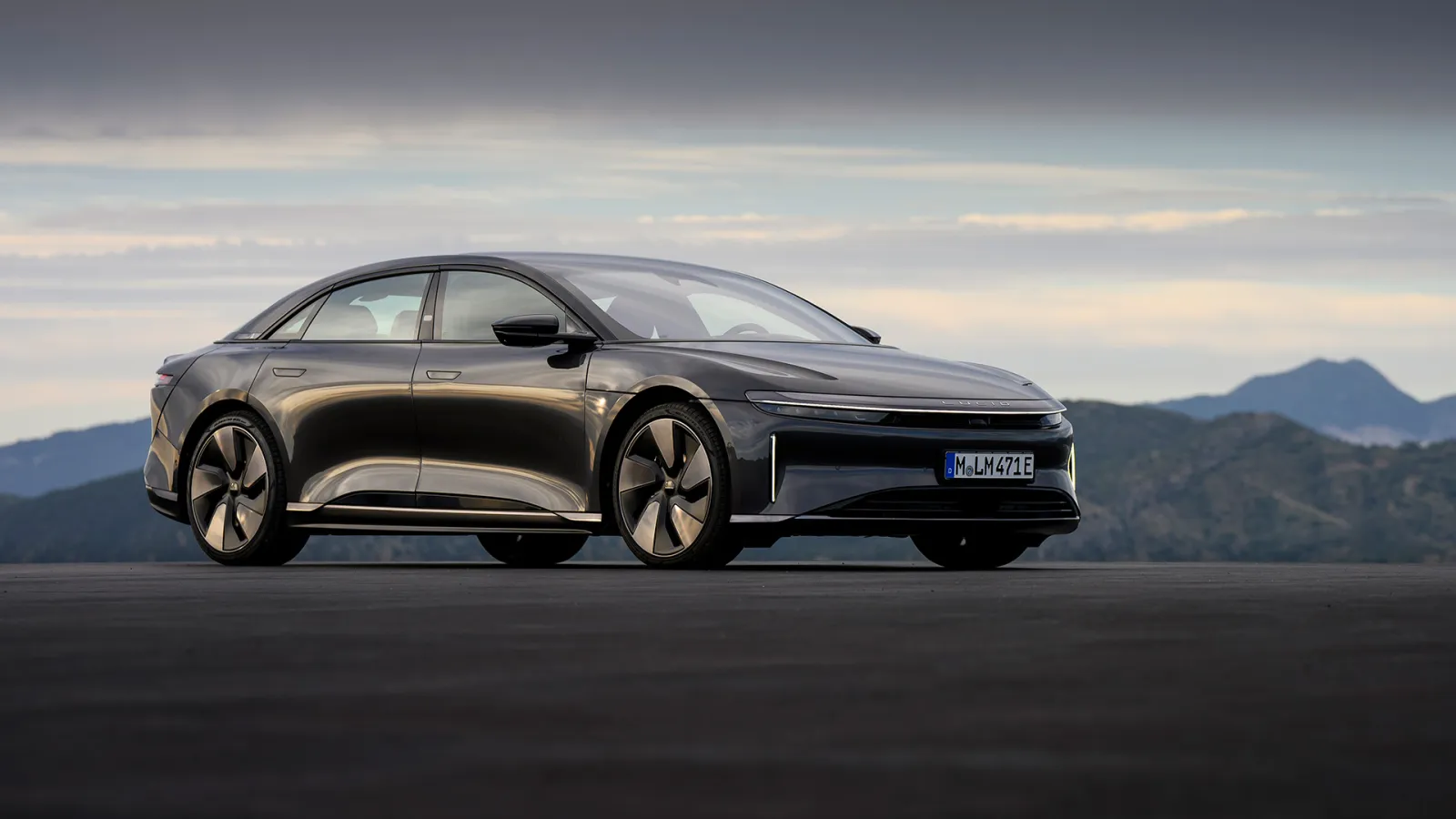
Uber said on Wednesday that the commercial launch of its robotaxi service with Nuro and Lucid in the San Francisco Bay Area is now scheduled for the first quarter of 2027, less than five months after the three companies said the service would “initially launch in the San Francisco Bay Area later this year.”
The ride-hailing giant disclosed the new timing in prepared remarks published with its third-quarter results on Wednesday. It did not say which of the three companies made the decision or give a reason for moving the launch to the first quarter of 2027.
“We expect to begin fully driverless testing with Nuro and Lucid this quarter, ahead of a commercial launch in the Bay Area in Q1 2027 that will operate fully driverless from day one,” CEO Dara Khosrowshahi said in prepared remarks published with Uber’s third-quarter results on Wednesday.
“Houston and additional cities will follow,” he said.
Chief Financial Officer Balaji Krishnamurthy confirmed the timing on X after a user asked about it.
“Is Nuro bay area launch not happening this year anymore? Was looking forward to trying it out but on earnings it sounded like it’s now in 27 with Houston,” X user Ethan McKanna wrote in a reply to Krishnamurthy on Wednesday.
“In the prepared remarks,” Krishnamurthy replied, attaching a screenshot of the autonomous vehicle section that contains the first-quarter 2027 Bay Area timing.
From ‘Later This Year’ to Q1 2027
Uber’s language on the program has shifted over three quarterly reports.
In its first-quarter remarks on May 6, Uber said the Lucid and Nuro program had begun employee trips in the Bay Area and remained “on track for a public launch later this year.”
On June 17, when Uber, Nuro and Lucid announced Houston as the second market, their joint release said the program would “initially launch in the San Francisco Bay Area later this year” and that the companies expected to launch in Houston “in mid-2027.”
In August, its second-quarter remarks said Uber had “advanced partnerships with Nuro, Wayve, and Zoox, and continued preparing for multiple U.S. launches later this year,” without giving a date for the Bay Area service.
On Wednesday’s earnings call, Khosrowshahi placed Nuro among the partners Uber expects to add next year, answering a question from Citi analyst Ron Josey on how the driverless rollout would be split between markets.
“Then next year, we expect to add Nuro in California and then in Houston as well in Texas, at least early on in 2027,” he said.
Uber did not give a reason for the new timing in its prepared remarks.
Driverless From Day One
The new plan sets a higher bar for the launch. Uber said the Bay Area service will operate without safety drivers from its first day, rather than starting with supervised rides.
That requires permits the program does not yet hold as of early Wednesday.
Nuro said on May 8 that it had received a California Public Utilities Commission permit to carry passengers with a safety driver on board. “They do not authorize paid rides, and the CPUC Drivered Pilot Permit does not authorize driverless passenger operations,” the company said at the time.
The CPUC’s list of autonomous vehicle permits still showed Nuro holding only a “Drivered Pilot” permit on Tuesday.
The California Department of Motor Vehicles has approved Nuro for driverless testing of the Lucid Gravity in Santa Clara and San Mateo counties, at speeds up to 45 mph, according to its list updated October 22.
In June, the companies said Nuro was conducting “24/7 autonomous on-road testing with safety operators in Houston and the San Francisco Bay Area,” with an engineering fleet of “nearly 100 vehicles across California and Texas.”
On Tuesday, Nuro said it had briefed police in Mountain View, Palo Alto and Los Altos “to prepare for the launch of our robotaxi program with @Uber and @Lucid.”
A Timeline That Has Moved
The program dates to July 2025, when Lucid signed a production agreement with Uber.
Under it, Uber and its fleet operators agreed to buy a minimum of 20,000 Gravity Plus vehicles over six years from the start of production, “which is targeted to occur in late 2026,” according to a Lucid filing. The minimum is conditioned on Lucid meeting certain volume and other requirements.
Uber said in October 2025 that the Bay Area would be the program’s first market, with a launch planned for 2026.
A timeline in Lucid’s first-quarter shareholder deck put production of vehicles for commercial launch and the start of safety and validation work early in the fourth quarter, with commercial operation in late 2026.
Lucid said on October 20 that another shipment of robotaxis built at its Arizona factory was on its way to the Bay Area.
In June, the three companies said Houston would be the program’s second market, with a launch targeted for mid-2027. Uber did not update that date on Wednesday.
A second agreement signed in April covers a minimum of 25,000 Lucid Midsize Plus robotaxis, with production targeted for late 2028. Through offset provisions, the two deals raise Uber’s total commitment to “at least 35,000 units,” according to Lucid’s second-quarter 10-Q.
Uber has invested $500 million in Lucid and owned about 9.6% of its common stock as of June 30, the filing showed.
Uber’s Wider Driverless Push
The Bay Area delay sits within a broader expansion of Uber’s driverless fleet.
“We are on track for ~700 fully driverless vehicles on Uber by year-end,” Khosrowshahi said, adding that Uber expects to deploy “over 2,000 fully driverless vehicles on Uber by the end of 2027.”
“In the U.S., we expect Zoox to launch on Uber in Las Vegas later this month,” he said, “followed by Motional transitioning to fully driverless operations soon thereafter.” Uber also expects “further driverless deployments with Avride in 2027,” with supervised NVIDIA and Rivian deployments beginning in 2027 and 2028, respectively.
Chief Financial Officer Balaji Krishnamurthy said on the call that Uber’s “long-run expectation is that this should be financed by third-party capital, not by Uber’s balance sheet.”
Uber reported third-quarter gross bookings of $59.8 billion, up 20%, and revenue of $14.8 billion, up 10%. Its shares were up 6.8% at $71.12 at 2:03 p.m. in New York.
Lucid will report its third-quarter results on November 9.