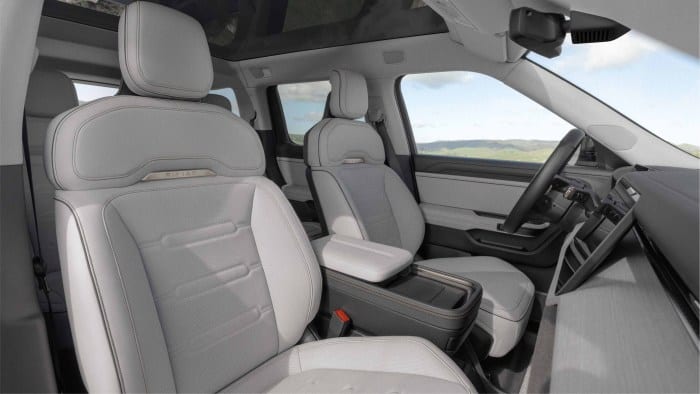

Lucid‘s Cosmos will travel more than 400 miles on a charge, chief executive Silvio Napoli said in a television interview this week — the first range figure any Lucid executive has attached to the midsize SUV.
The Saudi-backed premium brand has since said that “all numbers are preliminary.”
Earlier this month, Lucid delayed the model’s production start from “late 2026” to the second half of 2027.
Asked this week on CNN’s Quest Means Business how far the vehicle would go on a charge, Napoli told host Paula Newton: “On a charge, we are 400 miles plus.”
The CEO — who assumed the role on the first day of June — gave no trim, no drivetrain configuration, and no test cycle.
Why the Number Does Not Fit
Since Investor Day in March, Lucid has built its case for the Cosmos on a single number: 69 kWh.
Slide 74 of that presentation sets out the battery capacity each vehicle needs to cover 300 miles.
The Cosmos in all-wheel drive needs 69 kWh, against 73 kWh for what Lucid labels the US EV leader’s midsize crossover, 82 kWh for a new German midsize SUV and 86 kWh for a Chinese midsize crossover.
None of the three is named.
Slide 70 states the same advantage as efficiency, projecting the Cosmos at 4.3 to 4.5 EPA-estimated miles per kWh in all-wheel drive against roughly 4.0, 3.6 and 3.35 for the same three rivals, and claiming the vehicle will be over 10% more efficient than its closest competitor.
It is also worth noting what the slide’s own source line does not cover: the competitor bars are EPA data, while the Cosmos figure is Lucid‘s own projection for a vehicle the agency has not yet tested.
Lucid has since told InsideEVs that the vehicle remains in the prototype and development stage and that all numbers are preliminary.
“We’re still in the prototype and development stage, so all numbers are preliminary,” a company spokesperson said. “Official WLTP and EPA range estimates will be announced closer to the vehicle launch.”
Slide 74 attaches money to the battery comparison.
Assuming an average cell cost of $120 per kWh, which Lucid describes as the US average in 2025, it puts the Cosmos $500 ahead of the American rival on bill-of-materials cost for 300 miles of range, $1,500 ahead of the German and $2,000 ahead of the Chinese.
The Cosmos is not due into production until the second half of 2027, after Napoli pushed it back from late 2026 on the August 4 earnings call, saying the company would launch the car when it was ready rather than repeat the mistake of shipping vehicles before they were finished.
Where It Would Sit
At more than 400 miles, the Cosmos would be the shortest-range vehicle Lucid sells and still among the longest-range EVs in the United States.
The Air Grand Touring is rated at 512 miles, currently the longest of any EV on sale in the country, and the Gravity Grand Touring reaches up to 450 miles.
In its own segment the figure would put the Cosmos alongside the BMW iX3 and Volvo EX60, both premium vehicles expected to reach comparable range using batteries above 110 kWh — which is the efficiency argument Lucid has been making.
Earlier in the interview, Napoli said the Cosmos would triple or possibly quintuple Lucid‘s addressable market and confirmed pricing around $50,000, describing the launch plan as still being set.
What Is Established About the Cosmos
The vehicle rides on an entirely new midsize platform with an 800-volt architecture and an in-house drive unit called Atlas.
Lucid quotes 0 to 60 mph in 3.5 seconds in all-wheel drive, a drag coefficient below 0.22, bidirectional charging, and more than 200 miles of range recovered in 14 minutes of fast charging.
The design was shown to Investor Day attendees in New York on March 12 with phones confiscated, and appeared publicly for the first time in a European Union design filing registered on May 22 under Atieva Inc., Lucid‘s former corporate name.
Production is planned at AMP-2 in Saudi Arabia, which Napoli has said will be ready in early 2027 after the company transformed it from a kit-assembling unit to a full production plant.