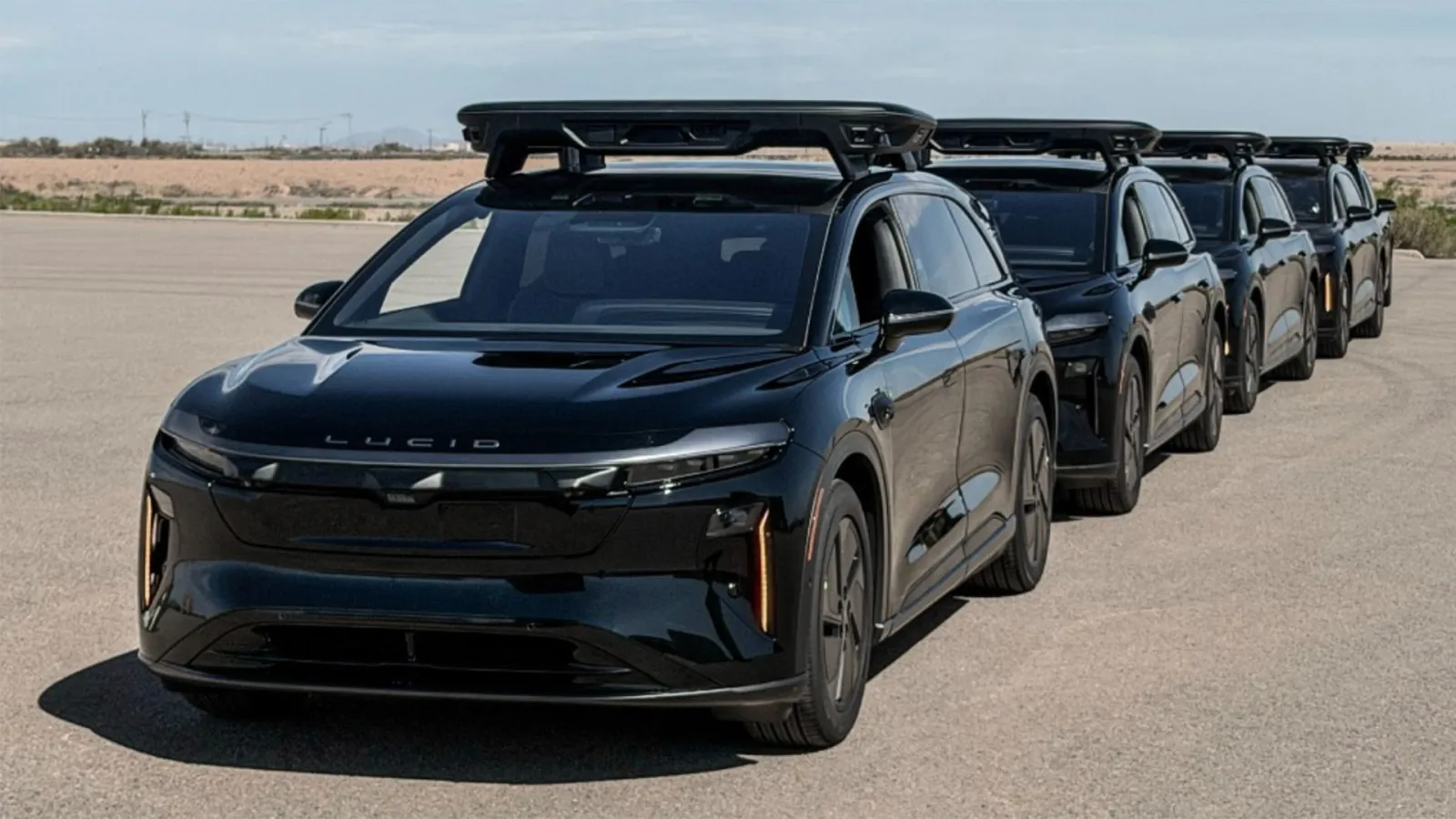
Bolt has chosen NVIDIA‘s Alpamayo Stack self-driving software to run the Lucid robotaxis it plans to deploy in Europe, and will start the program in Madrid in 2027, the ride-hailing company said on Wednesday, filling in two of the gaps left by the partnership the companies announced five weeks ago.
The Madrid program “is expected to begin with Lucid vehicles in 2027, initially gathering real-world driving data to support the development and validation of the autonomous driving technology, subject to regulatory approval,” Bolt said, naming Germany and France as “key markets for future deployment.”
Bolt told Reuters it expects “tens of vehicles” in Madrid next year, and the company’s President and Head of Autonomous Driving, Jevgeni Kabanov, told the agency the city was chosen because the regional government has created a permit that allows limited commercial operations before full approval.
The announcement came at NVIDIA’s GTC Berlin conference, where the chipmaker listed “Bolt with Lucid” alongside Mercedes-Benz, Volkswagen Commercial Vehicles and Einride among European companies showcasing autonomous-driving work on its Hyperion computing platform, with Volvo Cars adopting Hyperion and Alpamayo Stack.
From ‘Partners’ to a Named Stack
The September 17 release said Lucid and Bolt “will work with autonomous-driving technology partners” without naming one, and said only that the platform “is expected to utilize NVIDIA Hyperion,” the chipmaker’s reference computer and sensor architecture.
Wednesday’s release names the software that will drive the cars, describing Alpamayo Stack as full-stack driving software that “combines reasoning AI, classical perception and planning, and safety guardrails,” running on Hyperion with NVIDIA’s Halos safety system.
When NVIDIA unveiled the current DRIVE AGX Hyperion 10 in October 2025, it described it as a reference architecture that “makes any vehicle L4-ready,” built around two DRIVE AGX Thor computers on its Blackwell architecture with 14 cameras, nine radars, one LiDAR and 12 ultrasonic sensors.
Kabanov told Reuters the driving software runs entirely inside the vehicle without connecting to the internet, for cybersecurity reasons.
“Bolt and NVIDIA will work together to adapt the driving software for European roads and integrate it into vehicles from multiple manufacturers, beginning with Lucid,” the release said.
The two companies had already agreed at NVIDIA’s GTC conference on March 16 that Bolt would use its ride-hailing fleet data with NVIDIA’s Cosmos, Omniverse and Alpamayo tools and integrate Hyperion into its autonomous vehicles, without a timeline for robotaxis.
Neither release contains a production agreement, a purchase commitment, a price or an investment, and CEO Silvio Napoli told the Financial Times in September that the first batch could roll out “as early as 2028” under what the newspaper described as a memorandum of understanding.
Lucid’s Second Autonomy Partner
The choice gives Lucid two different self-driving stacks on two programs.
The Gravity robotaxis it builds in Arizona for Uber run the Nuro Driver from Nuro, in a program the July 17, 2025 announcement described as “created exclusively for the Uber ride-hailing platform,” and Lucid said on Tuesday that another shipment was headed to the Bay Area, where the partners aim to begin commercial service this year.
The Bolt vehicles will come from the Midsize platform, the same base Uber has committed to under its second vehicle production agreement, whose robotaxi variant, the Midsize Plus, is targeted to start production in late 2028, according to Lucid’s April 23 proxy statement.
NVIDIA software is not new to Lucid’s plans, since NVIDIA said in October 2025, when it announced its robotaxi partnership with Uber, that Lucid was “advancing level 4 autonomous capabilities for its next-generation passenger vehicles, also using full-stack NVIDIA AV software on the DRIVE Hyperion platform for its upcoming U.S. models.”
Bolt’s release is the first to attach that software to a Lucid robotaxi program, and Napoli told Bloomberg on September 17 that “there is no exclusivity” in the Uber arrangement that would stop Lucid supplying other operators.
“Lucid’s advanced vehicle architecture provides an ideal foundation for integrating NVIDIA Alpamayo technology with Bolt’s mobility platform,” Kay Stepper, President of Lucid Technologies and Chief Digital Officer, said in the release.
“Our close collaboration to date, and launch of data collection next year, mark the first steps toward bringing scalable, software-defined autonomous mobility in Europe,” he added.
Stepper told Lucid’s March investor day, as VP of Autonomy, that the Midsize platform’s new driver-assistance hardware would be ready in 2028, and was named President of Lucid Technologies, the unit that groups its AI, driver-assistance, autonomy and digital work, in the July leadership change.
Why Madrid
Bolt’s President and Head of Autonomous Driving, Jevgeni Kabanov, said the Region of Madrid “is pioneering a structured framework for commercial autonomous mobility in coordination with national authorities.”
The regional government is preparing what Expansión described in May as the European Union’s first pilot of autonomous ride-hailing vehicles, with Uber, Cabify and Bolt as the main operators and a start expected in the last quarter of 2026, beginning with a human operator on board.
“Following our first autonomous mobility launch in Luxembourg, our next step with NVIDIA and Lucid is to begin a programme in Madrid in 2027,” Kabanov said, adding that “Germany will also be a priority for what comes next.”
The Luxembourg program, announced in June with Pony.ai and Stellantis, uses Pony.ai’s seventh-generation system on a Stellantis midsize van in a one-year trial with a safety driver on board, and Bolt said the NVIDIA and Lucid program sits alongside that work in a strategy built on multiple vehicle manufacturers.
Bolt and Stellantis had already agreed in December 2025 to “jointly explore” driverless vehicles on Stellantis’s eK0 medium van and STLA Small platforms, with test vehicles from 2026 and an initial production target in 2029.
“Our ambition isn’t to bring autonomous driving to just a handful of cities,” Kabanov said, repeating Bolt’s goal of 100,000 autonomous vehicles on its platform across Europe and the wider UNECE region by 2035.
Pony.ai is also supplying Uber in Europe, having added London to their robotaxi plans this month.
Contracted Volume Versus Intent
The gap with Uber remains the measure of how far the Bolt arrangement has to go.
Uber’s two filed agreements carry minimum purchase commitments of 20,000 Gravity vehicles and 25,000 Midsize Plus vehicles, at least 35,000 combined after an offset clause, plus $500 million of equity investment, the plan Napoli reorganized the robotaxi business around in August.
Bolt’s 25,000 is a deployment aim with no filed contract, and Wednesday’s release adds no number of vehicles for Madrid and no date for commercial service, only that the cars will first gather data.
Lucid’s shares were rising as much as 1.9% to $3.33 in early New York trading as of publication time, valuing the company at about $1.32 billion.
NVIDIA shares were up 1.1%.
Lucid produced 2,954 vehicles and delivered 3,806 in the third quarter, with deliveries above output as it cut inventory, and reports results on November 9, the next scheduled occasion for a potential update on either robotaxi program.