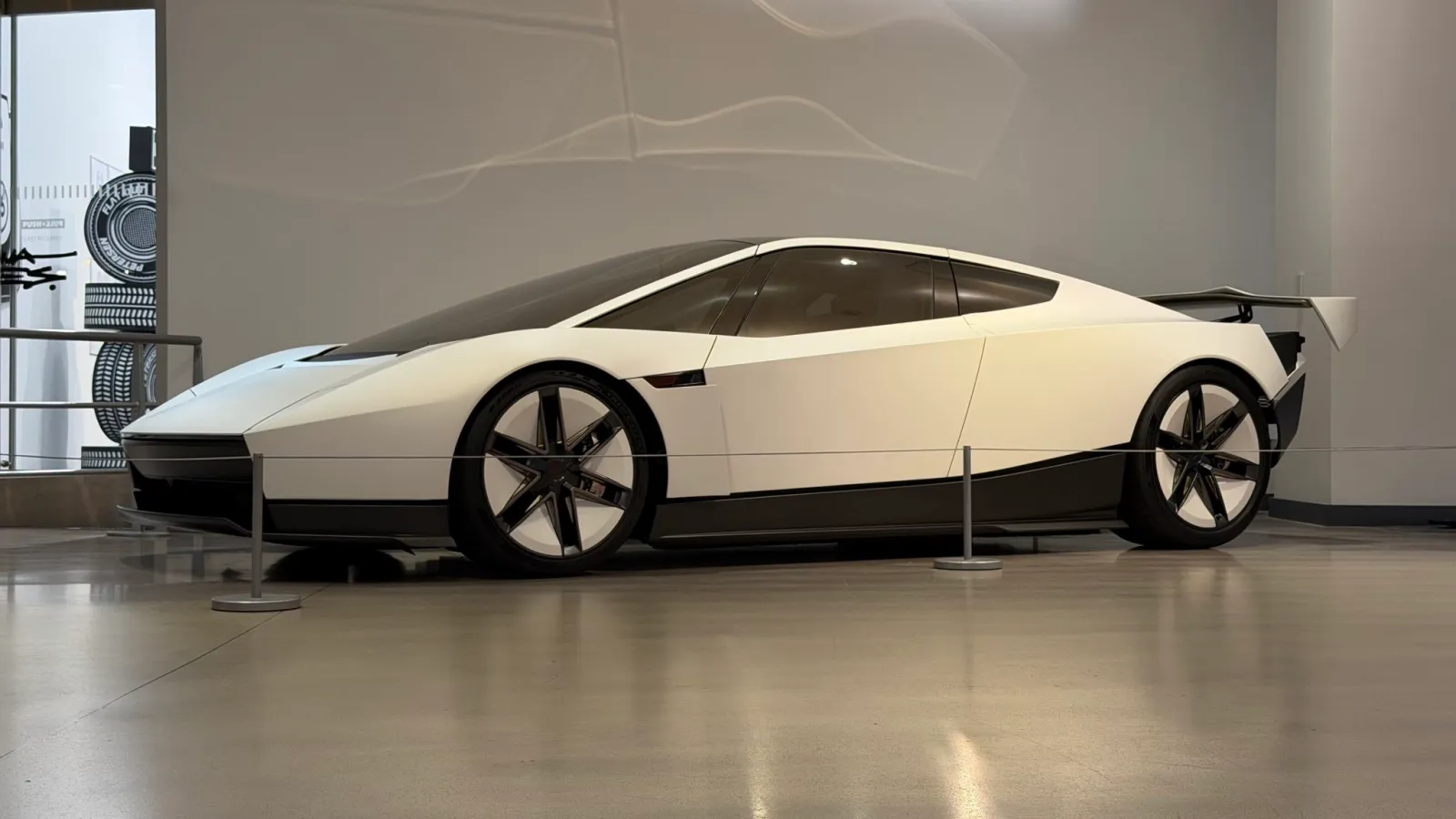
Tesla‘s base Roadster will go without the gold-tinted glass, “Supersonic” interior and cryogenic-protected Ano White paint offered on its costlier versions, a version that is “not to be messaged as having butterfly doors.”
The entry Performance trim, which Tesla bills as “road ready,” also has no cold-gas thrusters and none of the pressure vessels that feed them.
Tesla’s own guidance says none of the vehicle images on its Roadster web page show it. “All vehicle assets on the product page are Thrust or Rocket,” the documents say.
The same guidance says the Performance is “not to be messaged as having Butterfly doors.” Yet Tesla’s own trim comparison lists “Dihedral doors w/ removable roof panels” as standard on all three versions, including the Performance.
Tesla’s guidance do not explain the contradiction or say who the guidance is written for.
The documents list peak acceleration of more than 1.5 g for the Performance, against more than 5 g for the Thrust and Rocket. Top speed is more than 210 mph for the Performance and more than 230 mph for the two thruster-equipped versions.
The photos were shared by Ryan Zohoury, who described them as “a copy of the press resources for the new Tesla Roadster.”
Tesla’s documents detail how the Rocket’s thrusters are split by function and set out messaging rules, including an instruction not to say SpaceX owns any part of the car.
Doors and roof
The trim comparison lists “Dihedral doors w/ removable roof panels” as standard on the Performance, Thrust and Rocket.
Tesla had not previously named the door type or said whether the roof panels come off. The documents give Tesla’s own name for the doors, “dihedral,” and confirm the roof panels are removable.
Dihedral is the label McLaren uses for doors that swing up and outward from the windshield pillar. Scissor doors, by contrast, rotate straight up on a hinge at the front of the door.
That leaves the messaging guideline on the Performance unexplained.
The documents do not say whether the base car’s doors open differently from those on the Thrust and Rocket, whether Tesla simply prefers “dihedral” to “butterfly” for every trim, or whether the Performance’s door design is not yet final. Tesla has not described the Performance’s doors separately.
Chassis hardware
The media sheet lists a chassis package for all trims. Three items in it had not been reported before. They are “Individually controlled brake corner actuation,” “Spool valve adaptive dampers” and “Active Ride Height adjustment on both front and rear axles.”
The sheet also lists carbon-ceramic brakes. They had appeared only in secondary spec roundups that cited no Tesla source, and the documents are the first attributable confirmation.
A dual ride height and wheel-rate setup separates road and track behavior. In track settings stiffness “more than triples” and ride height drops by up to 40 millimeters.
Those figures had been given in a Hagerty walkthrough of the car after the reveal, and the documents confirm them.
Rocket’s 10 thrusters
Moravy had said the Rocket adds six thrusters to the Thrust’s four, for 10 in total. The documents assign them roles for the first time.
The Rocket’s two carbon-overwrapped pressure vessels (COPVs) feed four rear thrusters for acceleration, four downward perimeter thrusters for lift control and two side thrusters for yaw control, according to the comparison sheet. The Thrust carries one COPV and the four rear thrusters.
The documents also tie Tesla’s Optimus robot actuators to the thruster systems. They describe “electric Optimus Actuators” on the Thrust and “all-electric Optimus actuators” on the Rocket.
Tesla had previously linked Optimus actuators only to the Roadster’s wings.
Acceleration and range labels
The media sheet gives peak acceleration of more than 1.5 g for the Performance, a figure not published before. It lists more than 5 g for the Thrust and Rocket. Vice President of Vehicle Engineering Lars Moravy had already cited more than 5 g for the Thrust.
Range is listed as “EPA Range,” more than 300 miles for all trims. Tesla had previously given only “more than 300 miles.” No EPA rating has been announced for a car that is not yet in production.
The two documents differ on acceleration. The media sheet lists 0 to 60 mph in under 0.9 seconds for the Thrust and under 0.59 seconds for the Rocket, matching Tesla’s launch figures.
The comparison sheet lists “Under 1 second” for both and leaves the Performance’s 0-60 entry blank. The media sheet’s 0-60 row carries an asterisk whose footnote is not visible in the photos.
The Performance trim
Several of these features were already known. What the documents add is that the base car does not get them.
“Gold Glazed Glass Windows” are limited to the Thrust and Rocket. Tesla describes them as “Tinted glass windows designed to mimic copper, with subtle titanium accents.”
The “Supersonic Interior” is also limited to the Thrust and Rocket. It includes an “Ultrawhite interior with gray microsuede detailing,” seats with microsuede bolsters “for added grip” and a yoke designed for steer-by-wire. A center touchscreen is supported by two smaller forward displays.
“Ano White Exterior Paint” is Rocket-only, so neither the Performance nor the Thrust gets it. The Ano White name had been reported before. The documents add its properties, “UV and cryogenic protection, electrostatic dissipation, and corrosion resistance.” The documents do not say which colors the Performance and Thrust will offer.
Messaging rules
The comparison sheet ends with three “Messaging Guidelines,” none previously public. The first, on the product page images, is described above.
The second says not to mention that SpaceX owns any specific part of the car, followed by “Tesla developed Roadster in collaboration with SpaceX.”
Chief Executive Officer Elon Musk said at the October 15 reveal that the car was “the culmination of incredible work by Tesla and SpaceX engineers working closely together.”
The third is the instruction that the Performance is “not to be messaged as having Butterfly doors,” which sits at odds with the comparison sheet’s door listing.
What the documents confirm
Much of the material repeats figures Tesla and its executives gave after the reveal. These include peak power above 1 megawatt, motor torque above 1,400 Nm and thrust above 80 kN.
Top speeds are listed as more than 210 mph for the Performance and more than 230 mph for the Thrust and Rocket. Seating is two for the Performance and Thrust and one for the Rocket.
Also already public were the steer-by-wire yoke, the rear wing, the fan-and-skirt suction system and hidden headlights. So were the full-length taillight, thin-spoke wheels, the fixed seat base with a reclining back, the adjustable pedal bay and the use of magnesium, titanium and carbon fiber.
Tesla has not announced pricing for any version. It is taking reservations of $50,000 for the Performance and $250,000 for the Thrust. The Rocket is invite-only.