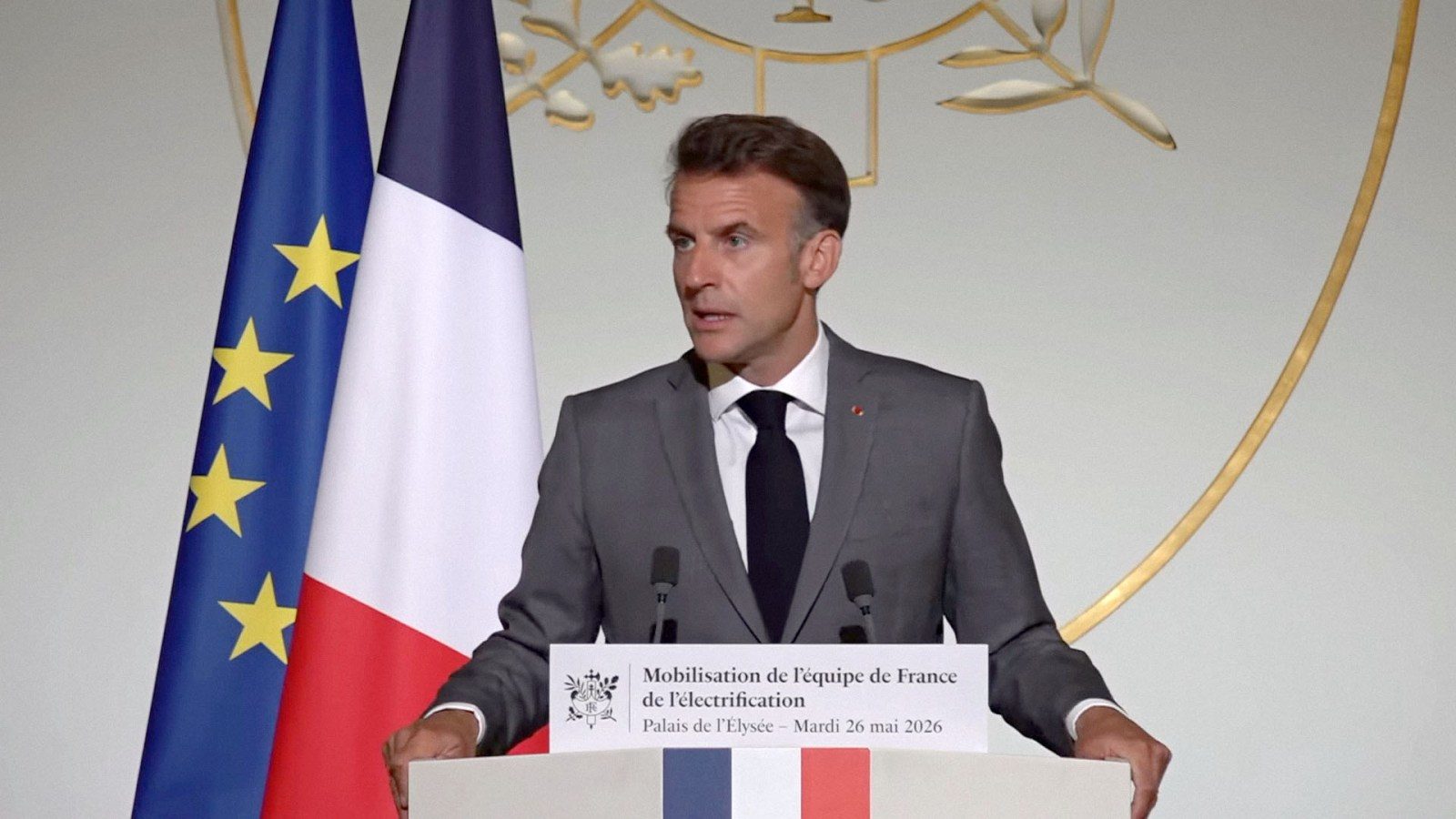

French President Emmanuel Macron revealed on Tuesday a new commitment from Stellantis in the country — as the group led by Antonio Filosa is set to invest more than €1 billion ($1.16 billion) in its Mulhouse plant to produce next-generation electric vehicles from 2029.
Speaking from the Élysée Palace this morning, Macron framed the pledge as proof that France’s industrial electrification strategy is delivering concrete results.
As of 2023, and according to a study published in late 2025 by the INSEE, the French automotive sector employs approximately 329,000 people across its value chain (vehicle manufacturing, equipment suppliers, R&D, and related activities).
The auto industry represents about 1.6% of private sector salaried employment, generating €31.2 billion in value added — equivalent to roughly 1.1% of France’s GDP.
The figures make it a key industrial pillar, despite a long-term decline in production and direct manufacturing jobs.
The President presented the Mulhouse investment alongside Renault‘s existing R5 and R4 electric vehicle production at Douai and Maubeuge as evidence of an emerging French EV manufacturing base — and one capable of attracting commitments from foreign manufacturers as well.
“So, you can clearly see that this is something concrete: electrification and electric vehicles, the Renault factories producing the R5 in Douai, the R4 in Maubeuge, our ability to build an entire industry around this,” Macron stated.
According to the President, this includes “models from foreign manufacturers that are ready to invest and produce here in France.”
The French president then framed the Stellantis announcement as a parallel commitment from the country’s second major automaker.
“I also want to thank all the manufacturers who are making commitments, and to announce new investments in this area,” he said. “I mentioned the R5 in Douai and the R4 in Maubeuge; Stellantis in Mulhouse will invest more than one billion euros to produce new generations of electric vehicles starting in 2029.”
Macron described the move as central to Stellantis‘ positioning within his government’s broader industrial strategy.
To him, “this is a commitment from our other major automaker within this strategy: producing electric vehicles in France and establishing new models here.”
“We are offering a real industrial future to the Mulhouse site, at the heart of the practical strategy we are pursuing in a region that loves the automobile industry, that has this history and believes in it,” Macron added.
FaSTLAne 2030
The Mulhouse pledge arrives just five days after Stellantis‘ CEO Antonio Filosa unveiled FaSTLAne 2030, the company’s €60 billion five-year strategic plan — presented at its investor day in Auburn Hills, Michigan, on May 21.
That plan calls for more than 60 new vehicle launches and 50 significant refreshes between now and 2030 across the group’s brand portfolio, including 29 battery-electric vehicles, 15 plug-in hybrid or range-extended models, 24 hybrids and 39 internal-combustion or mild-hybrid vehicles.
Stellantis said it would spend more than €24 billion over five years on global platforms, powertrains and new technologies — including the STLA One architecture, which is set to launch in 2027 and underpin more than 30 models across the B, C and D segments.
Manufacturing Moves
The Mulhouse commitment is the first specifically French plant-level allocation from that broader framework to be publicly attached to a euro figure.
The Alsace site has historically built Peugeot and DS sedans, and was identified during the FaSTLAne 2030 presentation as part of a European manufacturing footprint that Stellantis intends to restructure heavily.
The Investor Day plan calls for Stellantis to cut more than 800,000 units of capacity in its Enlarged Europe region while pushing capacity utilization from 60% to 80% by 2030.
The Poissy plant in France, under a deal with unions, will stop building cars around 2028.
Against that backdrop, Macron’s announcement positions Mulhouse on the surviving side of the restructuring — with a confirmed industrial future tied to next-generation EV production rather than retirement.
The commitment also sits alongside Stellantis’s plan to host a separate Europe-based joint venture with Dongfeng Group, 51% owned by Stellantis, that envisages potential production of Dongfeng‘s Voyah-branded premium EVs at the Rennes plant in France.
That venture was announced one day before FaSTLAne 2030, and is structured to bypass European Commission countervailing duties on Chinese-built EVs by manufacturing within the bloc.
Taken together, the Mulhouse, Poissy and Rennes decisions sketch the French footprint of Filosa’s strategy: capacity removed from one site, redirected to electrification at another, and opened to a Chinese partner at a third.
Charging Infrastructure
During his speech on Tuesday, Macron described charging infrastructure as essential to the sustainability of the electrification push.
“For this strategy to be fully sustainable, we must of course think about electrifying all uses and ensuring that we are never short of electricity for our vehicles,” he stated. “Charging station operators therefore have an essential role to play.”
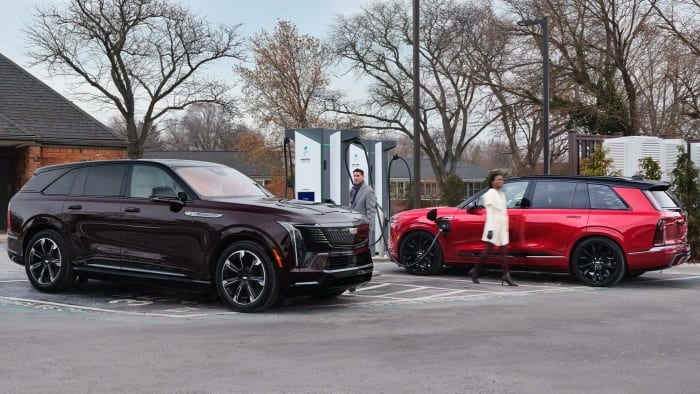
He cited industry commitments to deploy 240,000 charging stations, including 60,000 fast and ultra-fast charging points, and singled out several operators present at the event.
Macron highlighted the work of “Electra, which will invest 300 million euros by 2030,” before also acknowledging Engie and the Leclerc retail group.
“Leclerc has committed to deploying 10,000 charging stations by 2030,” he added, framing large-scale retail as having “a driving role to play both in local regions and on pricing.”
The French President also welcomed a €1.2 billion investment commitment from Banque des Territoires earmarked for charging infrastructure.
The new commitments, Macron said, will add to the more than 185,000 charging points already in service, with a target of 400,000 publicly accessible charging points by 2030.
He acknowledged price opacity as a persistent consumer complaint.
“Another strong criticism concerns the lack of price transparency for charging,” he noted, adding that he welcomed “the initiative launched by the Charge France federation to provide a calculator that will make it possible to estimate the economic savings from switching from a combustion-engine car to an electric car.”
Macron concluded by stating that “I trust our retailers, who know how to do this, but it is for the benefit of consumers and for the confidence I mentioned earlier, in order to accelerate this transition to electric vehicles.”
Stellantis has not separately disclosed which models will be built at Mulhouse from 2029, nor which of its core global brands will anchor production at the site.
Jeep, Ram, Peugeot and Fiat were identified under FaSTLAne 2030 as the recipients of 70% of the planned brand and product investment.