Mind Robotics, the industrial robotics company spun out of Rivian, has appointed Doug Field, Ford‘s former Chief EV, Digital and Design Officer, as President, the company said on Tuesday.
Field, who oversaw the Model 3 at Tesla and later led Apple‘s Special Projects Group, will oversee all aspects of the business, including product, engineering and operations.
He will work closely with RJ Scaringe, who founded Mind Robotics in 2025, chairs its board and is Rivian’s CEO.
“Doug is a remarkable leader with a track record of delivering new technologies in successful products, and I couldn’t be more excited to be building Mind with him,” Scaringe said.
“That’s exactly what Mind needs as we deploy robots into real factories and beyond,” he added.
Field said integrating AI and robotics was “one of the most important—and difficult—engineering challenges of our time,” and cited Mind’s “ability to deploy and learn inside a real, high-volume factory from day one.”
“I’m thrilled to join RJ in building a team, culture, and technology that will redefine what we can make in America,” he said.
Mind Robotics did not say when Field will start or disclose the terms of his appointment.
His LinkedIn profile still listed his Ford role as current on Tuesday.
Leaving Ford
Ford announced in April that Field had elected to leave after nearly five years, following a transition of about a month, as it folded his team into a new Product Creation and Industrialization organization under Chief Operating Officer Kumar Galhotra.
The automaker tied the reorganization to its target of an 8% adjusted EBIT margin by 2029.
“Doug has been an invaluable partner for me as CEO and helped Ford find its place in this new era,” Chief Executive Officer Jim Farley said at the time.
Field said then that he believed “Ford now has a winning technology strategy and plan.”
Field joined Ford in September 2021 as Chief Advanced Technology and Embedded Systems Officer, reporting to Farley, and later took charge of the combined electric vehicle, digital and design team.
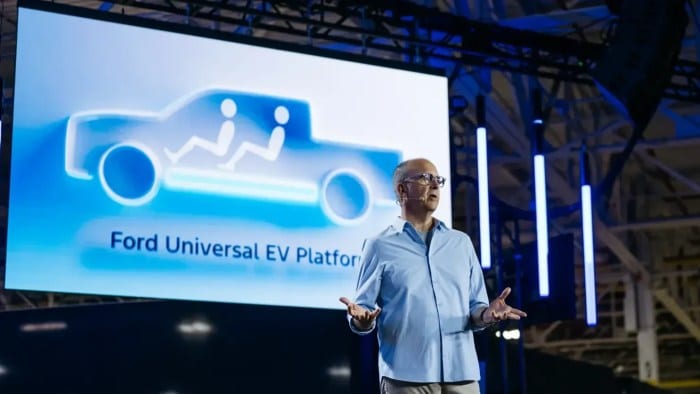
His tenure covered the development of the Universal EV platform, whose first model, the Fathom midsize pickup, is priced from $28,350 and due from Ford’s Louisville plant in 2027.
Field also laid out Ford’s plan in January for Level 3 “eyes-off” driving from 2028, built on in-house computing hardware.
The low-cost EV program grew out of a skunkworks team in Long Beach, California, run by former Tesla executive Alan Clarke, whom Ford promoted to Vice President of Advanced Development Projects in the April reshuffle.
“Lower battery costs will take time, so affordable EV’s must come from putting our best engineering and tech on our lowest-cost vehicles,” Field wrote on LinkedIn in February.
Ford’s Model e unit lost $4.8 billion in 2025, and the automaker expects a loss of about $4.0 billion for the unit this year.
A Career in Hardware
Field started his career at Ford as a development engineer in 1987, after studying mechanical engineering at Purdue University, and later earned a master’s degree from MIT.
He became the first hire at Segway, where he spent nearly a decade as Chief Technology Officer.
At Apple from 2008 to 2013, he led hardware development for the Mac, including the MacBook Air and MacBook Pro.
He joined Tesla in 2013 and rose to Senior Vice President of Engineering, overseeing development of the Model 3 before returning to Apple in 2018.
Apple has never confirmed the electric car project his Special Projects Group was widely reported to run.
Mind Robotics
Rivian disclosed Mind Robotics in its third-quarter shareholder letter in November 2025, saying it would use Rivian’s operations data “as the foundation for a robotics data flywheel.”
The company raised a $115 million seed round led by Eclipse, followed in March by a $500 million Series A co-led by Accel and Andreessen Horowitz.
A further $400 million round led by Kleiner Perkins in May took its total funding above $1 billion.
Mind Robotics has not disclosed its valuation, which The Wall Street Journal put at about $2 billion in March and about $3.4 billion in May.
The Palo Alto, California-based company says it is building foundation models, purpose-built robots and deployment infrastructure to automate industrial tasks.
It trains on video from Rivian’s active vehicle lines, and lists pick and place, sorting, fastening and connector assembly among the tasks it is targeting, according to its website.
It has not published images of its robots.
The company expected to reveal its first product in less than a year, CNBC reported in June.
Scaringe has argued that factory robots do not need to copy the human body, telling TechCrunch in March that many humanoid systems are “way too complex relative to what they do.”
“The work happens with the hands,” he said in the same interview, adding that everything else in a robotic system is there “to get the hands to the right place.”
That puts Mind at odds with rivals such as Tesla, whose Chief Executive Officer Elon Musk has said he expects to sell the Optimus humanoid to the public by the end of 2027.
Rivian’s Stake
Rivian owned 32.1% of Mind Robotics on a shares-outstanding basis at the end of June, according to its quarterly filing.
It consolidated the company until March, when it began accounting for the stake under the equity method and booked a $506 million gain, valuing its retained interest at about $569 million.
The May round diluted Rivian further, the filing showed.
Rivian is Mind’s first customer and launch partner, providing what the company calls a live, high-volume manufacturing environment to train and deploy its models.
A Mind Robotics job listing posted in June seeks a Forward Deployed Engineer to work “onsite at a key customer in Normal, IL,” starting with robot data-collection devices before moving to robot deployment support.
Normal is home to Rivian’s only EV manufacturing plant.
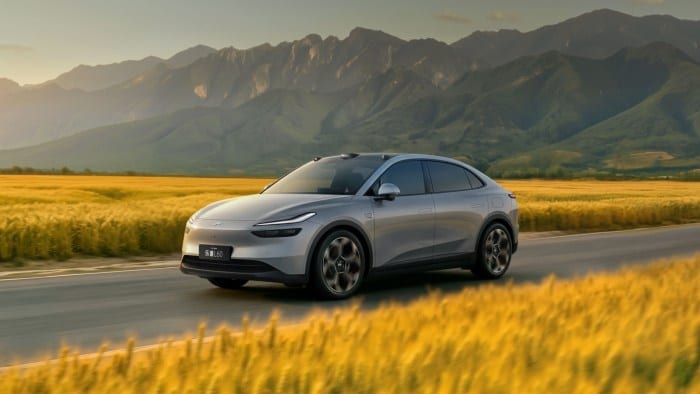
Mind Robotics is the second company Rivian has spun out, after the micromobility business ALSO, which became independent in 2025 and in which Rivian held a 35.3% stake at the end of June.
Scaringe had hinted at the robotics push weeks after Mind’s launch, saying Rivian had “other things we’re doing in the vision-based robotic space”.
Mind Robotics has not named any other executives publicly.