
Ford Motor Company‘s May US vehicle sales remained well below last year’s levels, with EV registrations falling for the eighth consecutive month.
Data published by the Detroit automaker on Wednesday showed sales of 190,828 units in May — a 13.6% decline year over year — despite the delivery increase of roughly 12,000 units sequentially.
Steeper declines continued in electrified powertrains, as the company adjusts its lineup following the halt of EV incentives last year.
The incentive cut led several automakers to turn back towards hybrids and internal combustion engine (ICE) vehicles.
Ford sold 3,769 EVs last month, a 43.9% decline year over year. Compared to April, registrations rose by 3.1%.
May’s drop marks a moderation from the first quarter’s 69.6% year-over-year decline, though volumes remain well below 2025 levels.
Year-to-date EV registrations totaled 14,284 through May, down 58.2% from 34,132 in the first five months of 2025.
Total vehicle sales between January and May stood at 826,810, a decline of 11.2%.
EV Business
Ford‘s electric vehicle business has undergone several changes in recent months — as the company continues to manage the fallout from the federal EV tax credit’s termination on September 30.
In December, the automaker announced approximately $19.5 billion in charges tied to the rationalization of its EV manufacturing capacity and product roadmap.
The changes included the cancellation of three previously planned EVs — a full-size pickup, a commercial van for the US, and a commercial van for Europe — and the end of production of the fully electric F-150 Lightning.
Still, year-to-date losses in EV sales were spread across the lineup.
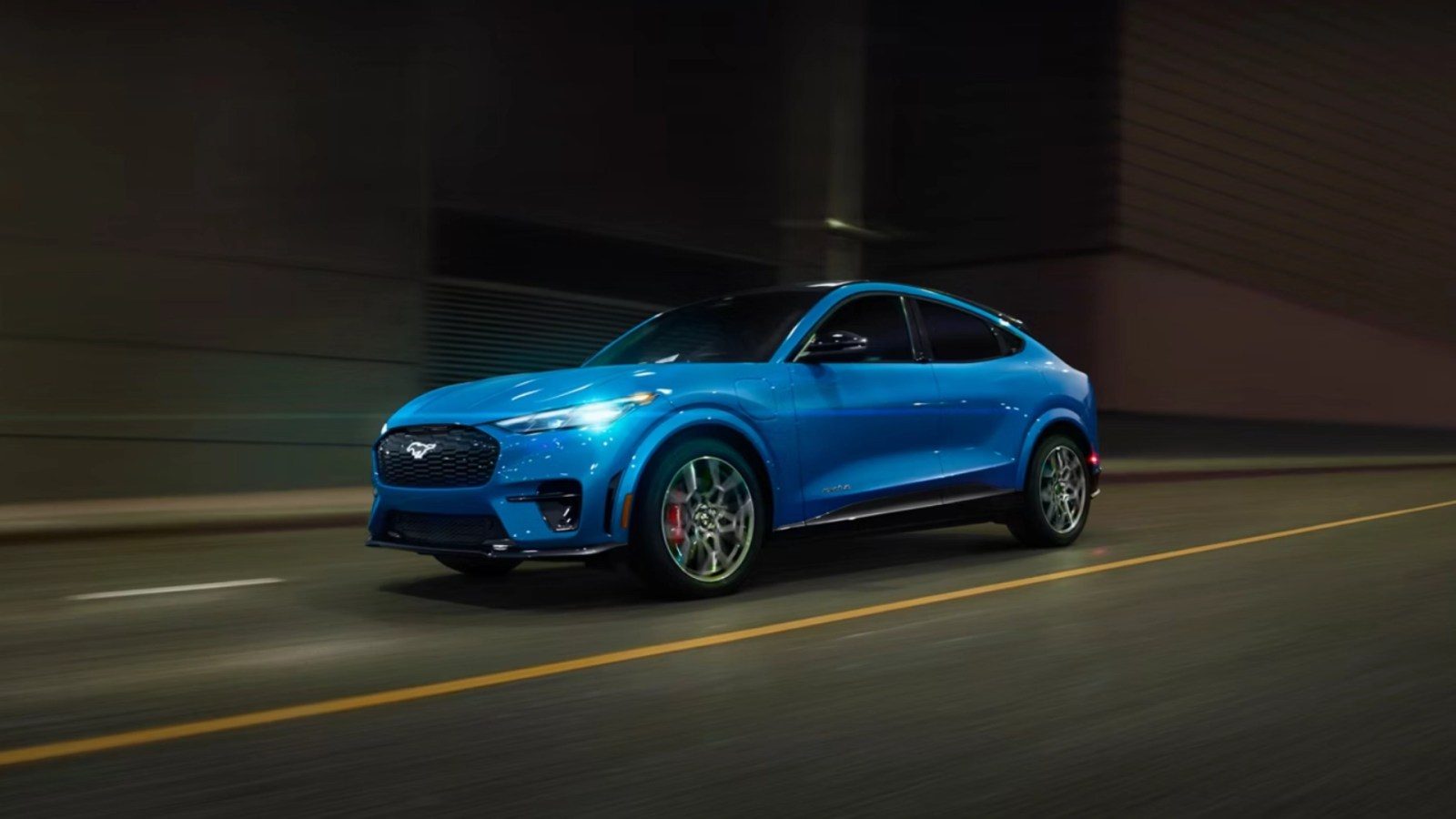
The Mustang Mach-e saw a 44.0% sales decline in May, when compared to the same period a year ago. Between January and May, the model accounted for 9,917 vehicles sold — nearly half (48.5%) of the first five months of 2025.
The EV unit ‘Model e’ recorded $4.8 billion in losses for the full year of 2025, with Chief Financial Officer Sherry House forecasting an additional $4 to $5 billion in losses in 2026.
Earlier this year, the CFO warned that the company did not expect ‘Model e’ to turn profitable until 2029.
More recently, the company announced the merging of its Electric Vehicle, Digital and Design team with its global Industrial System.
Ford called the integration a key lever in achieving its Ford+ objectives, including its target of an 8% adjusted EBIT margin by 2029.
As part of the changes, Doug Field — who led Ford‘s shift to electrified, connected vehicles — left the company.
Long Beach EV Skunkworks
Ford recently invited media to tour its Electric Vehicle Development Center in Long Beach, California — offering the first inside look at the 350-person hub where its next-generation affordable EVs are being designed and tested.
The facility is central to the automaker’s Universal Electric Vehicle (UEV) platform, a clean-sheet architecture that will underpin a midsize electric pickup truck priced around $30,000.
Production is set to begin at the Louisville Assembly Plant in 2027.
The Long Beach campus began as a confidential project around 2022, staffed by a small team assembled by Alan Clarke, a former Tesla executive with 12 years of experience who now serves as VP of Advanced Development Projects.
The group drew talent from Rivian and Lucid Motors, as well as aerospace firms, operating with a mandate to rethink how Ford designs and builds electric vehicles.
CEO Jim Farley described the UEV project as a “Model T moment” for Ford, framing the broader competitive landscape in existential terms.
Ford is investing approximately $5 billion in the UEV program, including a $2 billion upgrade to the Louisville Assembly Plant.
By 2030, Ford expects 90% of its vehicles by volume to feature updated electrical architectures, in-house user experiences, and next-generation over-the-air updates.
Nearly 90% of Ford‘s global nameplates will offer electrified powertrains by the same date, spanning hybrids (HEV), extended-range electric vehicles (EREV), and full battery electric vehicles (BEV).
Kentucky Plant Pivot
Also in May, the automaker formally assumed a $3.8 billion loan from the US Department of Energy tied to its battery manufacturing plant in Kentucky — marking the final step in Ford‘s exit from its BlueOval SK joint venture with South Korean battery manufacturer SK On.
Ford‘s wholly owned subsidiary, Ford Energy Battery LLC, acquired the Kentucky plant assets as part of the deal.
The DOE loan carries a fixed interest rate of 4.814% per annum, with principal and interest payments beginning in April 2030 through a final maturity date of July 2040.
Ford is converting the plant to manufacture battery energy storage systems (BESS) — large-scale units designed for data centers, utilities, and commercial customers.
The company plans to invest approximately $2 billion to retool the plant and expects to deploy at least 20 gigawatt-hours of storage systems annually by late 2027.
Additionally, it aims to hire about 2,100 workers for the new production line — following the layoff of approximately 1,600 BlueOval SK employees during the transition.
Stock Rally
Ford shares climbed to their highest level since January 2022 on May 29, rising to a four-year high of $17.78. The stock nearly doubled from a 52-week low of $9.42 set in June 2025.
The rally was fueled in part by Ford‘s first-quarter 2026 results, which showed revenue of $43.3 billion, net income of $2.5 billion, and adjusted EBIT of $3.5 billion — boosted by a $1.3 billion one-time benefit following the US Supreme Court’s invalidation of tariffs imposed under the International Emergency Economic Powers Act.
Ford raised its full-year adjusted EBIT guidance to $8.5 billion to $10.5 billion.
UBS maintained a Buy rating on the stock, citing a credible path to earnings per share above $2 by 2027.
Goldman Sachs recently set its price target at $13, while reiterating a Neutral rating.
Analyst Mark Delaney said the firm expects auto OEMs and suppliers to post softer results this quarter, noting that rising costs and weak sales weigh on Ford.
As of press time, the automaker’s shares were trading 1.6% down at $15.90 on Wednesday’s market session.