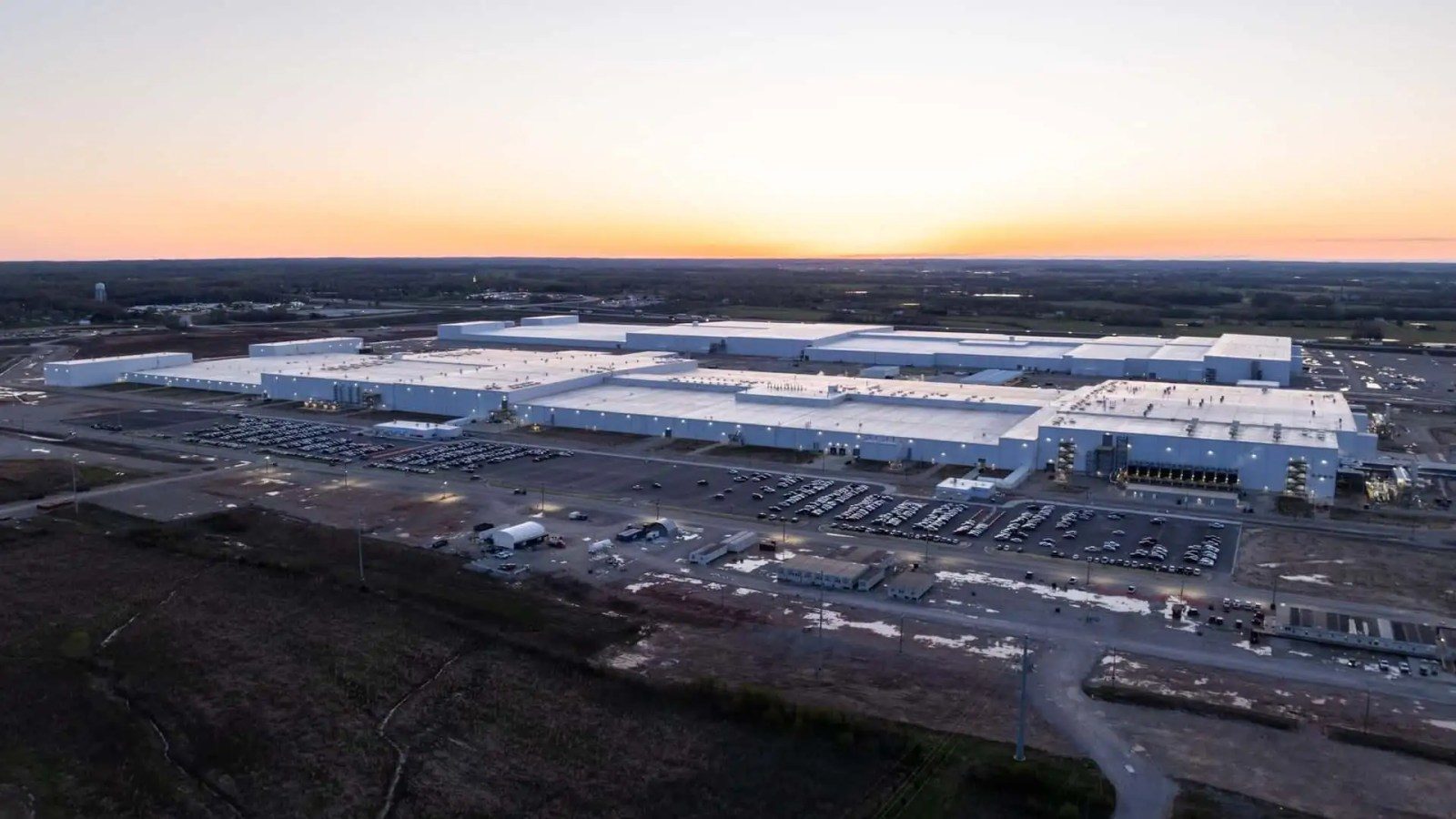

Ford Motor Company has formally assumed a $3.8 billion loan from the US Department of Energy (DOE) tied to its battery manufacturing plant in Kentucky, the company said in a new filing with the Securities and Exchange Commission (SEC).
The transaction marks the final step in Ford’s exit from its BlueOval SK joint venture. Until late last year, the factory was jointly operated with South Korean battery manufacturers SK On
The company’s wholly owned subsidiary, Ford Energy Battery LLC, acquired the Kentucky plant assets as part of the deal.
Loan Terms
The DOE loan carries a fixed interest rate of 4.814% per annum and Ford will make quarterly interest-only payments through January 15, 2030.
Principal and interest payments will then begin on April 15, 2030, and run through the final maturity date of July 15, 2040.
The structure gives Ford roughly four years of breathing room before it must begin repaying the $3.8 billion balance.
Under the loan agreement, the company must maintain at least $4 billion in available liquidity at all times.
Default triggers include cross-payment defaults on debt exceeding $1 billion, bankruptcy of Ford or significant guarantors, and US court rulings against Ford exceeding $100 million individually or $200 million in aggregate.
Joint Venture Dissolution
As part of the dissolution, Ford‘s obligation to contribute up to $6.6 billion in capital to BlueOval SK over five years ending this year was terminated.
The Detroit automaker was also released from its guarantee obligations under the original joint venture loan structure.
BlueOval SK had originally received $9.63 billion in total advances from the DOE under the Advanced Technology Vehicles Manufacturing (ATVM) loan program.
The loan — finalized in December 2024 — was at the time the largest ever granted under the ATVM program.
It was earmarked for the construction of three battery manufacturing plants: two in Kentucky and one in Tennessee.
Ford and SK On announced the dissolution of BlueOval SK in December 2025.
Under the split, Ford took full ownership of the Kentucky facilities through Ford Energy Battery LLC, while SK On assumed control of the Tennessee plant.
The DOE restructured and reduced the overall loan to reflect the new ownership arrangement, trimming the total to lower taxpayer exposure.
Ford‘s $3.8 billion portion represents the post-restructuring amount allocated to the Kentucky assets.
The BlueOval City campus in Stanton, Tennessee — originally planned as a site for next-generation electric F-Series trucks — will be renamed the Tennessee Truck Plant and produce gas-powered truck models starting in 2029 under SK On’s operational control.
From EV Batteries to Energy Storage
The Kentucky plant will not produce batteries for electric vehicles, however, as Ford is converting the facility to manufacture battery energy storage systems (BESS) — large-scale units designed for data centers, utilities, and commercial customers.
The company launched a new subsidiary, Ford Energy, earlier this year to run the business. Lisa Drake was appointed president of the unit.
Ford Energy’s flagship product is the DC Block, a standardized 20-foot containerized battery energy storage system built around 512 amp-hour lithium iron phosphate (LFP) prismatic cells.
The company plans to invest approximately $2 billion over the next two years to retool the plant and expects to deploy at least 20 gigawatt-hours of storage systems annually by late 2027.
Additionally, the automaker aims to hire about 2,100 workers for the new production line — following the layoff of approximately 1,600 BlueOval SK employees during the transition.
Ford’s Broader EV Restructuring
The BlueOval SK dissolution and Kentucky pivot are part of a wider pullback from Ford‘s original EV ambitions.
Late last year, the company announced a $19.5 billion write-down related to its electric vehicle strategy.
By then, Ford said it would restructure its EV business to focus on lower-cost models built on a new Universal EV Platform.
The Detroit automaker discontinued production of the all-electric F-150 Lightning, after demand softened following the expiration of the $7,500 federal EV tax credit by the end of the third quarter.
Ford‘s EV sales fell 69% year-over-year in the first quarter of 2026, extending the steepest decline in the company’s EV history.
The ‘Model e’ electric vehicle division posted a loss of $777 million in the first quarter of 2026, an improvement from $849 million a year earlier.
Ford expects Model e to lose between $4 billion and $4.5 billion for the full year and does not anticipate profitability for the unit until 2029.
Last month, Ford again restructured its EV business, merging its Electric Vehicle, Digital and Design team with its global Industrial System.
The company announced at the same time the exit of Doug Field — who joined Ford nearly five years ago to lead its shift to electrified, connected, and software-defined vehicles.
DOE Loan Restructurings
Ford is not the only automaker to renegotiate federal financing for a battery or EV facility in recent months.
Rivian renegotiated its DOE loan for the under-construction Georgia plant in late April, reducing the total from the original $6.57 billion — finalized under the Biden administration in January 2025 — down to $4.5 billion.
The revised terms consolidated what had been a two-phase production plan into a single phase with an increased capacity of 300,000 vehicles annually, up from the original 200,000-unit first phase.
Rivian plans to begin drawing on the loan in early 2027, a year ahead of schedule. Production of the R2 electric SUV at the Georgia facility remains on track for late 2028.
Both restructurings reflect the broader recalibration of EV-related government lending under the current administration, which has moved to scale back federal support for electric vehicle and battery production.
Automakers continue battling to align manufacturing capacity with real-world demand for electric vehicles.