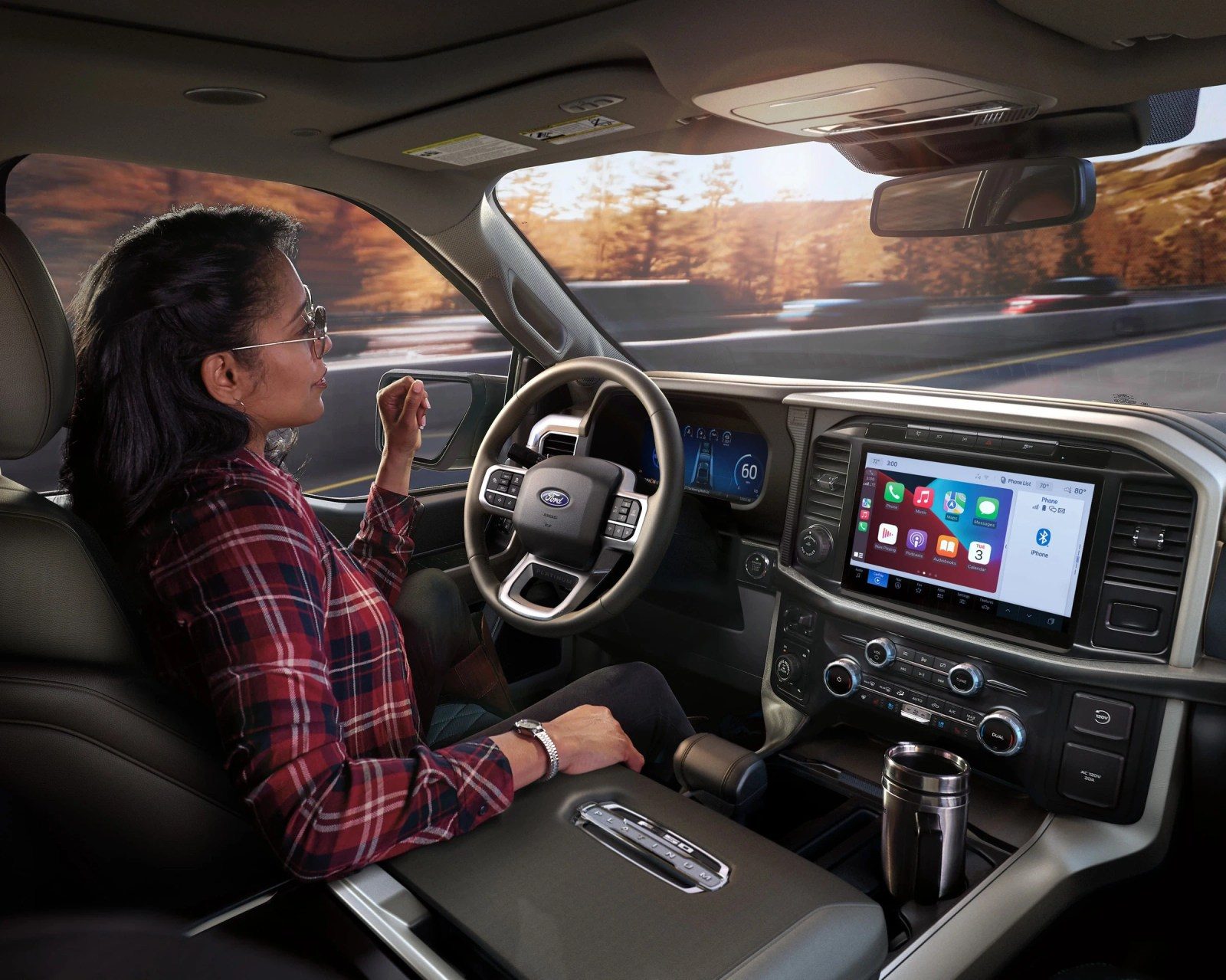

Ford Motor Co.’s Chief Executive Officer Jim Farley said on Tuesday that paid BlueCruise subscriptions grew 20% in the second quarter of 2026 — calling the hands-free highway driving system the company’s “best proof point for software” on the retail side.
Farley told analysts on the second-quarter earnings call that BlueCruise now accounts for 50% of Ford‘s retail Integrated Services revenue.
RBC analyst Tom Narayan prompted the disclosure by asking how BlueCruise contributes to Ford‘s financials, and whether the Apple Maps integration announced last week could expand beyond the upcoming Universal Electric Vehicle (UEV) platform.
Farley responded by pointing to the revenue management capability around the software as an area of growing strength.
Cumulative hands-free driving hours surpassed 12.1 million since launch, with the BlueCruise reaching 840 million miles driven, a figure Farley described as approaching one billion.
“We’re approaching a billion miles, 840 million miles now on BlueCruise,” the CEO stated. “It’s something that our dealers are getting better at selling.”
BlueCruise is available at $49.99 per month, $495 per year, or a one-time purchase of $2,495.
Eligible vehicles span five Ford lines — the F-150, F-150 Lightning, Expedition, Explorer, and Mustang Mach-E — as well as Lincoln models including the Aviator, Corsair, Nautilus, and Navigator.
Numbers Undisclosed
The company did not specifically disclose the number of BlueCruise subscriptions (either active/on the road or total) in its Q2 earnings presentation.
Total paid software subscriptions across Ford reached approximately 1.6 million, a roughly 50% year-over-year increase — which includes more than 900,000 Ford Pro Intelligence subscriptions alongside the consumer-facing BlueCruise base.
At the company’s CES 2026 presentation in January, Ford disclosed that 1.22 million vehicles globally carried BlueCruise hardware, and the system’s usage rose 88% in 2025 compared to the prior year.
Apple Maps
Narayan’s question about the Apple Maps partnership drew a response from Farley that went well beyond navigation.
Apple and Ford announced last week that Apple Maps will be embedded into the UEV platform through Apple‘s MapKit for Automotive SDK, making Ford the first automaker to integrate the mapping service natively into a vehicle’s infotainment system.
The UEV platform is due to debut in 2027 with a midsize electric pickup truck targeted at approximately $30,000.
Farley acknowledged the partnership but pivoted quickly to the broader significance of the UEV architecture.
While noting that “for sure it could” be integrated in other Ford vehicles,” though the company has not “made any announcements,” Farley highlighted that “the big story there for Ford is the transformation of our electric architectures.”
He said the platform carries a fully zone electric architecture with Ford‘s own software, a detail he argued had not yet been covered in the media.
“In fact, the ADAS solution, and the integration Apple Maps, are going to be mostly Ford efforts,” Farley stated, adding that it’s “a major step forward for our customers. I think that’s strategically the most important thing. We still continue to see great revenue growth on BlueCruise.”
New-generation products built on the platform will feature what Farley described as a massive upgrade to Ford‘s electric architectures, with a large portion of the software stack developed internally.
Farley added that he considers the in-house software development the most strategically important element of the UEV platform, ahead of any single supplier partnership.
Latitude AI, Ford‘s wholly owned autonomy subsidiary of approximately 600 machine learning, robotics, and software specialists, is developing the Ford Large Driving Model to support a range of self-driving capabilities on the UEV platform.
Apple Maps road-level data will feed into that work, enabling Latitude AI to build what Ford has called a seamless hands-free driving experience.
The UEV will launch with Level 2 hands-off capability in 2027, including ramp-to-ramp, off-ramp to on-ramp functionality that Farley said no competitor offers at the platform’s price point.
Ford has targeted Level 3 eyes-off driving for 2028 on the same architecture, using LiDAR.
In 2024, the CEO said the company was only two years away [2026] from reaching “hands and eyes off” capabilities.
Competitors
Ford‘s BlueCruise growth sits against a backdrop of rapidly expanding subscription-based driver assistance across the industry.
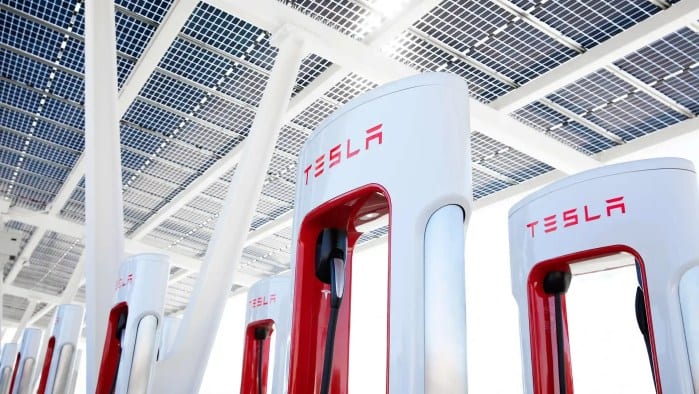
Tesla reported during its own Q2 earnings call last week that active Full Self-Driving subscriptions reached 1.48 million, a 56% year-over-year increase.
More than 55% of new North American deliveries included an FSD subscription at the time of purchase, a record attach rate.
Tesla charges $99 per month for the software after eliminating the upfront purchase option in February 2026, generating an estimated $1.76 billion in annualised recurring revenue at the current subscriber count.
Cumulative miles driven on FSD (Supervised) approached 12 billion by the end of the quarter, dwarfing BlueCruise’s 840 million.
Rivian launched its Autonomy+ subscription earlier this year, priced at $49.99 per month or a $2,500 one-time purchase — nearly identical to BlueCruise’s pricing structure.
The package includes Universal Hands-Free driving on more than 3.5 million miles of US and Canadian roads with visible lane markings, plus Lane Change on Command on divided highways.
Rivian is developing a custom 5nm autonomy processor, the RAP1, and a Gen 3 hardware suite with LiDAR for the R2 crossover, which it has said will carry the most powerful combination of sensors and inference compute in consumer vehicles in North America at launch in late 2026.
General Motors, Ford‘s closest domestic rival, is pursuing a different scale.
GM‘s SuperCruise service is expected to add another one million subscribers in 2026, reaching nearly 13 million by year-end, with recognized software revenue of $800 million in Q2 alone — a 20% year-over-year increase.
Q2 Results
Farley told analysts on the call that Ford still expects to see strong revenue growth on BlueCruise and that the cost of the system will come down as the functionality increases.
“The cost is going to come down, the functionality will go up,” he stated. “Even the UEV is going to have a ramp-to-ramp, off-ramp to on-ramp, L2 capability, which no one in that segment at that price point has anything close to that.”
He described the Integrated Services business, of which BlueCruise forms the largest retail component, as capable of contributing roughly half a percentage point to the company’s EBIT margin over time.
The BlueCruise subscription gains arrive at a complicated moment for Ford‘s broader electric vehicle strategy.
The company’s ‘Model e‘ division reported a $919 million loss in the second quarter on revenue of $1.0 billion, a 56% decline, as wholesales fell 53.3% to 28,000 units.
BlueCruise operates across Ford‘s gas-powered, hybrid, and electric powertrains, meaning its revenue base does not depend on the EV transition that has been costing the company billions.
The Detroit automaker reported adjusted EBIT of $2.5 billion in Q2 on revenue of $48.3 billion, beating the consensus earnings estimate of $0.35 per share with adjusted EPS of $0.42.
Management raised full-year adjusted EBIT guidance to $10.0 billion to $11.0 billion, from a prior range of $8.5 billion to $10.5 billion.
As of press time, Ford shares were jumping nearly 6% at $15.83 on Wednesday’s pre-market session. The stock closed 1.9% higher at $14.96 on Tuesday.