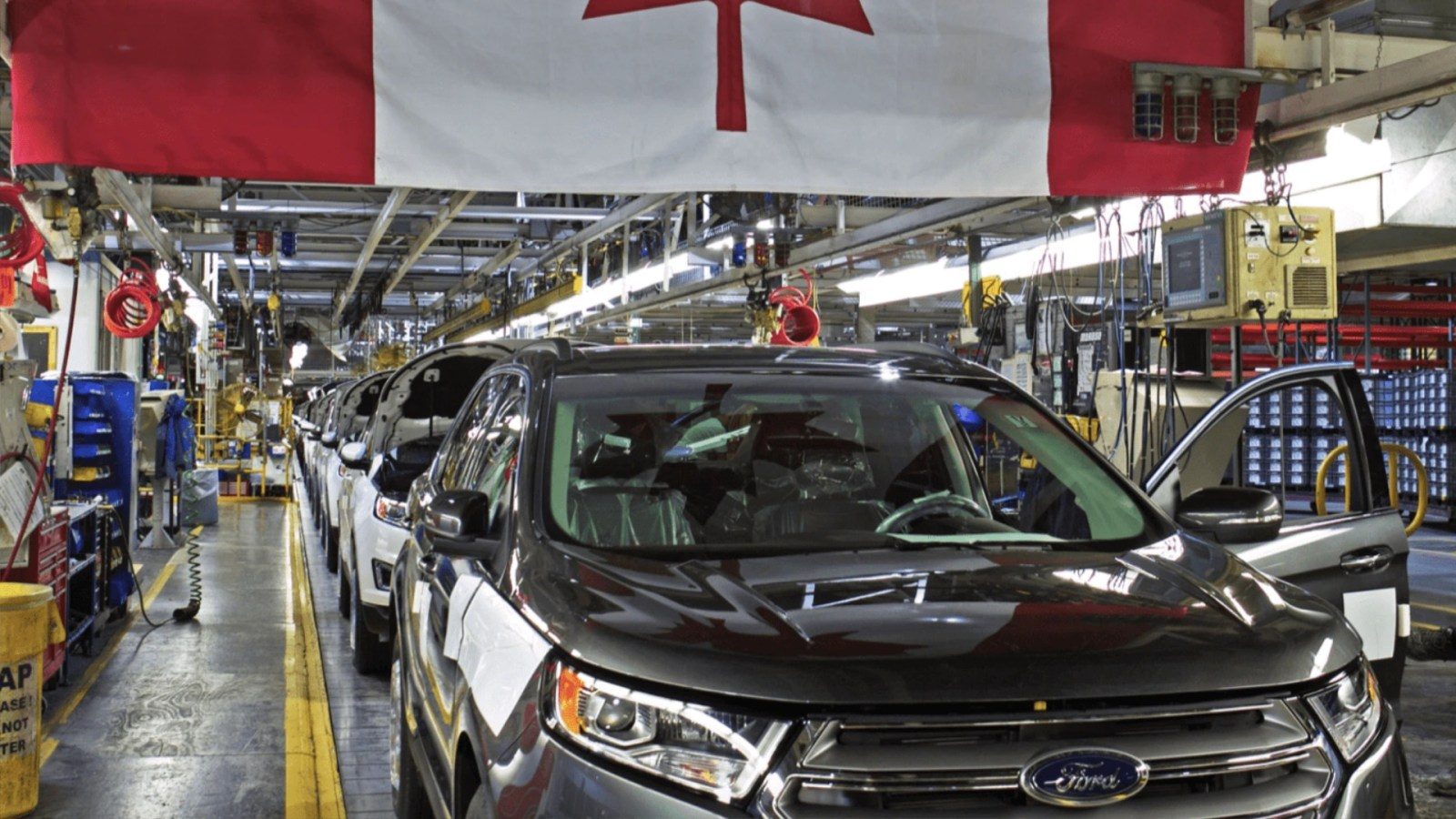

Canada is providing Ford Motor Co. with C$464.5 million (US$340.4 million) to retool its Oakville Assembly Complex in Ontario for production of heavy-duty pickup trucks, according to a grant notice first reported by The Logic.
Effective since March 30, the grant supports the Detroit automaker’s plan to produce up to 100,000 F-Series Super Duty trucks annually at the plant west of Toronto and to build a metal stamping facility at the site by 2029.
The plans have now differed from Ford‘s original C$1.8 billion plan — announced in April 2023 — to convert the facility into what would have been called the Oakville Electric Vehicle Complex, producing a family of next-generation EVs.
The factory, which has been closed for retooling since 2024, is expected to employ 1,800 people when it reopens later this year.
Ford confirmed to Driving.ca on Thursday that employees are already returning to the facility, with activity ramping up over the past several weeks as workers undergo training, take up positions, and begin initial test builds.
The automaker said it is aiming to have the production line running before the end of 2026, though it declined to share specific hiring figures.
From EVs to Super Duty
The Oakville plant previously manufactured the Ford Edge and Lincoln Nautilus.
Both the Ontario and federal governments had committed $295 million apiece to support that EV transformation, which Ford framed at the time as central to its electrification strategy.
About 3,000 workers were laid off when the plant shut down.
But as EV sales growth slowed across North America, Ford halted the EV plan in July 2024.
The automaker then announced it would instead invest $2.3 billion to produce gasoline and diesel Super Duty trucks — the F-250, F-350 and F-450 — at Oakville.
Ford said then that its Ohio Assembly Plant and Kentucky Truck Plant were operating at full capacity and were unable to meet rising demand for the highly profitable heavy-duty lineup.
North America Manufacturing
The five major automakers producing locally — GM, Stellantis, Ford, Honda and Toyota — have used their manufacturing footprint in Canada mostly for exports, the majority to the United States.
Under the United States-Mexico-Canada free trade agreement, through which a deeply integrated supply chain has been established between the three North American countries, 90 to 96% of vehicle production in Canada went to the US.
The scenario began changing last year.
Canadian Prime Minister Mark Carney has identified the auto industry as one of three sectors hardest hit by US tariffs — and the scenario at the upcoming, mandatory review of the US-Mexico-Canada Agreement is not favourable either.
Since US President Donald Trump imposed 25% tariffs on the non-US content of Canadian-made vehicles in April 2025, General Motors has cut 750 jobs at its Oshawa, Ontario plant and shifted pickup truck production volumes to the United States.
Stellantis redirected planned Jeep Compass production from its Brampton, Ontario facility to Belvidere, Illinois, leaving approximately 3,000 Unifor-represented workers furloughed.
GM also halted BrightDrop electric delivery van production at its CAMI Assembly plant in Ingersoll, Ontario, affecting more than 1,000 jobs.
Ottawa responded by cutting remission quotas — the tariff-free import allocations tied to domestic production commitments — by 50% for Stellantis and 24.2% for GM.
The government has also threatened to sue Stellantis to recover up to $529 million in subsidies tied to the Brampton plant.
Vehicle output at Ontario’s auto plants fell to 1.2 million units in 2025 from 2.3 million in 2016, according to the Trillium Network for Advanced Manufacturing — a decline driven largely by reduced volumes at factories owned by Ford, GM and Stellantis.
EV Investment Plans
Ford‘s pivot from EVs to trucks at Oakville is part of a broader pattern across the Canadian auto sector.
Japanese media outlet Nikkei reported earlier this week that Honda Motor Co.‘s C$15 billion EV manufacturing complex in Alliston, Ontario — which was to include a new EV assembly plant, battery facility, and cathode processing operations — has been effectively frozen.
The execution timeline for the project has been suspended for roughly a year.
In reaction to the report, however, the Canadian government reaffirmed that the company had not confirmed a definite halt, with the PM saying Canada is in “constant discussions” with Honda over the investment.
Industry Minister Joly has separately signaled that automakers maintaining or increasing domestic production would be rewarded with greater market access — mentioning Honda and Toyota by name when discussing the remission quota framework.
Honda produced just over 400,000 vehicles in Canada last year, making it the country’s second-largest automaker by volume after Toyota.
Its Alliston facility currently employs 4,200 workers building gas-powered and hybrid versions of the Civic and CR-V.
Part of the Auto Strategy
Meanwhile, Canada has pursued a trade deal with China that allows up to 49,000 Chinese-built EVs into the country at a 6.1% tariff — replacing the 100% surtax imposed in 2024.
BYD, Chery, and Geely are all preparing for Canadian market entry by year-end.
The Government aims for Chinese companies to set up joint ventures with local manufacturers, setting up local production as a way to boost the domestic auto industry.
The Conservative opposition has pledged to scrap the quota and align Canada’s Chinese tariffs with the US, where a 100% duty on Chinese EVs remains in place alongside a ban on Chinese-made software and hardware in connected vehicles.
Despite its push for more affordable EVs — with new incentives in the mix — the Ford Oakville grant signals Ottawa’s willingness to support domestic manufacturing irrespective of powertrain.
Ford’s CEO on Canada
Ford‘s CEO Jim Farley has struck contrasting tones on Canada’s role in the automaker’s manufacturing network over the past several months.
At the Detroit Auto Show held last January, Farley emphasized the importance of the integrated North American supply chain.
“We really see Canada and Mexico and the U.S. as an integrated manufacturing system,” he told Reuters on the sidelines of the event. “And that’s how we’re going to approach this negotiation. Very critical for us, but we need revisions.”
Farley highlighted Canada’s importance for powertrain production and the new Oakville facility at the time, stating that the US “can’t walk away” from Canada and Mexico while calling the USMCA “critical” for Ford and the broader industry.
By April, however, Farley’s tone had shifted, as trade relations between the two countries tanked further.
In an appearance on Fox News, the CEO endorsed criticism of Canada’s decision to allow limited Chinese EV imports under the quota deal with Beijing.
When host Brian Kilmeade suggested Canada had “sold their soul to China,” Farley agreed, adding that he hoped the US would not allow those vehicles to cross the border.
“We should not let them into our country, because the economic impact… manufacturing is the heart and soul of our country,” Farley said in the same interview. “And for us to lose that… to those exports, would be devastating for our country. That doesn’t even include the cyber and privacy risk of a Chinese vehicle.”
However, just days after saying Chinese carmakers should be kept out of America, Farley said his company is looking to expand business ties to Chinese automakers.
“We value our Chinese partners, they help us stay sharp and compete in many markets around the world,” he stated. “We will continue to expand these partnerships.”