
The Japanese newspaper Nikkei reported on Tuesday that Honda Motor Co. is “set to freeze plans to build an electric vehicle factory” complex in Ontario — a C$15 billion investment for which the execution timeline has been suspended for a year now.
According to the report, sluggish US demand is pushing the Japanese automaker to put hybrids at the center of its North American strategy.
The plans for the plant were first announced in April 2024.
They included a new EV assembly plant with a capacity of 240,000 vehicles per year, a 36 GWh battery plant, and cathode material processing facilities through joint ventures with South Korea’s POSCO Future M and Japan’s Asahi Kasei.
All four factories were planned for Honda‘s existing site in Alliston, Ontario, where the company has manufactured vehicles since 1986. Production was originally targeted for 2028.
Besides Honda‘s C$15 billion investment, the company had C$5 billion in federal and provincial subsidies.
Last May, however, Honda announced it was suspending the program as it reassessed the tariff scenario and amid slower-than-expected EV demand in North America, saying it would revisit the timeline in 2027.
The Nikkei report signals the suspension is now indefinite, with cancellation not ruled out.
Honda Canada spokesperson Ken Chiu did not address the report directly, repeating a statement first issued a year ago.
“We have nothing to report at this time,” he said. “The company will continue to evaluate the timing and project progression as market conditions change.”
Ottawa Responds
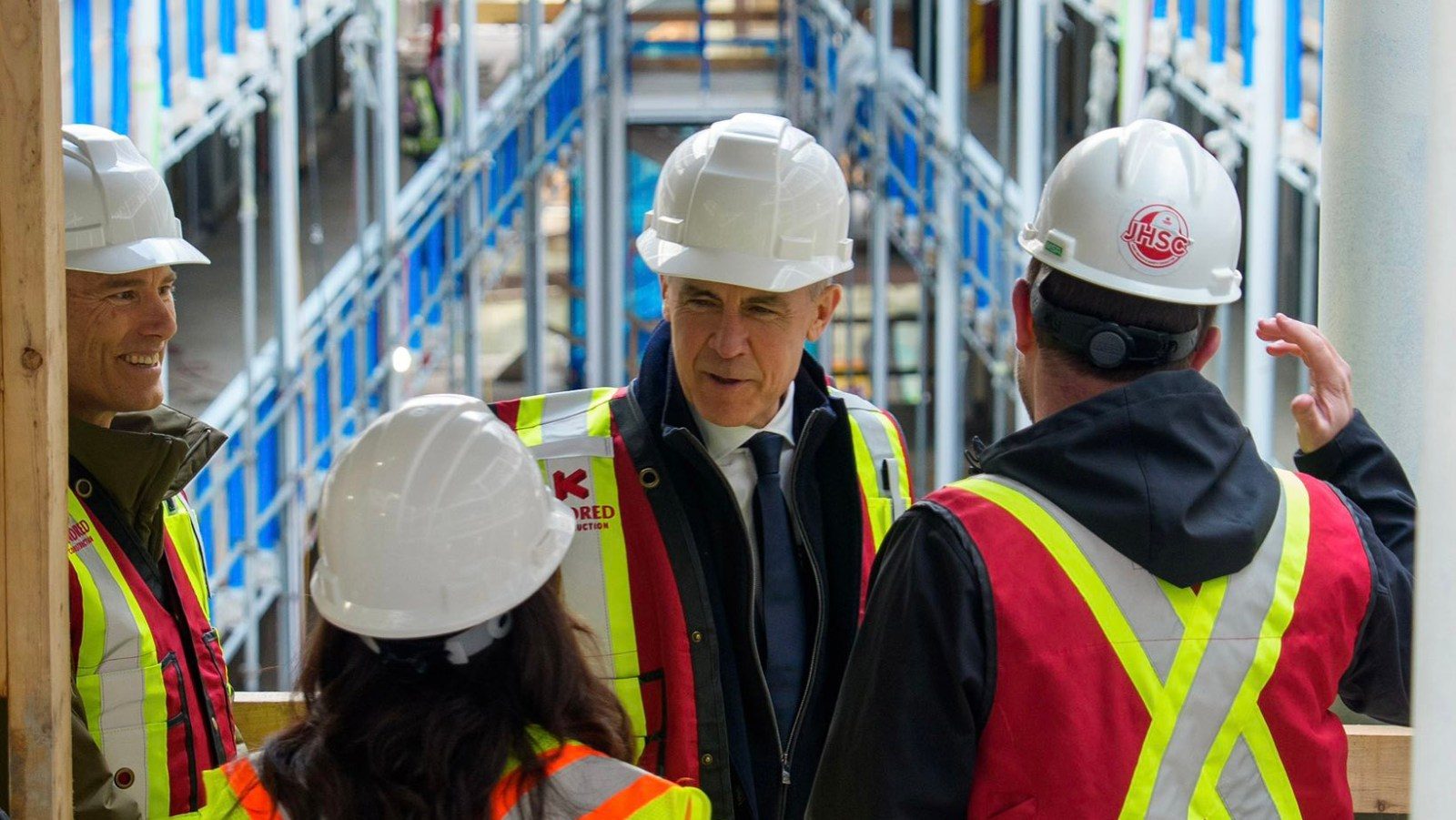
When questioned by a reporter on Wednesday whether the government had been informed of Honda‘s decision, Canadian Prime Minister Mark Carney said the Japanese automaker has not announced any official pause.
“First, we’re in constant contact with all the major automakers, actual, like in other words, currently producing in Canada, and potential,” the PM said, adding that it “includes Honda. We’re in discussions with them constantly.”
According to parliamentary secretary Karim Bardeesy, Industry Minister Mélanie Joly has been in contact with Honda.
“What’s happening is they’re communicating to us that they’re going to be in touch soon publicly with their medium- and long-term plans,” Bardeesy said.
Finance Minister François-Philippe Champagne also told CTV that the halt was not confirmed, despite suggesting the slowdown is a global trend.
“The word is ‘hold.’ It’s not unique to Canada. (…) If you look at what’s happening in Europe, what’s happening also in the United States,” Champagne said. “It’s just that the market has been shifting. If you ask my opinion, it’s been shifting a bit because of policies south of the border.”
Hours earlier, in a first reaction to the Nikkei report, Carney acknowledged that “there are challenges with the US tariffs, unjustified tariffs in the auto sector.”
Ontario Economic Development Minister Vic Fedeli also stated on Wednesday that no public funds have gone to Honda and none would be disbursed unless the project goes ahead.
Speaking after question period in Toronto, he said the automaker has given assurances of its commitment to Canada.
What’s at Stake
Honda is one of five major automakers producing vehicles in Canada — which also includes the three Detroit companies Stellantis, General Motors and Ford, and Japanese manufacturer Toyota.
All five benefit from tariff-free import quotas under Canada’s US Surtax Remission Order, which allows them to bring in a set volume of US-made, USMCA-compliant vehicles without paying Canada’s 25% counter-tariff.
The quotas are contingent on maintaining domestic production levels and following through on planned investments.
The framework has been applied as a disciplinary tool against automakers that scaled back their Canadian footprint.
Last October, the government cut Stellantis’s quota by 50% after the company abandoned plans to reopen its Brampton, Ontario assembly plant, and cut GM‘s quota by 24.2% following the closure of its BrightDrop electric delivery van plant in Ingersoll, Ontario and reduced output at the Oshawa facility.
Both redirected production to the United States amid the tariff escalation.
Conversely, in February, Canada raised the quota for an unnamed automaker after stronger-than-expected domestic production.
When asked, Joly mentioned Honda and Toyota without confirming which company had applied.
“When Honda and Toyota increase their production in Canada, we will make sure that they have greater market access. Period,” the Industry Minister said.
Honda produced just over 400,000 vehicles in Canada last year, making it the country’s second-largest automaker by volume after Toyota.
Its Alliston facility currently employs 4,200 workers building gas-powered and hybrid versions of the Civic and CR-V.
The company has previously said employment at the existing plant will not be affected by the EV project freeze.
Last May, upon announcing the delay of the EV factory, Honda also announced it would shift part of its production of the popular CR-V model intended for the US market to Ohio because of tariffs.
At the same time, the company redirected CR-Vs for other markets to Alliston to maintain full capacity at the Canadian facility.
Investment in Canada
Speaking at an event in Quebec on Wednesday, the Prime Minister framed Canada’s attractiveness to foreign investors more broadly.
“How do we convince companies to invest in Canada? A couple of things. One is, our country has twice the rate of investment, foreign direct investment, than the United States, adjusted for the size of our population,” Carney said.
According to the PM, Canada is seeing the “highest level of foreign direct investment” in 20 years.
To continue to convince and increase that investment, Carney highlighted the several trade deals his Government has been agreeing to in the past few months.
“Connectivity, those trade deals, those 20 deals, the deal with ASEAN, the deal with India, moving forward like that,” he noted.
The remarks come as Ottawa works to diversify its auto partnerships beyond traditional North American players.
These include a trade deal with China that allows up to 49,000 vehicles to enter Canada at a lowered tariff of 6.1% per year, through which the government aims to sell more affordable electric vehicles.
Industry Minister Joly has separately pushed for Chinese EV joint ventures with Canadian manufacturers such as Magna International to supply global markets from Canadian plants.
“Confidence … bold action, this is the time to be bold,” Carney stated. “To have confidence, move forward, open up, that’s what we’re doing, and we’ll continue to get that investment, despite the efforts of the Americans.”
As the USMCA (US-Mexico-Canada Agreement) renegotiations approach in July, the relations between US and Canada continue to face strain over trade disputes, industrial policy, and tariff concerns.
Honda’s EV Retreat
The Canadian plant freeze is the latest in a series of moves that have effectively dismantled Honda‘s electrification strategy in recent months.
In March, Honda announced a major restructuring that included cancelling three EV models planned for the North American market — two from its flagship 0 Series and the Acura RSX — which were supposed to anchor its US electric lineup.
The company took a writedown of up to 2.5 trillion yen ($16 billion) on its EV business, resulting in its first annual loss as a publicly listed company in nearly seven decades.
Honda also pulled the plug on the Afeela, the electric vehicle developed jointly with Sony that was set to start at $90,000.
The Prologue — a GM Ultium-based SUV that Honda did not engineer itself — is expected to cease production as early as the second half of this year, with sales ending once inventory is depleted.
The Acura ZDX, its sister model, was discontinued last year.
Honda‘s stated strategy now centers on hybrids for the near term.
The company plans to leverage its Ohio facilities to produce gasoline, hybrid, and EV models on shared lines, while its Ohio battery factory — originally built with LG Energy Solution for EVs — will now also support hybrid and energy storage production.
Affordable EVs priced under $30,000 have been pushed to the end of the decade.