EVs are projected to account for just 7.0% of US retail new-vehicle sales in May, down 1.2 percentage points from the same month a year ago, according to a joint forecast from JD Power and GlobalData released on Thursday.
Plug-in hybrid (PHEV) share is also expected to drop by 0.7 percentage points to 1.3%.
The decline is still explained by the elimination of the federal $7,500 EV tax credit on September 30, 2025, which triggered a rush of purchases in the third quarter of last year and a sustained downturn since.
To compensate, automakers have been leaning heavily on discounting.
EV incentive spending is on track to reach $10,308 per unit in May — up 11.2% from a year ago and more than three times the $2,973 average for non-EV vehicles.
Hybrid vehicles (HEV) have been the main powertrain to benefit from these changes, while the share of internal combustion engine (ICE) is expected to remain flat at 75.0%.
HEV share is set to climb to 16.3%, up 1.6 percentage points year over year, as elevated fuel prices and expanding hybrid lineups from legacy automakers accelerate the shift.
The powertrain mix shift reflects a US auto market that is growing in overall volume — total new-vehicle sales for May are projected at 1.49 million units, a 5.8% increase from a year ago — while the composition of that growth has tilted away from fully electric powertrains.
JD Power‘s President of OEM Solutions Thomas King noted that the overall results “reinforce the underlying strong demand for new vehicles,” with the annualized selling rate climbing to 16.3 million units.
He noted, however, that year-over-year comparisons have been “clouded by what happened a year ago when consumers reacted to the perceived risk of higher prices from vehicle tariffs.”
Incentives and Affordability
The gap between EV and non-EV incentive spending has become one of the defining features of the current US market.
At $10,308 per unit, EV discounts are now 3.5 times the $2,973 average for combustion and hybrid vehicles.
King said EV incentive spending “continues to underscore the role of discounting in supporting demand for electric vehicles.”
Overall incentive spending per vehicle is trending toward $3,297, a 20.7% increase from May 2025.
However, King cautioned that the comparison is partly a product of last year’s tariff-driven distortions.
“Sales in March and April of last year were inflated as consumers rushed to showrooms and ‘pulled ahead’ their purchases,” King stated. “But by May, however, the pull-ahead had turned into ‘payback’, with an estimated 63,000 sales pulled out of May into the preceding months.”
While the payback effect “makes for a flattering year-over-year comparison,” it “in no way diminishes the impressive sales pace achieved,” the analyst added.
Incentives as a percentage of Manufacturer’s Suggested Retail Price (MSRP) are expected to hit 6.4% in May, up 1.0 percentage point from a year ago.
For non-EV vehicles specifically, average incentive spending is trending toward $2,973, a 23.6% increase — though King noted that there “were unseasonal pullbacks in incentive spending last May as OEMs reduced discounts precautionarily to offset tariff costs.”
On affordability, King noted financing conditions are improving but remain insufficient to offset deeper structural pressures.
EV Share Decline
The 1.2 percentage point year-over-year drop in EV share comes as EV makers and legacy automakers alike have been recalibrating strategy in response to the policy shift.
US EV sales fell 27% year over year in the first quarter of 2026, according to Cox Automotive’s Kelley Blue Book, which described the period as “a necessary reset.”
EV share of new-vehicle registrations sat at 5.8% in the first quarter, well below the 10.6% peak reached in the third quarter of 2025 — when buyers rushed to lock in the federal credit before its expiration.
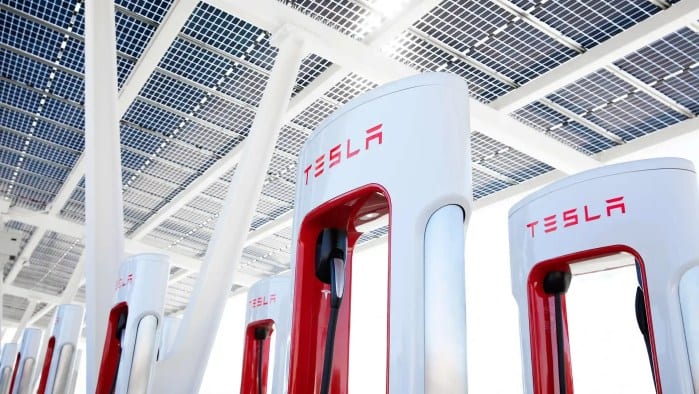
Tesla, still the dominant US EV seller with a 54.2% market share in the segment during the first quarter, delivered 358,023 vehicles globally in the first three months of the year.
Rivian began volume production of the R2 SUV at its Normal, Illinois plant last month, with customer deliveries expected in the coming weeks.
The company is targeting 20,000 to 25,000 R2 deliveries this year within a total guidance of 62,000 to 67,000 vehicles.
The Irvine-based EV maker beat first-quarter consensus with 10,365 deliveries.
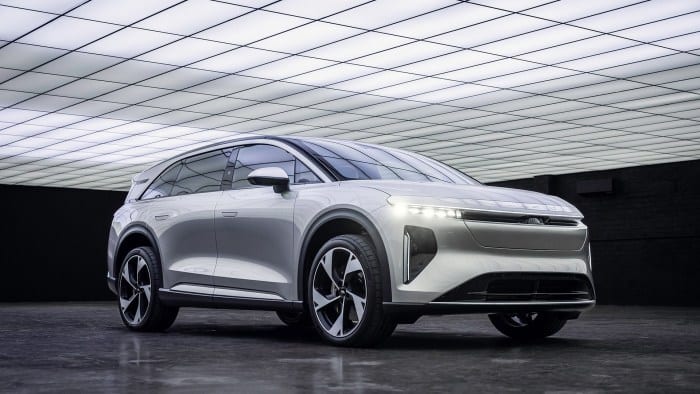
Lucid Motors reported deliveries of 3,093 vehicles globally in the first three months of 2026 — after a 29-day stop-sale on its Gravity SUV tied to a seat belt recall affecting nearly all vehicles produced.
The company recently produced its 50,000th vehicle and has labeled its 2026 production target “conservative”, while expanding an Uber robotaxi partnership to a potential 35,000 vehicles and $500 million.
Legacy Automakers Restructure
The broader legacy auto industry has been wrestling with the fallout from the credit’s expiration.
General Motors has recorded $7.6 billion in EV-related charges since mid-2025, driven by cancelled supplier contracts and production cuts, and is working to settle $4.2 billion in remaining cash payments by the end of the second quarter.
The company has temporarily idled Factory Zero and cut its EV workforce significantly.
GM‘s US EV sales fell 19% in the first quarter, though CEO Mary Barra has maintained that EVs remain part of the company’s long-term strategy.
Recently, CFO Paul Jacobson highlighted GM‘s affordability push as a priority.
“We sold last year over 700,000 vehicles at a starting price, approximately $30,000 or below,” the executive stated. “Being able to meet the consumer where they are, I think, is a recipe for success in times of uncertainty.”
Ford has been restructuring its EV business for the second time in less than a year, merging its EV unit with its global industrial system after a $19.5 billion writedown.
The company’s US EV sales plunged 70% in the first two months of the year following the cancellation of the F-150 Lightning.
EV losses are forecast at $4 to $5 billion for 2026. Ford does not expect its EV unit to reach profitability until 2029.
Stellantis, meanwhile, unveiled its €60 billion FaSTLAne 2030 strategic plan at its Investor Day in Auburn Hills, Michigan.
The plan concentrates 70% of investment on four global brands — Jeep, Ram, Peugeot, and Fiat — and includes more than 60 new vehicle launches across battery-electric, hybrid, and combustion powertrains by 2030.
Filosa said last week that “the US is adopting electrification more slowly” than Europe, framing the company’s powertrain approach as a market-by-market strategy.
Stellantis took a €22 billion hit earlier this year, similar to those reported by the other two Detroit automakers, as it restructured its EV business.
“The charges announced today largely reflect the cost of over-estimating the pace of the energy transition that distanced us from many car buyers’ real-world needs, means and desires,” Filosa said at the time.
Broader Market and Global Outlook
Despite the EV headwinds, the overall US market is showing resilience.
Retail volume is on pace to expand 6.0% to 1,231,900 units — the first positive year-over-year comparison since September 2025.
Total retail consumer expenditure is projected to rise to $54.5 billion, an increase of $1.1 billion from a year ago.
Lease penetration continues to recover, with 22.6% of buyers opting to lease — up 0.3 percentage points and providing OEMs an additional tool to manage monthly payment challenges.
Globally, the outlook is more muted.
April global light-vehicle sales declined 3.4% year over year to 7.1 million units, weighed down by a sharp contraction in China, where sales fell 19.7%.
GlobalData analyst Kimberly Krafft noted that the weakness in China “is being driven by a relatively weaker policy support with the trade-in subsidy slow to full implementation in all regions this year deterring some demand, with price rises and broader economic headwinds also hurting demand.”
The full-year 2026 global forecast has been revised down to 91.1 million units from 91.7 million a month earlier — a 1.1% year-over-year decline.
Krafft said “the ongoing conflict in the Middle East is one factor driving these declines,” noting that “another month has passed without resolution, continuing to create downstream effects on energy prices, GDP growth and consumer confidence, even in regions with limited direct exposure to the region.”
May global sales are expected to contract 1.8% from a year ago to 7.4 million units.
Krafft noted that “US and Western European markets performed better than expected despite deteriorating economic backdrop.”