
Ford Motor Company’s April US vehicle sales remain below last year’s levels, while EV registrations fell for the seventh consecutive month — according to data released Monday.
The Detroit automaker sold 178,667 units in April — a 14.4% decline year over year — despite the nearly 7,000-unit sequential increase.
The steeper declines were felt in electrified powertrains, as the company continues to adjust its lineup following the halt of EV incentives last year — which led several automakers to turn back towards hybrids and internal combustion engine (ICE) vehicles.
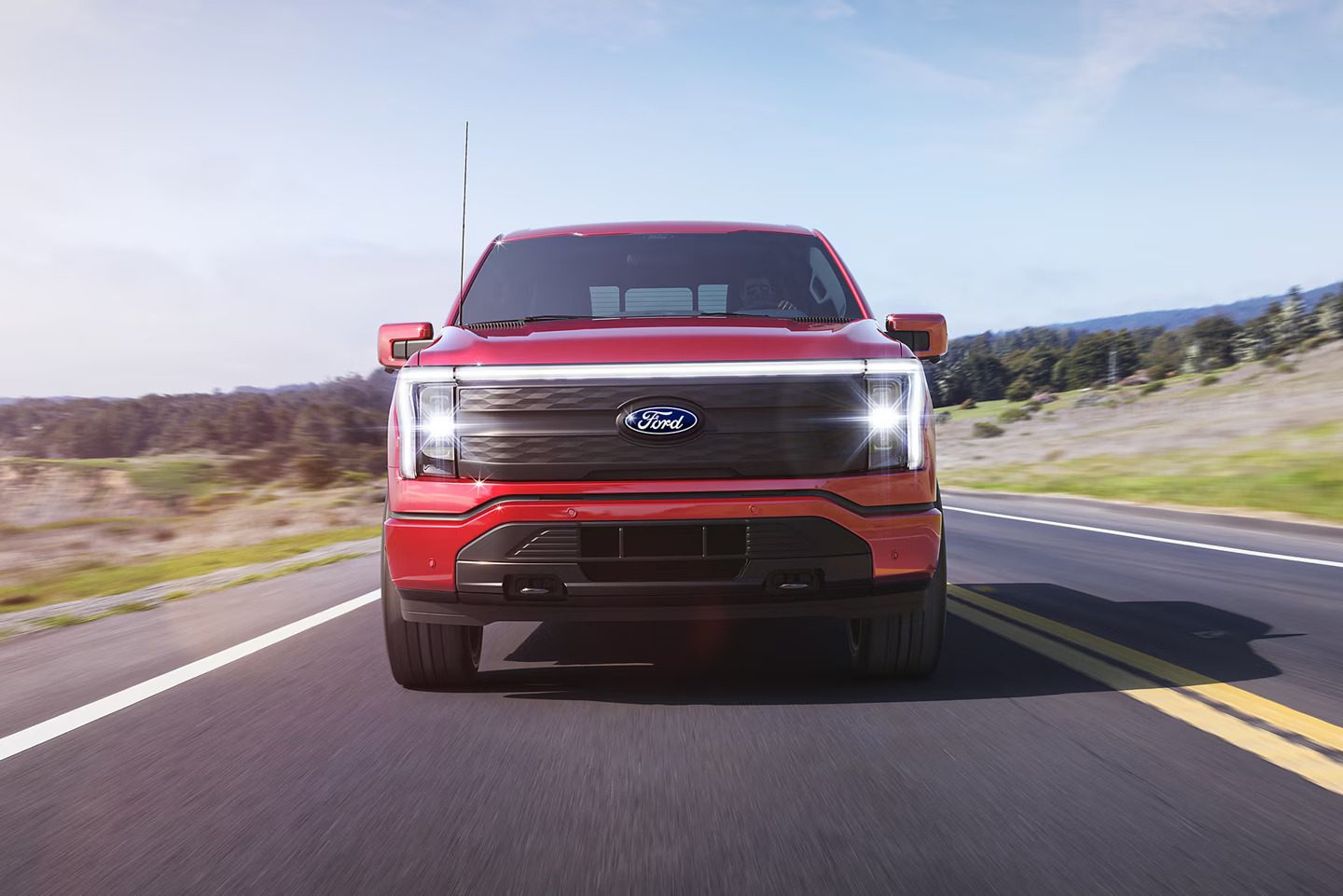
Electric vehicles fell 25%, and hybrids fell 33%, following the discontinuation of the fully electric F-150 Lightning and the Escape SUV — which was offered as both a hybrid and a plug-in hybrid.
US deliveries fell 69% in January and 71% in February, extending the steepest decline in the company’s EV history.
First-quarter figures showed that electric vehicle registrations fell by 69.6% year over year.
Ford sold 3,655 EVs last month. Compared to March, registrations rose by 22.0%.
As sales continue to slow across all powertrains, Ford has laid out a roadmap to renew most of its lineup by the end of the decade, anchored by a new low-cost EV platform and a broad electrification push.
By 2029, the automaker plans to refresh 80% of its North American portfolio by volume and 70% of its global portfolio.
EV Business
Ford‘s electric vehicle business has undergone several changes in the past few months — as the company continues to struggle with the effects of the federal EV tax credit’s termination on September 30.
In December, the automaker announced approximately $19.5 billion in charges tied to the rationalization of its EV manufacturing capacity and product roadmap.
The changes included the cancellation of three previously planned EVs — a full-size pickup, a commercial van for the US, and a commercial van for Europe — and the end of production of the fully electric F-150 Lightning.
The EV unit ‘Model e’ recorded $4.8 billion in losses for the full year of 2025, with Chief Financial Officer Sherry House forecasting an additional $4 to $5 billion in losses in 2026.
Earlier this year, the CFO warned that the company did not expect ‘Model e’ to turn profitable until 2029.
More recently, the company announced the merging of its Electric Vehicle, Digital and Design team with its global Industrial System.
Ford called the integration “a key lever in achieving the company’s Ford+ objectives, including its target of an 8% adjusted EBIT margin by 2029.”
As part of the changes, Doug Field — who led Ford’s shift to electrified, connected vehicles — is leaving the company this month.
In January, Field had laid out Ford’s eyes-off driving roadmap and AI assistant plans, framing the company’s in-house software and hardware development as a path to “democratize” advanced autonomy.
Universal EV Platform
The lineup overhaul includes the first vehicle built on Ford‘s new Universal Electric Vehicle (UEV) platform, a mid-sized pickup, and next-generation versions of the F-150 and F-Series Super Duty.
Ford is investing approximately $5 billion in the UEV program, which will debut in 2027 with a mid-size electric pickup priced around $30,000 — significantly below the entry price of the discontinued Lightning.
Farley has described the project as one of the company’s “most audacious”, citing aluminum unicastings that condense over 146 parts into two.
By 2030, Ford expects 90% of its vehicles by volume to feature updated electrical architectures, in-house user experiences, and next-generation over-the-air updates.
The foundation will support BlueCruise, the Ford Digital Experience, and “a scalable path toward future Level 3 autonomous driving,” the company added.
Nearly 90% of Ford‘s global nameplates will offer electrified powertrains by 2030, spanning hybrids (HEV), extended-range electric vehicles (EREV), and full battery electric vehicles (BEV).
Analysts View
Last month, UBS upgraded Ford‘s stock rating to Buy, citing a “credible path” to earnings per share (EPS) above $2 by 2027.
After closing the year at $12.98, the company saw its shares jump $14.80 in late February, before ultimately dropping to a yearly low of $11.11 amid the impact of the geopolitical conflict in the Middle East.
The stock has been trading in line with RBC Capital’s target of $11, lowered last month.
Analyst Tom Narayan adopted a cautious tone on Detroit automakers amid the post-credit EV reset.
Goldman Sachs also recently changed its price target to $13 from $15, while reiterating a Neutral rating on the company’s stock.
Analyst Mark Delaney said the firm is expecting auto OEMs and suppliers to post softer results this quarter, while noting that rising costs and weak sales are weighing on Ford.
On Monday, Citi analyst Michael Ward decreased its price target on the company’s shares — to $13 from $13.50.
As of press time, Ford shares were trading 3.1% lower at $11.52 on Monday’s market session.