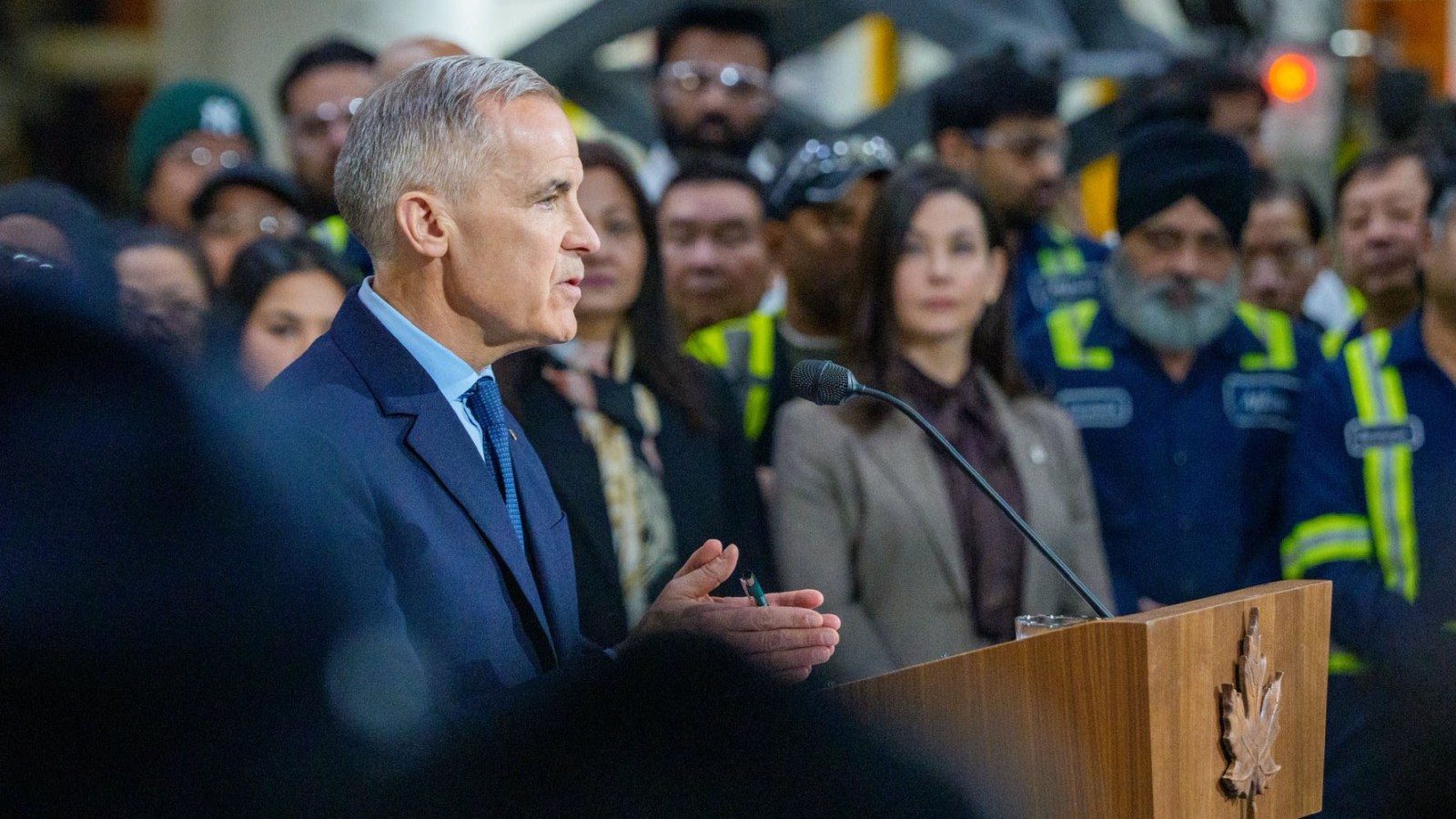

Canada’s auto industry is among the three domestic sectors most affected by US tariffs under President Donald Trump, Prime Minister Mark Carney said in a nine-minute address released on his YouTube channel on Sunday.
The video marks the first in what Carney said would be a series of regular video statements updating on Canada’s response to the US trade shift.
“The world, as I said earlier, is more dangerous and divided,” Carney said in the pre-recorded message titled “Forward Guidance with Prime Minister Mark Carney.”
“The US is fundamentally changed its approach to trade, raising its tariffs to levels last seen during the Great Depression.”
The United States, Canada and Mexico must convene by July 1 under Article 34.7 of the United States-Mexico-Canada Agreement to decide whether to extend the trilateral deal for another 16 years, negotiate revisions, or allow it to enter annual review until its 2036 expiration.
“Many of our former strengths, based on our close ties to America, have become our weaknesses, weaknesses that we must correct,” Carney added in the video.
Carney specifically named the three Canadian industries he said were under threat.
“Workers in our industries most affected by US tariffs in autos, in steel and in lumber are under threat,” the Prime Minister said.
“Businesses are holding back investments restrained by the pall of uncertainty that’s hanging over all of us,” Carney added before saying that the US “has changed and we must respond.”
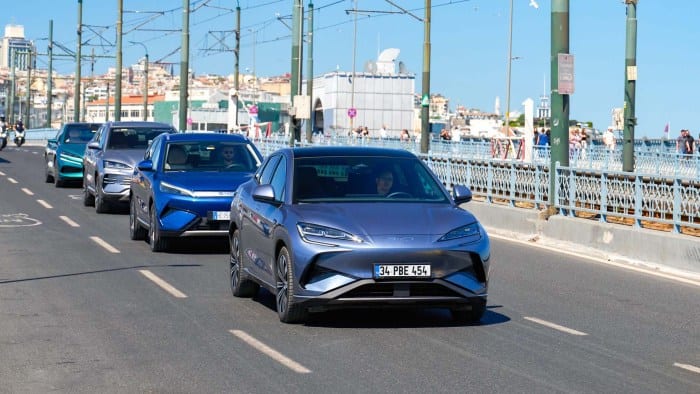
In mid January, Canada agreed to allow up to 49,000 Chinese-built EVs into its market annually at the most-favoured-nation tariff rate of 6.1%, down from the 106.1% effective rate set in late 2024.
“Nostalgia Is Not a Strategy”
Carney framed the address around “Canada Strong,” the economic plan he first outlined during the 2025 election campaign.
“Canada Strong is our plan to build Canada by Canadians, for Canadians,” he said.
“We will attract new investment so we can build more for ourselves. Striking new partnerships abroad so we can sell into new markets.”
“It’s about taking back control of our security, our borders and our future.”
The Prime Minister directly addressed critics who argue Ottawa should wait for a change in US posture.
“There are some who say there’s no need for a comprehensive plan,” Carney said.
“They believe we should wait it out in the hope that the United States will return to normal. That the good old days will come back.”
“But hope is in the plan. And nostalgia is not a strategy.”
Carney closed the address by displaying a miniature statue of Maj.-Gen. Sir Isaac Brock — the British officer known as the “Hero of Upper Canada” during the War of 1812 against the United States — which he said had been given to him by actor Mike Myers.
Lutnick’s Attack Days Earlier
The video comes days after US Commerce Secretary Howard Lutnick publicly attacked Carney’s trade strategy and Canada’s January trade deal with China.
“Carney has a problem with us. He gets on a plane and he goes to China,” Lutnick said.
“Does he think the Chinese economy is going to buy his stuff? China is entirely an export-driven economy, right? So what do you do?”
“[Carney] came back and said, ‘Oh, we’ll take their electric cars.’ I mean, is this nuts?”
Lutnick, responding to suggestions by Canada’s former trade negotiator Steve Verheul that time is on Canada’s side as the US economy wavers, was dismissive.
“That is, like, the worst strategy I’ve ever heard. They suck,” Lutnick said.
“We are a $30-trillion economy, right?”
US Trade Representative Jamieson Greer, Trump’s chief trade negotiator, told CBC that Canada should accept “some level of high tariff” on its exports to the US.
“Reshoring didn’t happen fast enough,” Greer said.
Greer is heading to Mexico on Monday to continue bilateral USMCA talks, while the US and Canada have yet to formally launch their own version.
The USMCA Deadline
The United States, Canada and Mexico must convene by July 1 under Article 34.7 of the United States-Mexico-Canada Agreement to decide whether to extend the trilateral deal for another 16 years, negotiate revisions, or allow it to enter annual review until its 2036 expiration.
Greer must report to Congress on June 1 about the administration’s plans for the USMCA.
Automotive products account for roughly 22% of total USMCA trade, according to the Baker Institute — the single largest category.
Components in a finished North American vehicle may cross the Canada-US border seven or more times during production.
The average US tariff rate on Canadian products has risen from 0.1% to 5.8% over the past year, the Bank of Canada said in a January report.
Canada’s auto sector shed thousands of jobs in January alone.
General Motors cut one of three production shifts at its Oshawa, Ontario plant, laying off about 500 workers by the end of the month.
Stellantis redirected investment from its Brampton facility toward US production.
US auto factories were running at 58% of capacity as of the reporting — their lowest in more than four years, according to Federal Reserve data.
On January 13 — three days before Canada announced its tariff deal with China — Trump said the United States-Mexico-Canada trade agreement is not relevant for his country.
“There’s no real advantage to it, it’s irrelevant,” Trump said. “Canada would love it. Canada wants it. They need it.”
Carney’s Counter-Strategy
The Sunday address echoed the foundations of a trade and industrial pivot Carney has pursued since January.
On January 16, Carney became the first Canadian prime minister to visit China since 2017, announcing a bilateral trade agreement with President Xi Jinping in Beijing.
Under the deal, Canada agreed to allow up to 49,000 Chinese-built EVs into its market annually at the most-favoured-nation tariff rate of 6.1%, down from the 106.1% effective rate imposed by the previous Liberal government under Justin Trudeau in October 2024.
The 49,000-vehicle cap approximates the volume imported from China in 2023.
Carney said the quota will rise by approximately 6% annually, reaching about 70,000 units within five years.
More than half of the vehicles admitted over the five-year horizon are expected to carry an import price below C$35,000.
In exchange, China agreed to lower its retaliatory tariffs on Canadian canola seed to approximately 15%, a significant drop from the combined 85% then in force, and to remove anti-discrimination tariffs on Canadian canola meal, lobster, crab and peas through at least the end of 2026.
The agreement is expected to unlock nearly C$3 billion in export orders for Canadian producers.
“At its best, the Canada-China relationship has created massive opportunities for both our peoples,” Carney said in the January 16 statement.
“By leveraging our strengths and focusing on trade, energy, agri-food, and areas where we can make huge gains, we are forging a new strategic partnership that builds on the best of our past, reflects the world as it is today, and benefits the people of both our nations.”
The deal also includes a clause requiring Chinese automakers to pursue joint ventures or local manufacturing and battery production in Canada within three years of market entry, framed by the government as a mechanism to protect domestic auto jobs and build out the Canadian EV supply chain.
“Build the Cars of the Future”
Less than a month after the Beijing agreement, Carney unveiled a federal auto sector strategy framing the industry’s transformation as an opportunity rather than a concession to Chinese market access.
In a speech on February 6, the Prime Minister invoked Canada’s automotive history, citing the country’s role in assembling the Ford Model T and its rise to become the world’s second-largest car producer by the end of the First World War.
“These feats were the result of Canadian determination and ingenuity,” Carney said.
“They were the product of an industry that adapted, pivoted, and when necessary, transformed. That’s what we must now do to build the vehicles of the future.”
The Prime Minister outlined a vision for “lower emission, autonomous, more reliable, more affordable” vehicles as part of building what he called “a stronger, more resilient, more independent Canadian economy that creates great jobs here at home.”
“That is what we are building together. That is a confident Canada. That is Canada strong,” Carney said.
Two days later, Carney reinforced the message on X.
“The choices we make now will shape the Canadian auto industry for decades to come,” the Prime Minister wrote on February 8.
“Our new strategy will build a stronger Canadian auto sector, where Canadian workers build the cars of the future and sell them to the world.”
The strategy announcement came as Industry Minister Mélanie Joly confirmed to Bloomberg that the government was in talks to establish a joint-venture EV plant with Chinese automakers for global exports.
Canadian auto parts suppliers Magna International, Linamar and Martinrea International were named as potential partners.
Joly also signalled “active conversations” on how domestic firms might complement new Chinese investment, including with Ottawa-based software developer QNX, owned by BlackBerry.
“We believe that these great Canadian champions can partner with Chinese EV companies to make a Canadian-Chinese car to export it around the world,” Joly told Bloomberg.
The announcement followed Joly’s creation of an auto task force with Ontario earlier in February to protect jobs and coordinate investment strategy amid US tariff threats.
“We can’t look at one policy, we have to look at everything that is affecting the auto workers,” Joly said.
Sidhu’s Guangzhou Meetings
International Trade Minister Maninder Sidhu met in Guangzhou on Thursday with executives from three of China‘s largest automakers — BYD, XPeng and Guangzhou Automobile Group — in the first ministerial visit to South China since 2018.
The meetings are the most concrete step yet toward the joint-venture investment commitments that were a central condition of the January framework.
“China makes some of those most advanced electric vehicles in the world, and ensuring Canadians have access to affordable EVs means working with global partners,” Sidhu wrote on X after the meetings.
“That’s why I met with some of the largest EV manufacturers like BYD, XPeng and Aion in Guangzhou to discuss collaboration and investment in Canada’s leading automotive sector and utilizing the Canadian supply chains to build the very cars in Canada.”
Sidhu also met executives from Alibaba Group and JD.com to discuss Canadian goods exports through Chinese e-commerce platforms.
The Guangzhou visit followed the sixth China International Consumer Products Expo in Haikou, where Canada served as Guest Country of Honour with a delegation of nearly 40 Canadian companies.
China is Canada‘s second-largest single-country merchandise trading partner, with C$125.1 billion in two-way trade in 2025.
Submarine Leverage for Auto Plants
In parallel, Ottawa has tied a C$40 billion naval procurement contract for 12 attack submarines to demands that bidders commit to Canadian auto-sector investment.
Two consortiums are competing: South Korea’s Hanwha Ocean and a German-Norwegian partnership anchored by Thyssenkrupp Marine Systems.
Final proposals are expected this year.
Industry Minister Mélanie Joly signed a memorandum of understanding with Seoul on January 29 covering Korean automotive manufacturing investment.
Joly subsequently travelled to Berlin to negotiate a parallel arrangement with Germany.
Katherina Reiche, Germany’s Federal Minister for Economic Affairs and Energy, visited Ottawa in February and described Carney’s auto strategy as “very attractive.”
“Our car industry is willing to invest here, because we will find good conditions here,” Reiche told the Globe and Mail.
“It’s more than just talking. We are looking into numbers, into details.”
Volkswagen has already committed to building a battery cell plant in St. Thomas, Ontario through its PowerCo division.
Political Pressure at Home
Carney’s Liberals secured a majority government this week, sweeping three by-elections and locking the opposition Conservatives into minority status until the next federal election in 2029.
Four Conservative MPs have defected to Carney’s caucus in the past five months.
Opposition leader Pierre Poilievre has ratcheted up attacks on Carney for moving too slowly to secure a US trade deal, telling a Toronto business audience on Thursday that Trump’s tariffs are “actually getting much worse.”
“There’s no more time to waste, no more jobs we can afford to lose,” Poilievre said, citing $1 billion in expected impact on Windsor-based auto businesses.
“He’s wrong to suggest that we can have a permanent rupture with our biggest customer and closest neighbor in favor of a strategic partnership for a new world order with the regime in Beijing,” Poilievre said of Carney.
Ontario Premier Doug Ford has also publicly criticized the China EV deal, calling Chinese-made vehicles “subsidized spy cars” and comparing the agreement to the Huawei controversy.
“I’m not too sure if President Trump wants Chinese spy vehicles coming across the border, but I’m betting the answer is no,” Ford said in January.
What Comes Next
Carney closed the Sunday address by invoking his tenure at the Bank of Canada during the 2008 financial crisis, when he used the practice of “forward guidance” — pre-committing markets to a policy path — to stabilise expectations.
“There’s much forward guidance to be found in our shared history. We will get through this because of who we have always been,” Carney said.
“It’s our country. It’s our future. We are taking back control, to build Canada strong.”
The Prime Minister said future “Forward Guidance” videos would provide regular updates on Canada’s diversification efforts.