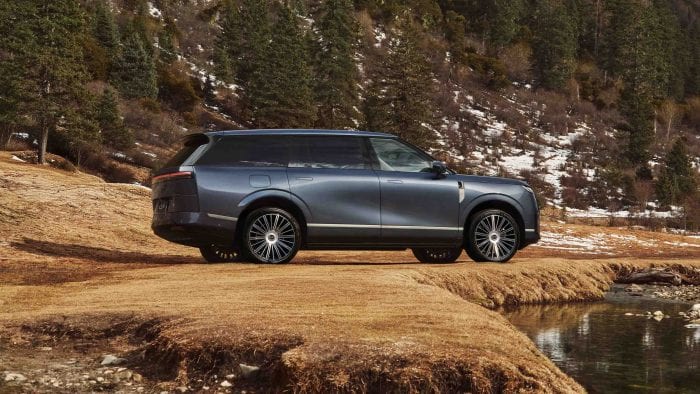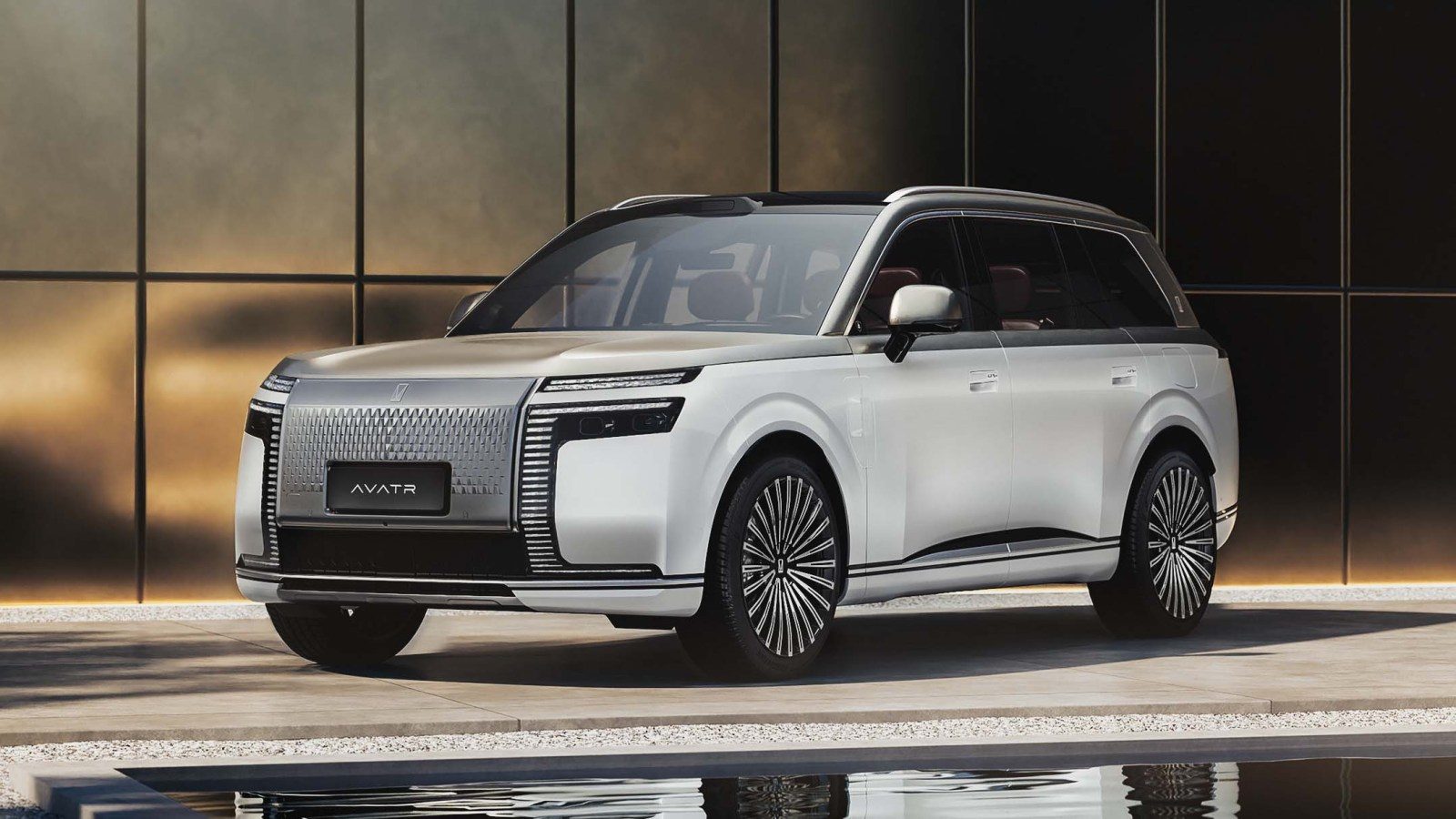

Avatr’s flagship six-seat SUV appeared in the Ministry of Industry and Information Technology’s (MIIT) new-product announcement on Tuesday evening under the code T09, hours after the Changan-backed brand published the first official images of the model it plans to launch by the end of the year.
Avatr is backed by Changan, the tech giant Huawei, and the world’s largest EV battery maker, CATL.
The filing, in the ministry’s 411th batch, lists a 5,285 mm long, 2,025 mm wide vehicle on a 3,150 mm wheelbase.
The model — codenamed T09 — will be available in two plug-in hybrid powertrains: a 1.5-litre engine paired with two motors for 490 kW of electric output, and a 2.0-litre engine with three motors for 630 kW.
The T09 is the first Avatr “developed in full collaboration with Huawei in the true sense,” Vice President Yong Jun said on August 14, with Huawei supplying the vehicle control, lighting, voice and driver-assistance systems rather than the driving and cockpit software alone.
Avatr describes the exterior as co-designed with Huawei Qiankun, the Chinese group’s automotive unit.
President Chen Zhuo said on Tuesday that further details would be released in stages before launch.
Avatr has not given the official name, a price, a battery capacity or an electric range.
The Filing
The dual-motor version pairs Changan’s JL469ZQ1 1.5-litre engine, rated at 110 kW, with a 180 kW front motor and a 310 kW rear motor. It weighs 2,880 or 2,968 kg depending on specification, with a gross weight of 3,505 kg.
The tri-motor version uses the 2.0-litre engine, rated at 155 kW, with the same 180 kW front motor and two 225 kW motors, one at each rear wheel.
It weighs 3,035 kg with a gross weight of 3,630 kg. Both versions are limited to 220 km/h and both are rated for six occupants.
The two-litre engine is the first in an Avatr filing.
The brand’s ‘Kunlun’ range-extender system, introduced in August 2024 and fitted to the 07, 12 and 11, uses a 1.5-litre unit, as does the 06T filed in February.
The filing lists ternary lithium cells and a pack from its backer CATL, and permits external charging. CATL owns about 24% of Avatr.
Tuesday’s document does not give battery capacity, electric range, charging speed or fuel-tank size.
The Design
The images Avatr released on Tuesday morning show the front, side and rear of a boxy, high-roofed body that departs from the fastback shapes of the 11 and 12.
The front carries a closed dot-matrix panel with split headlamps whose lower elements run into the grille.
A LiDAR sits above the windscreen, which Chinese outlets expect to be Huawei Qiankun’s 896-line dual-optical-path unit already used on the 07L. The side shows partially flush door handles and dense-spoke wheels, the rear a full-width light bar beneath the Avatr script.
Avatr had teased the front end in a video on September 2 and confirmed the large six-seat SUV in Yong’s August remarks.
Where It Sits
The T09 enters the large six-seat class at its median size.
Xiaomi’s N90 Max, launched on Monday, is the same 5,285 mm long on a 3,080 mm wheelbase. The Yijing X9, the Dongfeng–Huawei six-seater filed in May, is 5,301 mm on 3,120 mm.
The Denza N9 is 5,258 mm on 3,125 mm, the Zeekr 9X 5,239 mm on 3,169 mm and the Nio ES9 5,365 mm on 3,250 mm.
The T09’s roof, at 1,810 to 1,820 mm, is lower than the M9’s and the ES9’s, which puts third-row headroom among the things to check when the interior is shown.
The car will sit above the 07L, launched in August, at the top of a range Changan has said will focus on 250,000 to 700,000 yuan, with a “million-yuan-class” six-seat flagship promised for 2026 in a 2025 investor record.
The Yijing X9 is the closest comparison in origin as well as size: two Huawei-designed large six-seaters from two state carmakers in one year, with Huawei owning equity in neither.
Avatr holds 10% of Huawei’s Yinwang automotive unit, bought for 11.5 billion yuan in 2024.
Avatr
Avatr sold 122,702 vehicles in 2025, up from 61,588 in 2024 and 20,021 in 2023, on revenue of 25.6 billion yuan, according to its Hong Kong listing prospectus, which puts the 2025 net loss at about 3.5 billion yuan ($521.5 million).
Sales fell 54% in the first five months of 2026 to 20,160, Caixin reported, and reached 35,250 through July with 8,082 in August by the company’s count.
The listing application lapsed on May 27 and was refiled in early July, for up to $1 billion according to earlier reports.
Cash and equivalents stood at 9.69 billion yuan at the end of 2025, and Caixin has reported that Changan plans to integrate Avatr with Deepal to cut costs by 20% to 30%.
Avatr’s guidance is for five launches or upgrades in 2026 and 17 new products by 2030.