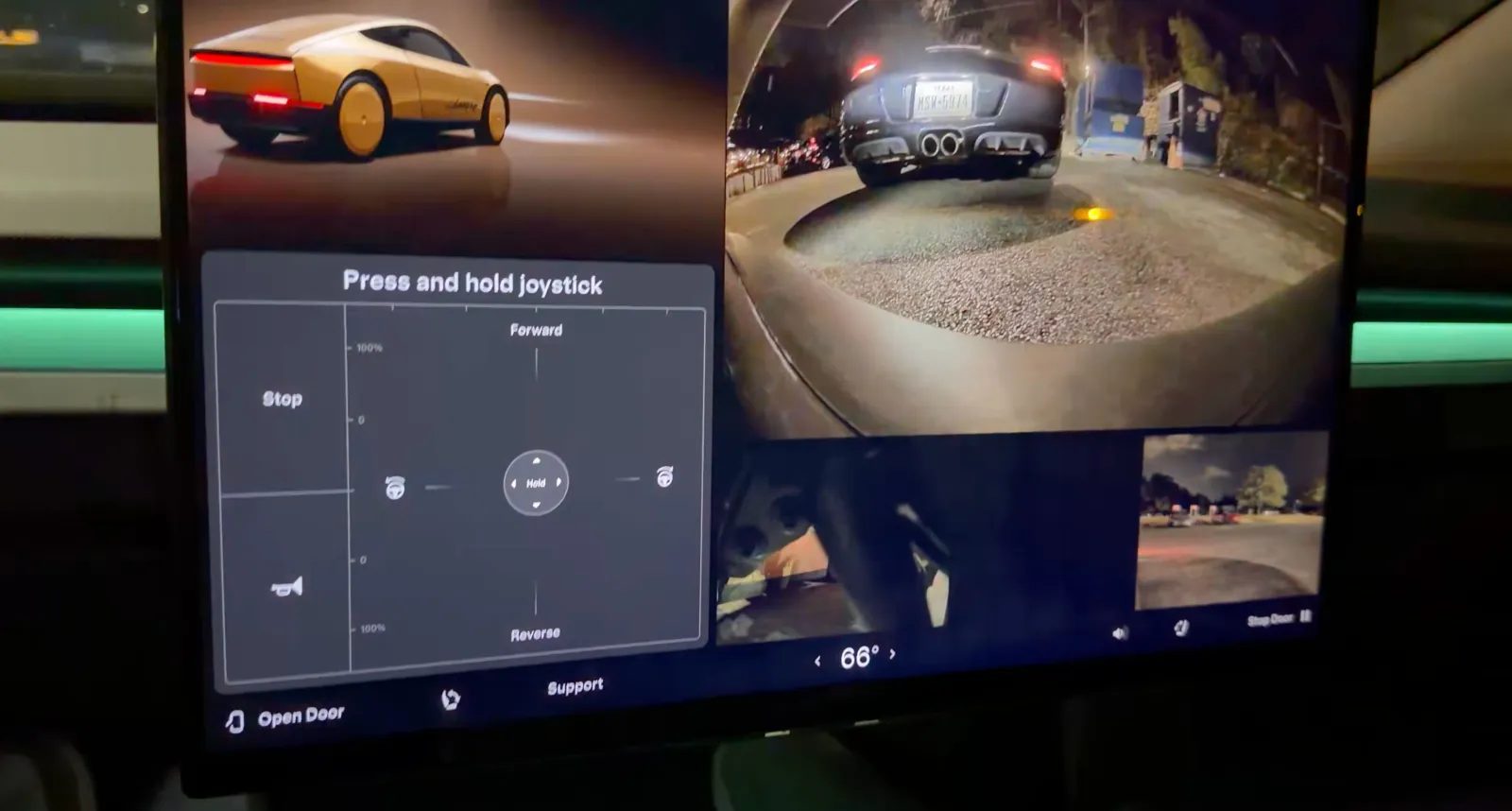

Two passengers hailing Tesla’s Cybercab in Austin within days of its public launch found the car arrive with its service interface on the cabin screen: a virtual joystick for driving the vehicle manually, with buttons for stop, horn and closing the doors, in place of the rider display, according to videos both posted on X.
David Moss, an autonomous-vehicle content creator known for long-distance drives on Tesla’s Full Self-Driving software, posted a six-and-a-half-minute video on Monday evening Central time of a ride that began at Terry Black’s Barbecue in Austin.
“I can confidently say I am the closest person from the public to being able to drive a Tesla Cybercab,” he wrote.
“So close yet so far. The vehicle arrived in some sort of mode I think it goes into at a supercharger for manual assistance,” Moss added. “I couldn’t use any apps & the left repeater camera feed was frozen & the worst part was the loud chime that would happen every time the vehicle speed reached >5 mph or so.”
Matthew Skrzypczak, another rider, posted a video on Monday of the same screen.
“When I got in the vehicle, the display was in a different configuration with a virtual joystick for manual driving,” he wrote. “I have a feeling I wasn’t supposed to see this… but I try to manually drive the vehicle anyway.”
The company opened Cybercab rides to the public in Austin at 2:00 p.m. Central on Friday, September 4, through its Robotaxi app, with 45 units registered in Texas.
What the Screen Showed
The interface in Moss’s video is a debugging or service layout rather than the 22-inch entertainment display Tesla describes to riders.
The left pane of the screen carries a circular joystick marked Hold, with Forward at the top and Reverse at the bottom, a throttle-percentage scale beside it, and a Stop button, a horn button and a “Close cabin doors” command around it.
Camera feeds occupy the right pane, with a Support button along the bottom. Those elements are legible in the footage.
In the video, which was shot with the screen in view, Moss and a companion can be heard working through the controls: confirming the horn works, reading the “press and hold joystick” prompt and trying it without the car responding, finding the front and rear camera views and the frozen left feed, and identifying the scale as throttle percentage.
Moss told the Tesla Suppoert agent there is no start-ride button, and after a pause the agent says the car should now be moving, at which point the ride begins with the car driving itself.
Moss remarks that they are not the first riders this has happened to. He was able to edit the destination and return to Terry Black’s.
He described it a “unique software bug.”
The Interface
Not a Tesla App, which covered Skrzypczak’s video on Monday, says the same layout appeared in a video posted by Caleb Barry on August 30, in which the site described a validation tester using the on-screen controls to reposition a Cybercab at an Austin Supercharger, and describes the interface as the means by which “service technicians or validation testers manually move the Cybercab if and when necessary,” since the car has no steering wheel or pedals.
Whether a passenger could have driven the car is the question the videos raise and do not answer. Moss’s joystick input produced no movement in the footage. Skrzypczak said he tried and did not report the car moving.
The incidents come as the National Highway Traffic Safety Administration (NHTSA) conducts an audit query, announced on September 4, into Tesla’s self-certification of a vehicle without a steering wheel, pedals or mirrors against standards that assume them.
A manual-driving interface accessible from the passenger screen sits inside that question.
Moss was among the creators Tesla invited to the September 3 launch event, and he has recorded long unsupervised FSD drives that Tesla treats as customer benchmarks.
His post had about 220,000 views and 1,000 likes at the time of writing.
The service screen is the third feature of the production Cybercab to surface from riders rather than from Tesla since the launch, after the concealed charging port and the absence of an onboard AC charger, reported on Monday.