
Mirattery, the battery-asset operator behind Nio‘s Battery-as-a-Service business, raised a combined 2.02 billion yuan ($278.8 million) on June 30 across two green asset-backed offerings, pricing their senior tranches at a record-low 1.68%.
The operator established its Phase 2 Green Technology Innovation Asset-Backed Special Plan on the Shanghai Stock Exchange, an offering of 971 million yuan ($143 million), according to a statement on Tuesday.
Mirattery’s major shareholders include Nio and CATL, the world’s largest battery maker and the EV maker’s main cell supplier and swap-network partner, which holds a 10.68% stake in the operator.
A second deal, Mirattery’s third green directed asset-backed notes of 2026, closed the same day in China’s interbank market at 1.05 billion yuan, distributed to international investors through the Bond Connect scheme.
Both offerings priced their senior Class A1 tranches at 1.68%, which the company called a record low for its programme.
Priced Like Infrastructure
Yields of 1.68% are typically reserved for the safest assets in China’s bond market, such as top-rated state-owned power grids and toll roads.
The Battery-as-a-Service framework, once viewed as an unproven cost carried by a loss-making technology company, is increasingly priced as a stable, cash-generative green asset.
Pricing has trended lower with each round, and the 1.68% A1 coupon undercuts the rate on Mirattery’s previous green-note sale earlier this year.
That earlier deal had already drawn strong demand and priced near the low end of expectations, and the latest coupon extends the downward path.
The two formats — an exchange-traded plan in Shanghai and interbank notes open to foreign money — let Mirattery tap both domestic and offshore demand in a single day.
The exchange offering also carried a senior tranche running as long as seven years, the longest tenor the programme has reached.
Two Deals, One Structure
The Shanghai exchange plan priced a 129-million-yuan senior A1 tranche at 1.68%, alongside larger A2 and A3 senior tranches at 1.90% and 3.00%, all rated AAA.
A fourth AAA senior tranche, an AA+ piece and two subordinate tranches completed the 971-million-yuan structure.
The interbank notes mirrored that shape, pricing a 160-million-yuan A1 tranche at the same 1.68% with AAAsf ratings, followed by A2 and A3 tranches at 1.90% and 3.00%.
That deal was issued unsecured and benchmarked against the simple, transparent and comparable, or STC, standard, with full asset verification and hot-standby servicing.
The unsecured structure signals that the underlying battery pool was judged strong enough to stand without a third-party guarantee, while Bond Connect opened the notes to offshore buyers.
CICC led both deals as lead underwriter and bookrunner, with Bank of Communications, Bank of China and SDIC Securities among the joint leads.
CCB Trust acted as the special-purpose vehicle manager and ICBC as fund custodian, while Lianhe Ratings and Lianhe Equator supplied the credit and green ratings under the National Association of Financial Market Institutional Investors.
Both deals were certified green, tying the funding to the environmental case for battery reuse and recycling rather than to the carmaker’s own credit.
What Mirattery Holds
Mirattery, also known as Wuhan Weineng, was founded in August 2020 to hold the batteries that Nio customers can lease rather than buy when acquiring the vehicle.
CATL, the world’s largest battery maker and Nio‘s main cell supplier and swap-network partner, holds a 10.68% stake in the operator.
The operator’s capacity exceeds 42 gigawatt-hours and serves more than 550,000 users, and it had filed 196 patents by the end of 2025, most of them in battery technology.
That scale gives the asset pool the diversification and payment history that the agencies rewarded with their top structured-finance grades.
Mirattery deepened its tie with CATL last year through a strategic cooperation agreement spanning equity investment, battery rental and the joint build-out of swap networks.
Late last year the two shareholders set up a Wuhan joint venture, wholly owned by Mirattery, to extend the business into battery leasing, recycling, second-life use of retired packs and charging operations.
By owning the packs, Mirattery lets Nio sell cars without the battery, the core of a model in which 80% to 90% of the company’s Chinese buyers lease their cells.
The recently launched ES9 flagship starts at 420,000 yuan under Battery-as-a-Service against 528,000 yuan with the pack included.
Securitizing the battery assets lets Nio recycle capital and keep the packs off its own balance sheet, easing a burden its founder has flagged as a constraint on growth.
Founder and CEO William Li has said the absence of such a partner in Europe, where Nio still holds the battery assets itself, creates “quite a significant financial pressure and burden,” in remarks on the search for a regional partner.
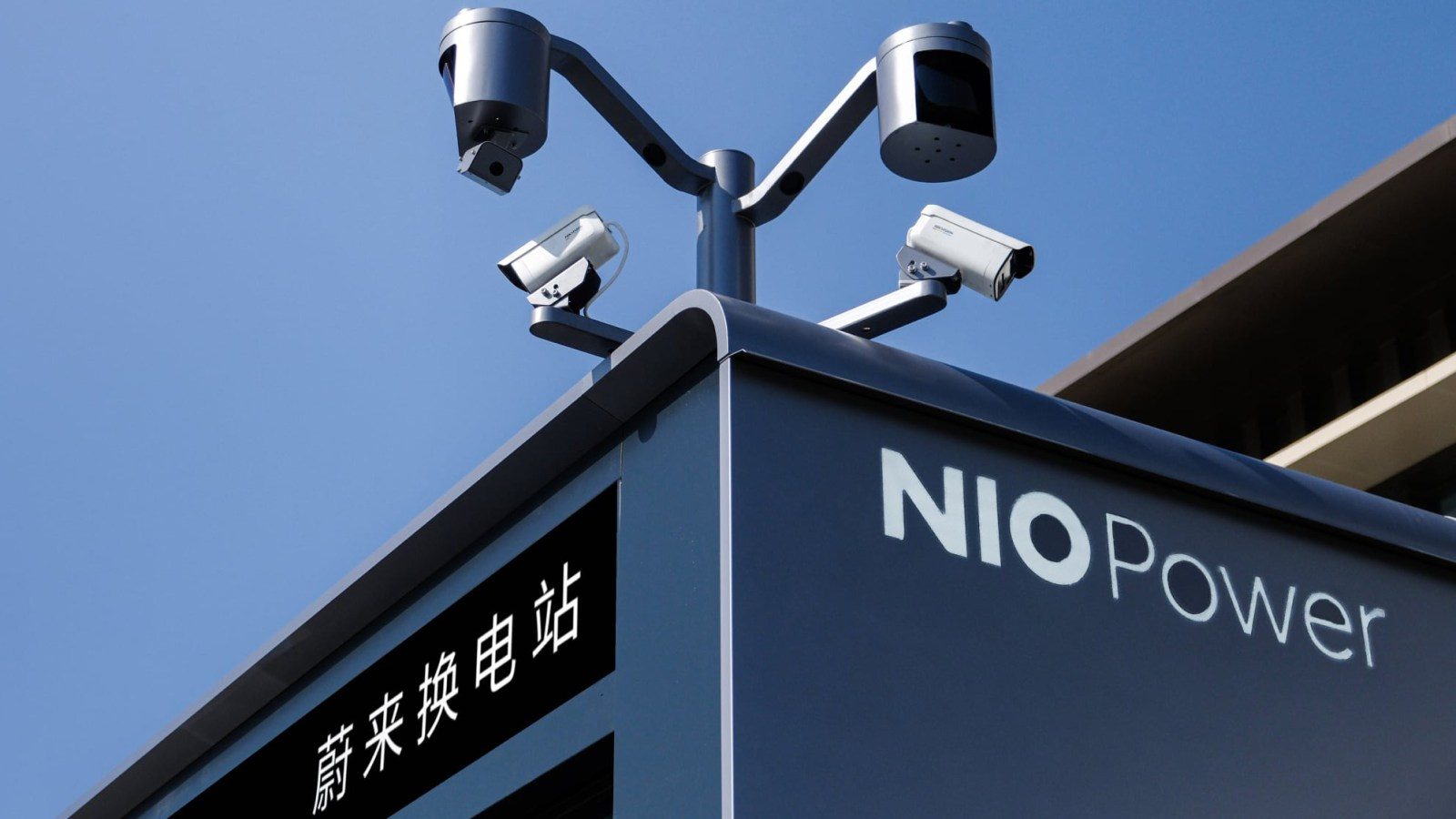
The proceeds support a swap operation that Nio is expanding toward more than 4,600 stations in China by year-end, with fifth-generation units rolling out through 2026.