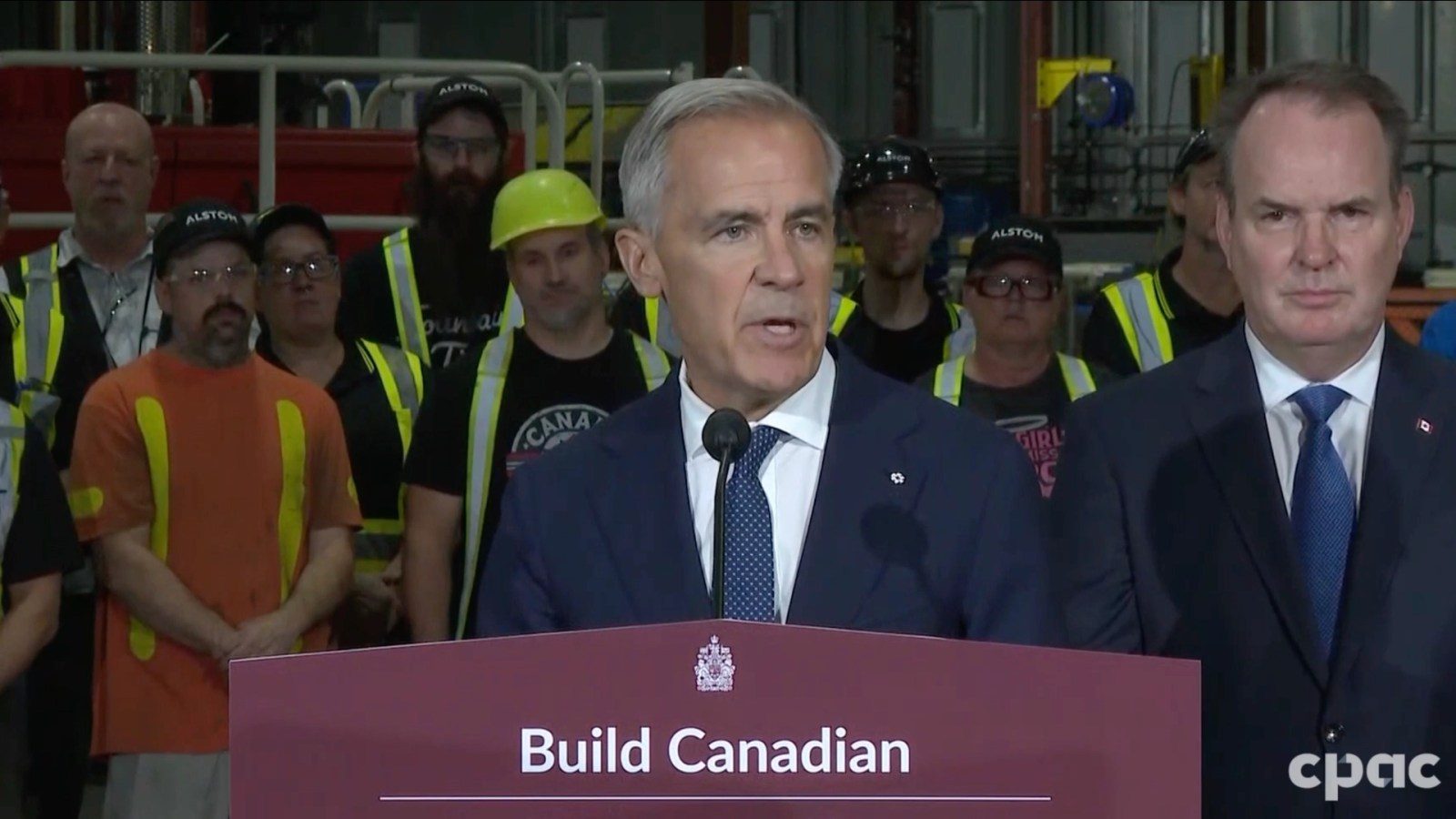

Prime Minister Mark Carney travelled to Thunder Bay on Thursday to announce what he called a “historic investment” in Canadian manufacturing, amid an escalating trade war with the United States.
Ottawa has spent much of 2026 shoring up domestic industry — unveiling a multi-billion-dollar auto-sector package in February and routing federal procurement toward Canadian suppliers.
The new announcement extends that push to passenger rail.
A contract worth C$4.7 billion was assigned to Alstom Canada to build 313 new passenger train cars at plants in Thunder Bay, Ontario, and La Pocatière, Québec — the first time in four decades VIA Rail passenger cars will be manufactured domestically.
Design and engineering work will take place in Saint-Bruno-de-Montarville, Québec.
Ottawa expects the project to support nearly 700 jobs and generate more than C$1.6 billion in economic benefits.
Speaking in Thunder Bay, Carney framed the deal as a direct answer to the trade standoff with Washington.
“Our country’s been tested,” he said. “Two weeks ago we made the right decision to suspend our trade negotiations with the United States. We couldn’t accept what they’d offered, we wouldn’t give what they’d asked.”
Buy Canadian
Carney cast the announcement as a centerpiece of Ottawa’s Buy Canadian policy, which directs federal procurement toward domestic suppliers, labour and materials.
VIA Rail’s existing long-distance fleet, some of it more than 70 years old, was largely built in the United States.
“Cars once made in the United States, now made here at home,” Carney said. “This means new contracts for Canadian suppliers, good jobs for Canadian workers, and paycheques that stay in Canadian cities and towns.”
Alstom will draw on its existing network of more than 900 Canadian suppliers and is required to maximise the use of Canadian steel in structural assemblies, supports and fabricated metal elements.
The procurement is expected to support 4,850 person-years of employment: about 615 full-time equivalent jobs annually over four to eight years for design, manufacturing and delivery, plus 55 jobs annually over 15 years for technical support, spare parts and maintenance.
Combined with a recent C$1.95 billion investment in 45 new passenger locomotives from Switzerland-based Stadler — up to 36 of which will undergo final assembly at a new facility in Montréal — Ottawa’s total commitment to renewing VIA Rail’s long-distance, regional and remote fleet now stands at more than C$6.6 billion.
Trade-War Backdrop
The announcement landed five days before Ottawa’s latest retaliatory tariffs on American goods take effect.
Canada imposed counter-tariffs of 15%, 25% and 50% across C$27.6 billion of US goods on August 25, effective September 8, targeting steel, dairy, appliances, agricultural equipment, pulp and paper, electronics and similar categories.
Washington’s 50% tariffs on $20 billion of Canadian goods took effect on August 22, hours after Carney suspended trade negotiations.
President Donald Trump announced on August 24 that all cars, trucks, auto parts and steel from Canada would face a 50% tariff from January 1, 2027.
Days later, he posted on Truth Social that he wanted no Canadian cars, parts or anything else, calling Canada one of the worst abusers on trade.
By late August, upon the halt of the deal, Carney had stated that American negotiators had introduced last-minute terms that were neither fair nor economically sound.
Carney was blunter on Tuesday, when he told reporters in Ottawa that US negotiators had approached the talks with an attitude that would have left Canada’s core industries — the auto sector among them — operating as “subsidiaries” of their American counterparts or wound down until they disappeared.
In Thunder Bay, Carney called the new tariffs a miscalculation.
“Canadians will always take care of each other,” he stated. “And it’s a miscalculation because we have everything we need to build the country we want. We have the reserves, we have the resilience and we have the right plan.”
Industry Says: Don’t Rush
Union and industry leaders rallied on Parliament Hill on August 28 with a unified message: Ottawa should not hurry back to the negotiating table.
Flavio Volpe, President of the Automotive Parts Manufacturers’ Association, told reporters the auto sector was incurring “very damaging” costs from tariffs but warned that a bad deal could prove worse.
Canada should wait for terms that make manufacturing sustainable, he said. Asked how long the industry could endure, Volpe answered: “just watch us.”
Unifor President Lana Payne has described recent GM investment commitments as vital, made at a time when the domestic auto industry is “under siege” from the Trump administration.
Diversification Push
Carney has made trade diversification a centerpiece of his economic agenda, pledging to double non-US exports by 2035 — a target worth an additional $300 billion in trade.
Global Affairs Canada‘s State of Trade 2026 report showed exports to non-US destinations rose 11.1% in 2025, pushing the non-US share of Canadian exports to 32.8%, the highest level in more than four decades.
The gains, however, were concentrated in gold, crude oil and critical minerals rather than broad-based manufacturing.