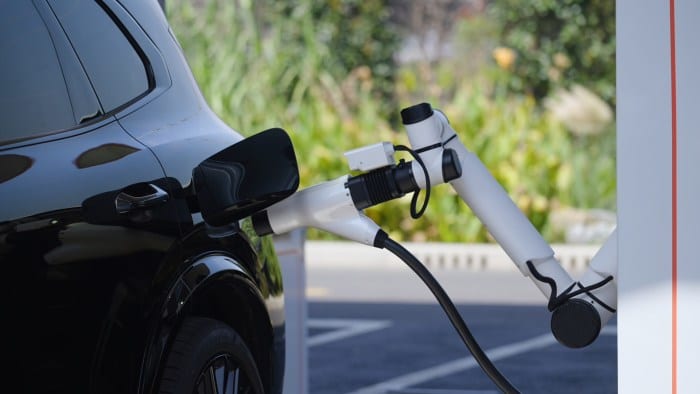

Geely unveiled a charging station rated at up to 2,250 kilowatts on Wednesday. The new charger is the fifth-generation Geely Smart Charging Station. Geely presented it in Ningbo alongside an AI energy model, a new battery for cheaper models, and an updated version of its SUV Galaxy E5.
The Chinese automaker’s fastest production battery has a certified peak input of about half that, and its current models reach full speed only on the group’s own chargers.
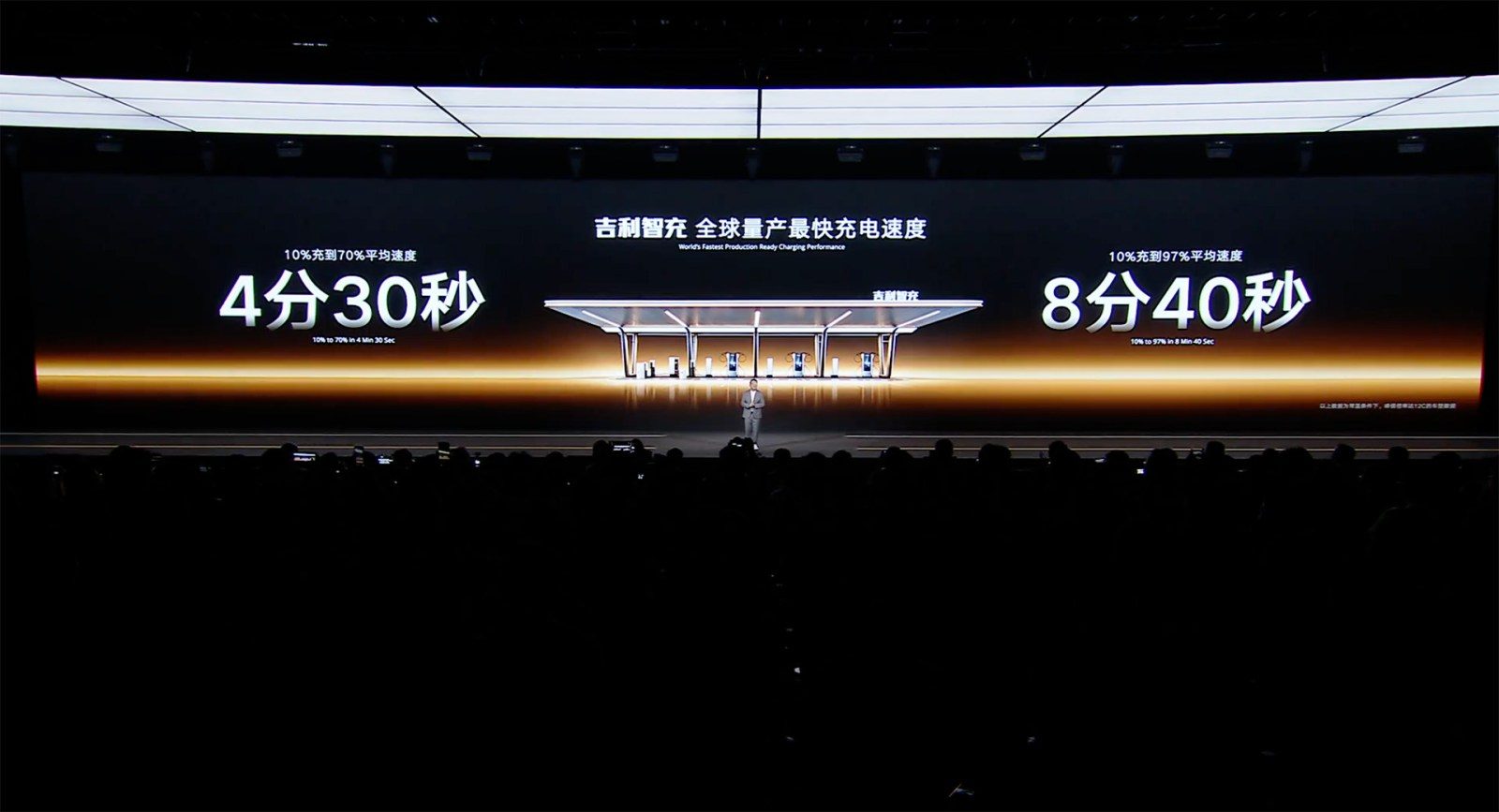
Using the station, a Lynk & Co 10 and a Zeekr 001 charged from 10% to 70% in 4 minutes 30 seconds, and from 10% to 97% in 8 minutes 40 seconds, the company said.
The slide shown at the launch labelled both figures as averages. Fine print said they were measured at room temperature, on models with a peak charging rate of 12C.
That excludes the Galaxy E5 launched the same day, whose battery charges at up to 6C, Geely said last week.
Geely gave no cold-weather figures. BYD says its system charges from 20% to 97% in 12 minutes at -30°C.
The auto giant called the results its fastest production-ready charging performance to date. The slide went further.
Its Chinese headline claimed the fastest charging speed of any mass-produced car in the world, and the English line beneath it read “World’s Fastest Production Ready Charging Performance.”
On company figures, the claim holds against cars on sale. BYD’s second-generation Blade Battery charges from 10% to 70% in five minutes and to 97% in nine minutes.
CATL’s third-generation Shenxing battery is faster on paper, charging from 10% to 80% in 3 minutes 44 seconds and from 10% to 98% in 6 minutes 27 seconds. CATL has said it will reach cars in the fourth quarter and has not named the first model.
Those figures are close to what Lynk & Co published in early April, when the Lynk & Co 10 charged from 10% to 70% in 4 minutes 22 seconds and to 97% in 8 minutes 42 seconds. That test ran on a Zeekr V4 charger, which CarNewsChina described as rated at 1,300 kW.
Because Wednesday’s times are averages, they are not directly comparable with April’s. The April figures appear to come from a single recorded charging session, which would explain why the 10% to 70% time was eight seconds faster then.
The Car Sets the Limit
A station’s rating shows how much power it can supply. How fast a car actually charges depends on how much power its battery can accept.
The China Automotive Technology and Research Center (CATARC) measured a peak input of more than 1,093 kW on the Lynk & Co 10’s battery, Geely said in June. The pack peaked at 64°C during that test.
Geely’s performance battery, the Shendun Golden Battery, is rated for a peak of 12C, the company said on Wednesday. On a 95 kWh pack, 12C works out to about 1,140 kW.
That means today’s cars can use roughly half of the 2,250 kW the new station can deliver.
That comparison holds only if the full 2,250 kW is available through one connector. Geely has not said whether it is.
Geely’s English release describes it only as the station’s peak charging power. If the power is shared across two or more connectors, each car gets less, and most of the gap between what the station can supply and what a car can accept disappears.
Rated for 900 Volts, Built on 800
Lynk & Co markets the 95 kWh pack as a 900-volt system. Its nominal voltage is 772.8 volts, placing it in the 800-volt class, according to specifications reported by CarNewsChina and electrive.
The gap matters because charging power is voltage multiplied by current. At the pack’s nominal voltage, a peak of 1,093 kW works out to approximately 1,400 amps through the connector and cable. Cables and connectors that can be cooled at that current, rather than the station’s rating, set the practical limit.
Geely said in August it is developing a 1,000-volt architecture to push the Lynk & Co 10’s charging below 5.5 minutes from 10% to 80%. It has not said when that architecture will reach production cars.
Managing Director of Geely UK Michael Yang told Autocar on September 3 that Geely was developing an ultra-fast charging facility in China rated at 1,800 kW. He gave no date for the UK.
Speed Depends on Whose Charger
The same Lynk & Co 10 that peaked at about 1,100 kW on a Zeekr charger reached a peak of 430 kW at a BYD Flash Charging station, CarNewsChina and electrive reported in August.
BYD designed its network around its own 1,000-volt vehicles, and its flash chargers deliver up to 1,500 kW per connector, the company has said.
The difference shows that peak speeds depend on the car’s software being able to communicate with the charger, and on the station’s cooling and on-site storage, not only on the cell chemistry.
Geely’s AI model, Xingrui PowerMind, is meant to manage that relationship. It was developed with the Chinese AI start-up StepFun, and coordinates the vehicle, battery, charger, cloud, grid and on-site storage, Geely said.
The company did not say whether PowerMind works with third-party chargers.
A Network Still Being Built
At the end of February, Geely’s self-built network had 2,103 stations and 10,212 piles in 215 cities, New Atlas reported, citing Zeekr.
Chinese media reports before Wednesday’s launch put the network of Geely’s charging operator, Haohan Energy, at more than 11,000 guns in 232 cities. More than 6,700 of those are ultra-fast. Geely has not published those figures in a filing or an English release.
The counts are of individual guns, while BYD counts whole stations, so the two networks cannot be compared directly.
BYD reached 10,000 Flash Charging stations in China in late August, half of its target of 20,000 by the end of 2026. It plans a further 30,000 in 2027 and 40,000 in 2028, for a total of 90,000, Deutsche Bank said, citing a meeting with BYD management.
A third of the 1.83 million drivers who used BYD’s network in its first six months drove non-BYD cars, according to BYD figures reported by InsideEVs.
“Current charging speeds are already approaching the physical limit, and the marginal gains from pursuing even faster speeds in the future will become increasingly small,” Geely executive Zhang Dewang told Reuters at the launch.
Zhang said the charging market would come to resemble petrol stations with diverse brands, and that infrastructure built by multiple parties would speed up global deployment, Reuters reported.
Open Chargers Elsewhere
XPeng has taken that approach in Hong Kong. With the local operator Halo Energy, it opened a megawatt station that is open to all brands. XPeng announced the station was operating on September 15 and held a formal opening ceremony on September 22.
The station peaks at 1 MW and 1,000 amps and has 400 kWh of on-site storage. That storage lets it draw no more than 240 kW from the grid, XPeng said.
XPeng first presented the platform in Munich in July at 1,040 kW. It said it plans more than 1,000 self-operated supercharging stations across 13 European countries.
Geely did not say on Wednesday how many fifth-generation stations it will build, where, or when.