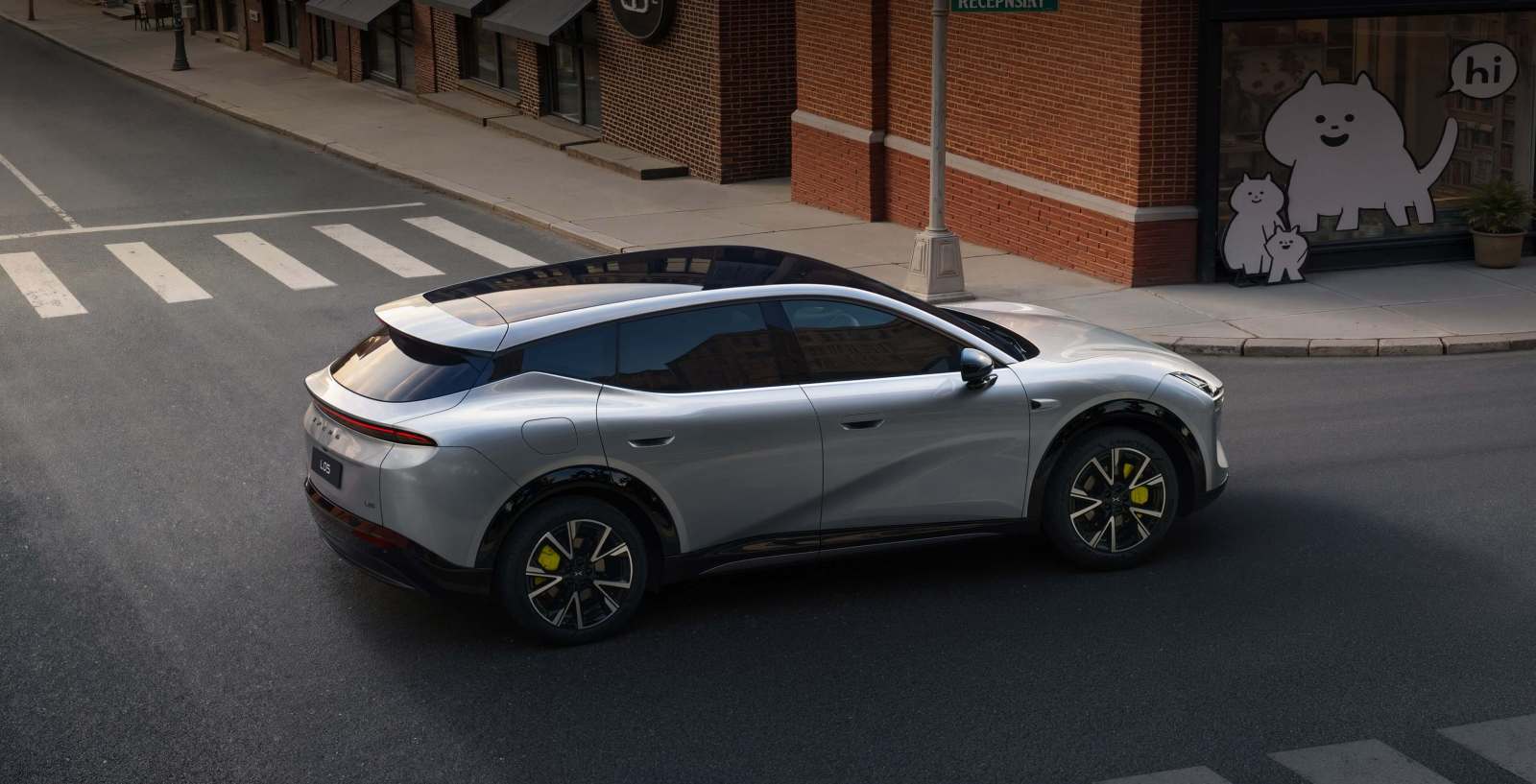
XPeng launched what it calls the world’s first megawatt flash-charging station in Hong Kong on Tuesday, giving the city its first publicly accessible charger at that power tier.
The station, branded X-Energy, was jointly built by XPeng and local charging solutions provider Halo Energy.
Owners of all vehicle brands can use the facility, the company said in a Weibo post announcing operations.
XPeng called the station “another milestone in XPeng’s self-developed charging technology.”
Promotional materials show peak output of 1 MW from the full unit, liquid-cooled charging at 1,000 amps, a grid connection requirement of 240 kilowatts or less, and on-site energy storage of 400 kilowatt-hours.
Station Specifications
XPeng first showed the X-Energy platform to journalists at a media workshop in Munich on July 16, hours before the global launch of its L03 sport utility vehicle.
A company slide reviewed by EV at the time listed peak output at 1,040 kilowatts, grid input compatibility of 120 to 240 kilowatts, and round-trip efficiency of 91.5%.
Hong Kong’s promotional material rounds peak output to 1 MW. Grid input remains consistent with the Munich disclosure.
One new detail emerges from the Hong Kong launch: storage capacity of 400 kilowatt-hours.
XPeng did not disclose that figure in Munich, where the slide showed power output alone.
Storage is the mechanism that bridges the gap between the station’s megawatt-class peak and the sub-240-kilowatt draw on the local grid, allowing operators to avoid costly network upgrades.
The arithmetic sets the limits. At full output the net drain on the battery is about 760 kilowatts, so 400 kilowatt-hours sustains about half an hour of continuous peak delivery, and refilling the buffer at 240 kilowatts takes about 100 minutes.
An XPeng X9 MPV appears alongside the charging unit in the launch image.
All three Hong Kong variants of the X9 carry 5C ultra-fast charging on an 800-volt platform, with peak direct-current charging of 537 kilowatts on the Standard Range model and 542 kilowatts on Long Range and all-wheel-drive Performance trims.
Hong Kong Charging Footprint
XPeng chose Hong Kong as the first stop outside mainland China for its self-branded supercharging network in March 2025, partnering with Malaysian car distributor Sime Darby to build a station at Convention Square in Wan Chai.
Vice-chairman and President Brian Gu said at the time that peak speeds of 360 kilowatts would surpass Tesla Superchargers deployed in the city, which top out at 250 kilowatts.
Halo Energy, the local partner on the megawatt station, describes itself as Hong Kong’s largest universal fast-charging network provider.
Halo partnered with Shell to set up the city’s fastest universal station at the time — 300 kilowatts at China Hong Kong City in Tsim Sha Tsui — and signed a memorandum of understanding with Ricoh Hong Kong in July 2026 to develop enterprise charging and fleet management solutions.
Hong Kong’s electric vehicle fleet reached about 178,000 units by the end of May 2026, accounting for around 19.4% of all registered vehicles, according to figures cited in the Ricoh–Halo agreement.
XPeng launched an integrated charging payment service in the city in February 2026 through a partnership with Ant International’s Antom, integrating AlipayHK into the XPeng app across more than 1,600 public chargers operated by Cornerstone Technologies and EV Power.
In the Weibo post, the company said it “has never stopped exploring new possibilities in the world of EV charging,” framing the Hong Kong station as a step from investing in ultra-fast charging infrastructure to delivering megawatt-class output.
BYD Comparison
Rival BYD launched a first-generation megawatt system in March 2025, pairing 1,000 volts and 1,000 amps for 1,000 kilowatts.
A second generation followed in March 2026, raising peak output 50.0% to 1,500 kilowatts at 1,500 amps through a single charging gun.
European deployment began at the Palais Garnier in Paris on April 8, where BYD showed the charger alongside the Denza Z9GT.
BYD has committed to 6,000 flash-charging stations outside China within twelve months, of which 3,000 are earmarked for Europe.
Chinese installations passed 6,100 by late May 2026, against a target of 20,000 by year-end.
Peak output on the XPeng Hong Kong unit, at 1 MW, sits at 66.7% of the 1,500 kilowatts a single BYD gun can deliver.
Charging operator Eleport has described a standard BYD configuration of two 190 kilowatt-hour units for 380 kilowatt-hours per site, built on Blade 2.0 cells rated for 10C charge and discharge.
XPeng’s 400-kilowatt-hour figure exceeds that configuration on a per-site basis.
Broader Network
XPeng added more than 1,100 self-operated charging stations during 2025, bringing its domestic network to 3,000 stations by year-end.
Globally, the company’s integrated charging network covers 31 countries and regions with more than 2.66 million charging points, including partnerships with Plugsurfing across 27 European countries and Charge+ across Singapore, Malaysia and Thailand.
XPeng plans more than 4,000 ultra-fast charging stations across Europe by 2028, with more than 1,000 self-operated sites across 13 countries.
Plans to deploy 1,000-kilowatt chargers in Europe were first reported by the Federation of Danish Motorists in February, with the first units expected to be operational by year-end.
Each station can charge up to 15 vehicles simultaneously, according to that report, with large integrated batteries reducing grid connection requirements to about 100 kilowatts.
Founder and chief executive He Xiaopeng named the X-Energy platform at the L03 launch in Munich, calling it the basis for Europe’s fastest charging network.
In a January 2025 partnership with BP Pulse, XPeng’s charging arm signed a memorandum of understanding covering solar-powered charging, energy storage, integrated energy networks and demand-side energy management.
XPeng said it will “continue to bring this commitment and spirit of innovation to more cities and more users,” starting from Hong Kong.
No timeline or site count was given for additional megawatt installations outside mainland China.