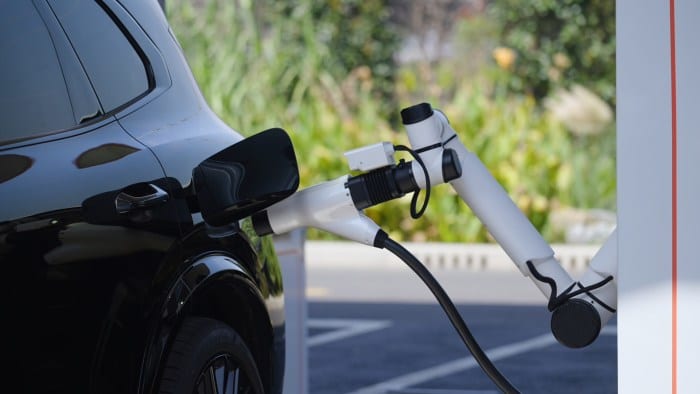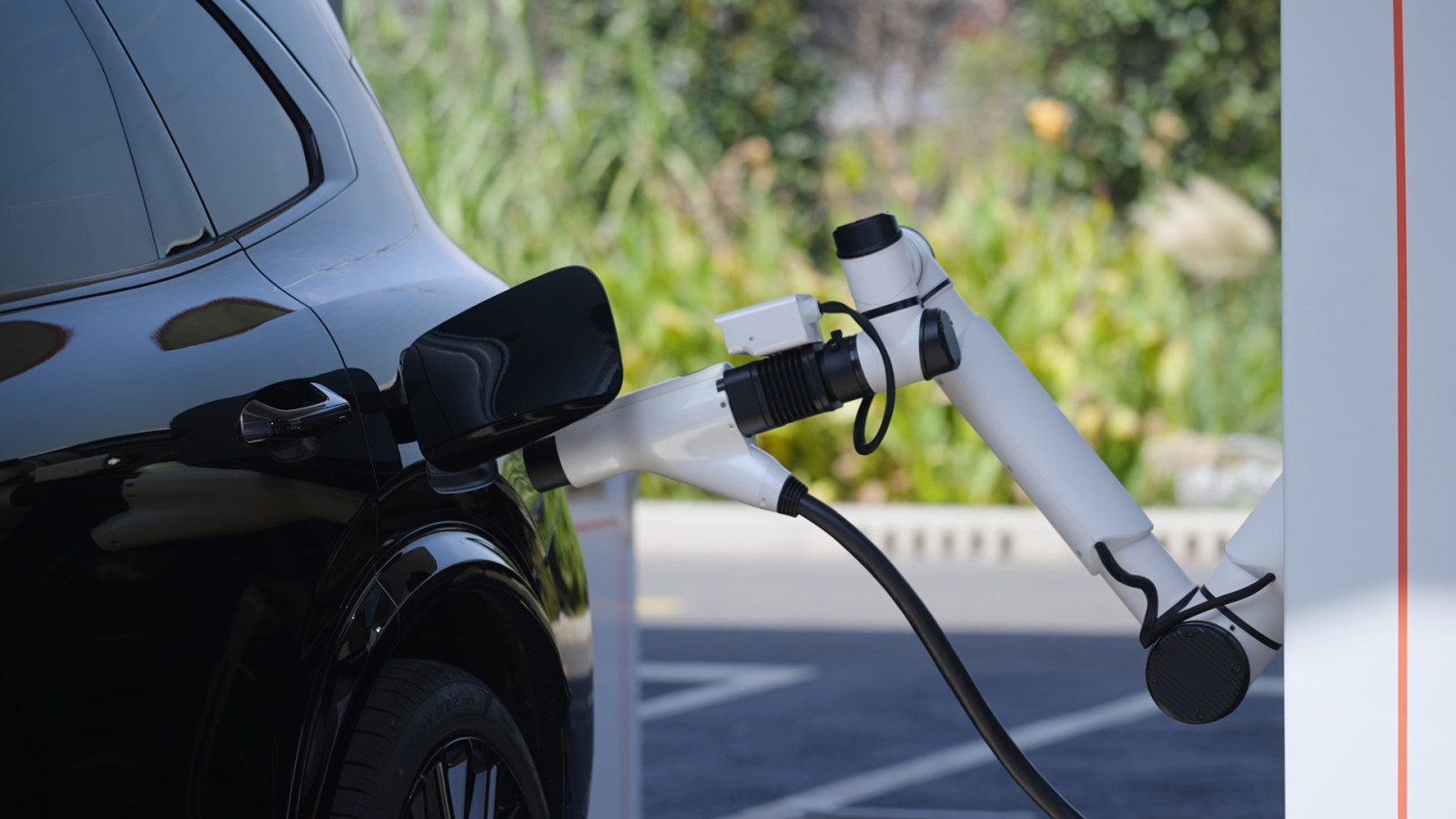

Geely says AI can extend battery life by 20% under repeated ultra-fast charging. The auto giant is the latest Chinese automaker to make durability its main selling point, now that gains in charging speed are shrinking.
The claim was part of Geely Smart Charging, which Geely unveiled on Wednesday in Ningbo. The company did not say what the 20% is measured against.
“Current charging speeds are already approaching the physical limit, and the marginal gains from pursuing even faster speeds in the future will become increasingly small,” Geely executive Zhang Dewang told Reuters at the launch.
Predicting Heat
Geely’s system uses Xingrui PowerMind, an energy AI model developed with the Chinese AI start-up StepFun. Geely and StepFun have worked together since 2023, according to Xinhua.
The model predicts battery temperature up to 30 seconds ahead and adjusts charging power before heat builds up, Geely said. It sets peak current, cooling intensity and charging duration for each vehicle and battery.
The company said the system holds the battery at an average temperature of 55°C during fast charging and keeps its peak below 65°C.
Geely described its five-point liquid-cooling system as the industry’s first. It manages heat across the charging chain, from the station’s storage battery to the charger, cable, charging port and battery pack.
Megawatt chargers already use liquid-cooled cables and piles, and battery packs already use cooling plates. What Geely presents as new is cooling all five points as a single system.
The 65°C figure is the reference limit for charging temperature of lithium iron phosphate (LFP) batteries in the national standard GB/T 44500-2024, which Geely has cited. The standard is a recommended inspection procedure, not a mandatory rule.
In June, Geely said CATARC had measured a peak of 64°C on the battery in a Lynk & Co 10 charging at more than 1,093 kW.
Reversing Fast-Charge Wear
Geely also said it had developed a lithium-ion pulse restoration technology. Micro-pulses of current reactivate lithium that builds up on the negative electrode during repeated fast charging, the company said.
Pulse charging of LFP batteries is an established research field. Geely did not publish the frequency, amplitude or waveform of its pulses, or any anode analysis showing the lithium was recovered.
Combining that with its AI charging management raises battery cycle life by 20%, Geely said. It did not give the chemistry, charging rate or number of cycles behind the figure.
For home charging, Geely described a low-rate charging mode designed to gradually repair wear from repeated fast charging.
Geely also launched a next-generation Shendun Ultra Short Blade battery for cheaper models. Laser-welded cell tabs and covers cut heat during charging by 10%, the company said, and peak charging rises to 6C.
Geely did not say what welding process or charging rate the 10% is measured against, or whether it refers to the cell or the pack.
The updated Galaxy E5, launched the same day, is the first model to carry the 6C short-blade battery and the new charging system, Chinese media reported. It uses an 800-volt platform.
The 4-minute-30-second charging demonstration used a different battery. The Lynk & Co 10 and Zeekr 001 carry Geely’s 12C Shendun Golden Battery.
Geely’s Earlier Numbers
Geely’s durability claims for its short-blade LFP cells date back to their June 2024 launch. At the time, the company said the cells would last 3,500 cycles, which it equated to one million kilometres.
In a livestream on July 29, 2024, Geely took apart the pack of a Galaxy E5 durability test car that had covered more than 300,000 km, to show its structure was intact. In the same livestream, a separate pack that had completed 921 full charge cycles measured 90.5% battery health.
Those figures were produced at much lower charging rates. The 2024 cell charged from 10% to 80% in 17 minutes 4 seconds at an average of 2.45C. That is less than half the 6C now claimed for the affordable battery and about a fifth of the 12C for the performance pack.
Geely registered a new battery company, Zhejiang Jiyao Tongxing Energy Technology, on January 26, 2025, according to corporate records.
It announced in April 2025 that all its battery operations would be merged into the company. It installed 15.08 GWh of batteries last year, up 62.5%, according to the 21st Century Business Herald.
What Rivals Claim
CATL made a similar claim when it launched its third-generation Shenxing LFP battery in April. The cell retains more than 90% of its capacity after 1,000 full fast-charging cycles, Chief Technology Officer Gao Huan said.
The Shenxing charges from 10% to 98% in 6 minutes 27 seconds at a peak rate of 15C, CATL said. Gao said the battery is expected to reach cars in the fourth quarter. CATL has not named the first model.
Gao said the main obstacle to ultra-fast charging is heat, not current. He said a battery’s internal side reactions roughly double for every 10°C rise in temperature.
CATL’s cycle-life figure was measured in a laboratory. How the battery holds up in customer cars has yet to be shown.
BYD launched its second-generation Blade Battery in March with a designed service life of more than one million kilometres. It charges from 10% to 97% in nine minutes, the company said.
BYD’s premium brand, Yangwang, said on August 25 that a U7 sedan kept 98.7% of its battery capacity after more than 350 flash charges and 30,000 km. The car was selected at random from a retail store, the company said.
The test ran for eight days, 19 hours and 58 minutes in Nanning, at an average temperature above 36°C and a constant 240 km/h. Like CATL’s figure, the result came from the manufacturer.
An accelerated test of that length measures wear from repeated charging. It cannot capture calendar ageing, the loss of capacity a battery suffers over years at different temperatures and states of charge.
Some carmakers remain sceptical.
BMW questioned in April whether BYD’s charging speeds come at a cost to range, durability and affordability. It said its Neue Klasse models already charge fast enough for most drivers.
None of the three Chinese manufacturers has published independent data on how their batteries age over years of repeated charging at 6C to 15C.