
BYD will disclose its manufacturing approach for Malaysia within a week, a senior executive told Malaysian reporters in Shenzhen on Saturday, a year after the company announced a wholly owned assembly plant in Perak whose status the government says remains unconfirmed.
“Wait another week and we will announce it,” Liu Xueliang, BYD’s VP and General Manager of its Asia-Pacific auto sales division, said when asked whether the company would work with a local partner or pursue another route, according to state news agency Bernama.
“We will continue to explore, together with local partners, how we can better support the development of Malaysia’s new energy vehicle industry. Of course, our development in Malaysia has also been progressing very well. Very soon, we will announce our approach towards sustainable development,” Liu said after a session titled “Stories of Industrial Integration” at the Asia-Pacific Media Forum, held ahead of the APEC leaders’ meeting China hosts in Shenzhen on November 18 and 19.
Liu did not give a date, a venue or any detail of the announcement, and BYD has issued no statement beyond his remarks.
Two Visits in Four Months
Liu’s remarks follow two disclosed contacts between BYD and Sime Motors, the Sime Darby unit that has been BYD’s sole Malaysian distributor since the brand’s entry in December 2022.
In May, Liu visited the Inokom contract-assembly plant in Kulim, Kedah, a Sime Motors subsidiary, a visit disclosed by Sime Motors rather than by BYD.
In a LinkedIn post reported by Paultan on September 4, Sime Motors said its leadership team had visited BYD’s Shenzhen headquarters to “strengthen collaboration, facilitate knowledge transfer and in-depth discussions” and to “align on strategic priorities and identify areas of mutual interest in support of Malaysia’s growing mobility ecosystem.”
Neither post mentioned local assembly, and BYD has not commented on either visit.
Inokom assembles for seven brands at Kulim, including the BMW i5 and Chery’s Omoda E5, and opened a third paint shop in August that added capacity for 50,000 bodies a year, according to the outlet.
The Tanjong Malim Plant
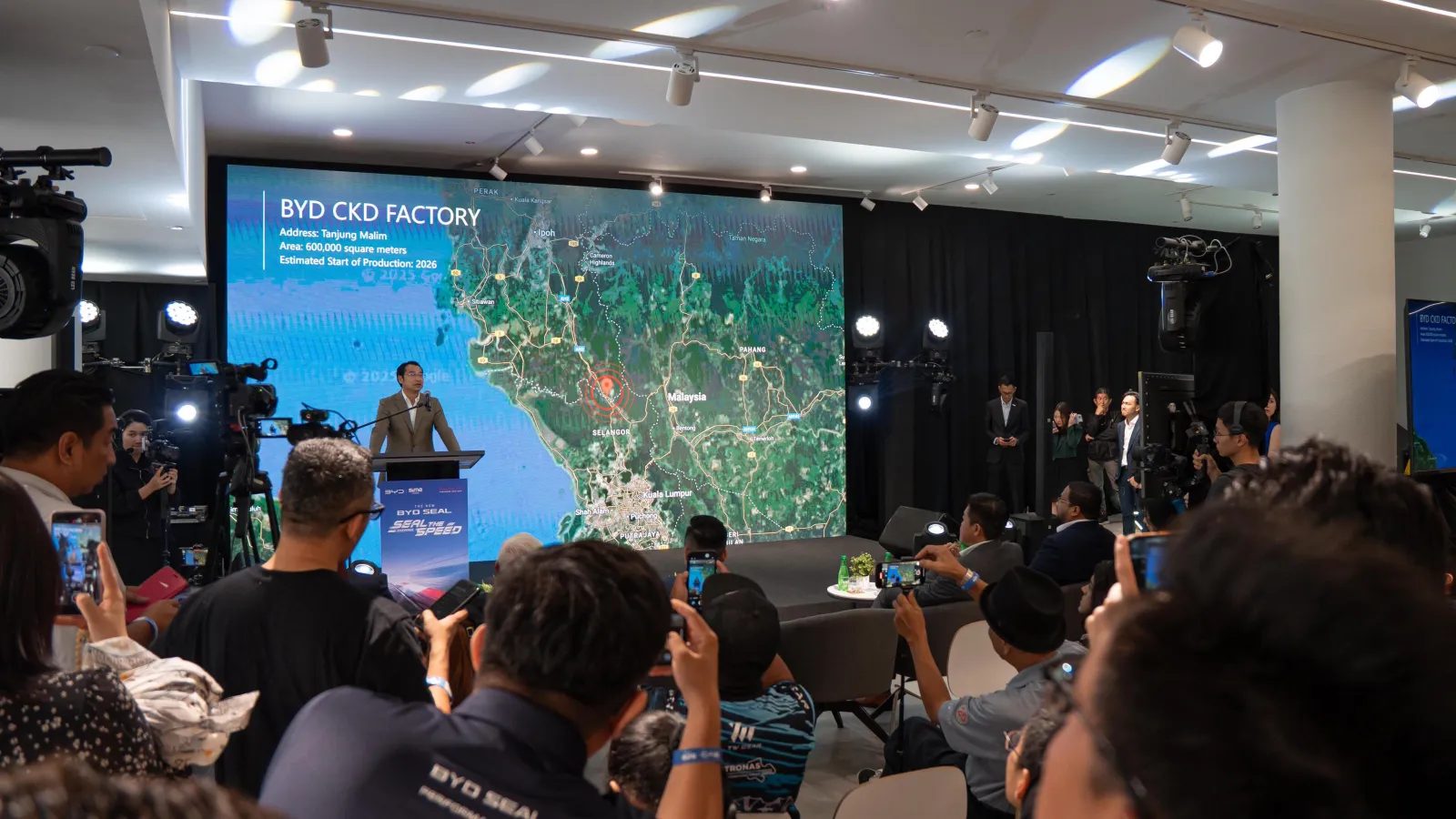
BYD announced its own completely-knocked-down plant on August 22, 2025, at the Malaysian launch of the updated Seal, saying the facility would be fully BYD-funded and begin production in the second half of 2026.
KLK Land said the same day that BYD would be the anchor tenant of its KLK TechPark in Tanjong Malim, Perak, taking 150 acres, or about 600,000 square metres, in the park’s first phase, with infrastructure targeted for completion by the end of 2026.
Perak state executive councillor Loh Sze Yee said construction was expected to run from June to December 2026.
“Malaysia has always been one of BYD’s most important markets in Southeast Asia,” Liu said, according to Nanfang Metropolis Daily, adding that the company looked forward to “working with Malaysian local partners” and that its commitment ran “from local assembly to talent development to the promotion of electric mobility.”
In October 2025, BYD told institutional investors in China that the Malaysian plant was expected to start production in 2026.
The Licence Conditions
The Ministry of Investment, Trade and Industry said in a March 31 statement that BYD Automotive Malaysia had received an interim manufacturing licence on September 29, 2025, to assemble electric and plug-in hybrid vehicles at Tanjong Malim.
The licence caps domestic sales at 10,000 vehicles a year, equal to 20% of BYD’s projected capacity, implying 40,000 units for export; sets a minimum on-the-road price of RM100,000 for locally assembled vehicles sold in Malaysia; and requires body, paint and trim operations to be carried out in the country.
The ministry said the conditions were not specific to BYD but apply to any new CKD entrant licensed from September 2025, with an exception for manufacturers using existing local assembly facilities, according to SoyaCincau‘s account of the statement.
The statement followed a March 30 report by paultan.org that talks had stalled over the terms, and DigiTimes reported on April 21 that BYD was reassessing the project.
Trade Minister Johari Abdul Ghani told the Senate on August 4 that the ministry had received no formal notice on whether BYD would proceed under those conditions.
“Any decision to proceed with, defer or revise its investment plans is a commercial decision for the company,” Johari said, adding that locally assembled EVs remain exempt from import duty, excise duty and sales tax until December 31, 2027, subject to customs regulations and government conditions.
Deputy Minister Sim Tze Tzin had told The Edge in May that carmakers wanting to price EVs between RM100,000 and RM200,000 could work with contract manufacturers, the route MG, XPeng and GWM take with EPMB in Melaka.
The Import Rules
Malaysia’s tax exemption for fully imported EVs expired on December 31, 2025.
Since July 1, newly approved imported EVs must carry a minimum declared cost, insurance and freight value of RM200,000 and a minimum motor output of 180 kW, and the ministry said on July 15 it had no plans to reverse the policy.
Most of BYD‘s Malaysian range fails both tests: the Atto 3 starts at RM125,800, the Seal 6 and Atto 2 at about RM100,000, the M6 at RM109,800 and the Sealion 7 at RM163,800, and the volume models use single motors of 150 kW or less, according to paultan.org price data and SoyaCincau.
Only the Seal, from RM171,800, and the Denza models sit near or above the price threshold.
BYD’s Position in the Market
Sime Motors said in August 2025 that BYD had led Malaysia’s EV market for three consecutive years, and the brand finished 2025 on top with 14,407 registrations, or 15,607 including Denza, a 34.8% share of the 44,813 EVs registered nationally, according to Road Transport Department data compiled by SoyaCincau.
Proton has since overtaken it on the strength of the locally assembled e.MAS 5, with 16,458 registrations in the first seven months of 2026 against BYD’s 6,901, while the overall EV market grew 85.1% in the first half to 31,738.
The Atto 3 remains BYD’s top seller, with 531 registrations in July, second only to the e.MAS 5.
Sime Motors said in November it had more than 24,000 BYD and Denza customers and was targeting 50 BYD outlets by the end of 2026; a sister company, Sime Darby Auto Imports, was named Denza importer in October 2024.
The Regional Network
A Malaysian plant would be BYD‘s fourth manufacturing site in Southeast Asia, after the $490 million, 150,000-unit plant opened in Rayong, Thailand, in July 2024, the $1 billion, 150,000-unit plant in Subang, West Java, and a plant in Cambodia.
Liu also singled out Borneo: “We believe East Malaysia still has significant room for development, but first, we hope to have suitable models for the East Malaysian market,” he said, adding that BYD’s strategy covers the whole country.
BYD’s global sales fell 15.7% to 1,808,511 in the first half of 2026 while overseas sales rose 70.7% to 792,256, leaving foreign markets to carry its full-year target of 5.0 million to 5.5 million vehicles.
Whether the announcement Liu promised will confirm the Tanjong Malim plant, replace it with contract assembly at Kulim, or combine the two, neither company has said.