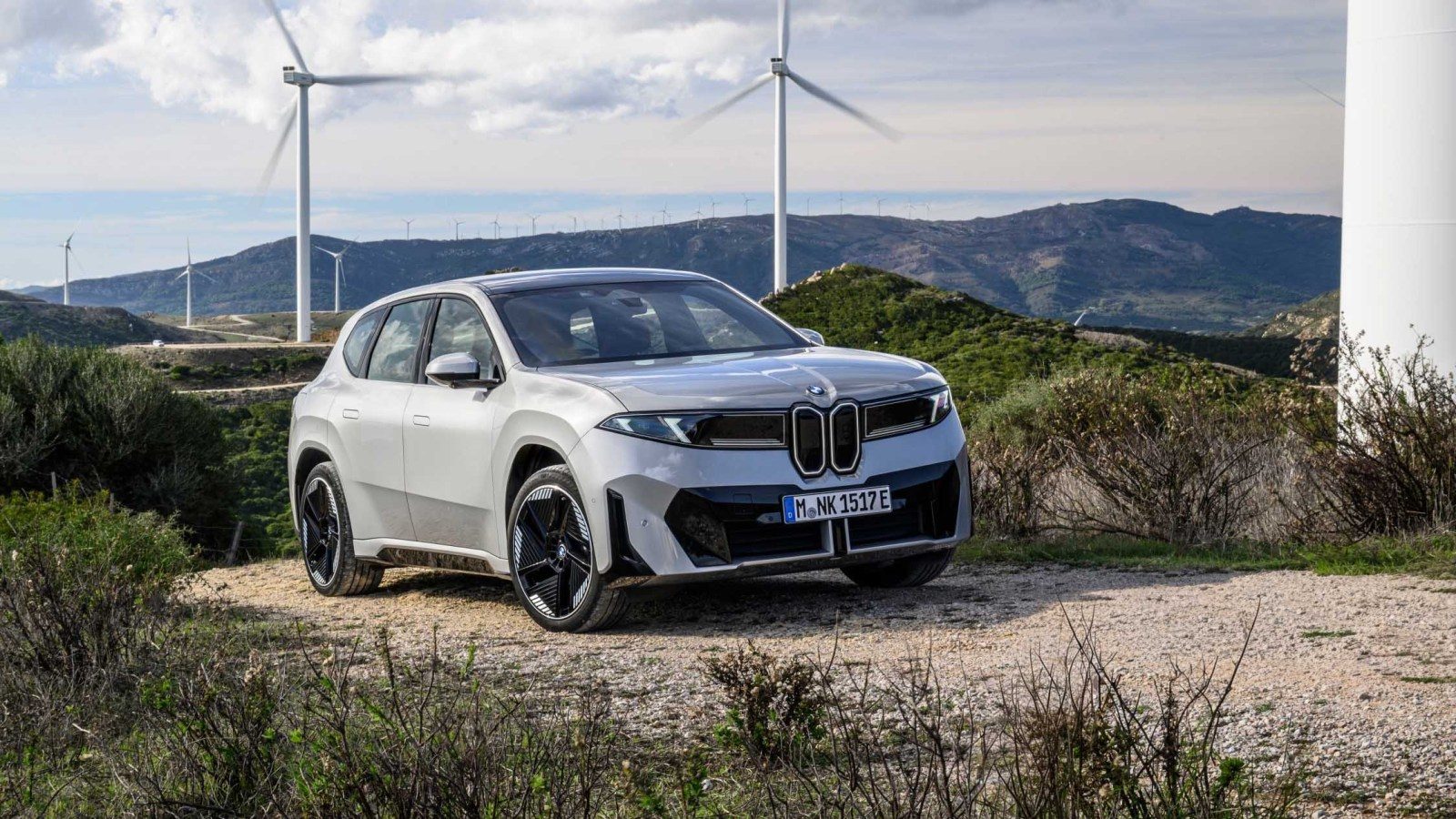

BMW Group has moved its Debrecen plant in Hungary to a third shift, putting the factory that builds the iX3 on 24-hour production, after the electric SUV drew 100,000 orders in Europe in its first year on sale.
The company confirmed both to Hungarian news agency MTI on Thursday. The order figure covers the year since the model’s world premiere on September 5, 2025, and the shift change took effect this month.
Debrecen is the sole source of the standard-wheelbase iX3 for every market that sells it, including the United States, where deliveries begin this month.
The Fastest Ramp
Series production began at the site in late October 2025 on a single shift. A second followed in February, earlier than planned, because order intake ran ahead of the ramp-up drawn up before launch. The 50,000th car came off the line on July 28.
BMW calls the progression the fastest ramp-up of any new plant in its history and puts it at about eight months, a figure that appears to count from full series output early this year rather than from the October start, which is eleven months back.
Plant President and CEO Hans-Peter Kemser tied the pace to recruitment at a site that now employs more than 5,000 people.
“Such a rapid ramp-up is only possible if the workforce grows as quickly as production volumes,” he said. “Bringing in and training so many new colleagues in such a short time is the result of extraordinary teamwork.”
The Order Number
The 100,000 threshold had been approaching for some time. BMW said in late July that it was on track to reach the figure soon, and repeated almost identical wording in its two-million-BEV announcement in August.
Seven weeks passed between those statements and the milestone.
Orders are also not deliveries, and the two diverge when supply is tight, which is the condition that prompted the third shift in the first place.
One in three fully electric BMWs ordered in Europe since the iX3’s premiere has been an iX3, and within the X3 family one in every two orders is now the electric version, a rate BMW Italy chief Sergio Solero said at the Turin Auto Show last weekend still holds.
A Falling Global Line
The demand is concentrated in one region. BMW’s European fully electric deliveries rose 38% in the second quarter to 81,445 units, and fully electric cars took around 28% of its European sales in the first half.
Globally the picture inverts.
The group delivered 204,295 battery-electric vehicles worldwide in the first six months, down 7.4% year on year, with fully electric cars at 17.6% of passenger car sales, below the roughly 18% recorded for all of 2025.
China deliveries fell sharply across the half and US battery-electric volumes dropped after the federal tax credit expired, while overall US deliveries rose.
BMW’s own milestone announcement last month, marking the two-millionth fully electric delivery, contained no global battery-electric figure at all.
The Plant
Debrecen sits on more than 400 hectares northwest of the city, in eastern Hungary, and represents an investment of around €2 billion ($2.3 billion).
BMW announced the location in July 2018, decided in December 2020 to dedicate it to fully electric cars and laid the foundation stone in 2022.
It runs press shop, bodyshop, paint shop, assembly and battery assembly on one site, the last built with EVE Power as partner.
BMW describes it as the first of its car plants to operate without fossil fuels in normal running, cutting per-vehicle production emissions by about 90%, to roughly 34 kg of CO2 equivalent. A 50-hectare photovoltaic array of 71,000 panels rated at 43 MW covers about a quarter of annual electricity demand.
Planned capacity is around 150,000 vehicles a year, which leaves headroom above the current run rate. A second Neue Klasse model enters production there this autumn, unnamed by BMW and widely assumed to be the iX4, a coupé version of the iX3.
Standard-wheelbase assembly extends to San Luis Potosí in Mexico from the second half of 2027.
The iX3
The iX3 is the first series-production Neue Klasse model, on an architecture BMW plans to carry across 40 new or updated models by the end of 2027.
The standard-wheelbase car carries the NA5 code, while the long-wheelbase NA6 is built at BMW Brilliance’s Dadong plant in Shenyang for China.
The entry iX3 40 is rear-wheel drive with an 82.6 kWh usable nickel-manganese-cobalt pack of cylindrical cells in a cell-to-pack layout, 320 hp and 500 Nm, reaching 100 km/h in 5.9 seconds and rated at up to 637 km on the WLTP cycle, a figure BMW has also published as 635 km and which falls with larger wheels. It starts at €63,400 ($73,500).
The iX3 50 xDrive adds a front motor for 463 hp and 645 Nm, uses a 108.7 kWh pack and is rated at up to 805 km. It was listed at €70,900 ($82,200) in March and has appeared higher since, so the current figure is worth checking against the configurator.
Both run an 800-volt architecture, charging at up to 300 kW on the 40 and 400 kW on the 50 xDrive, with a 10 to 80% fill quoted at 21 minutes for each, and both support bidirectional charging to the home and the grid. In the United States, the iX3 50 xDrive starts at $61,500.