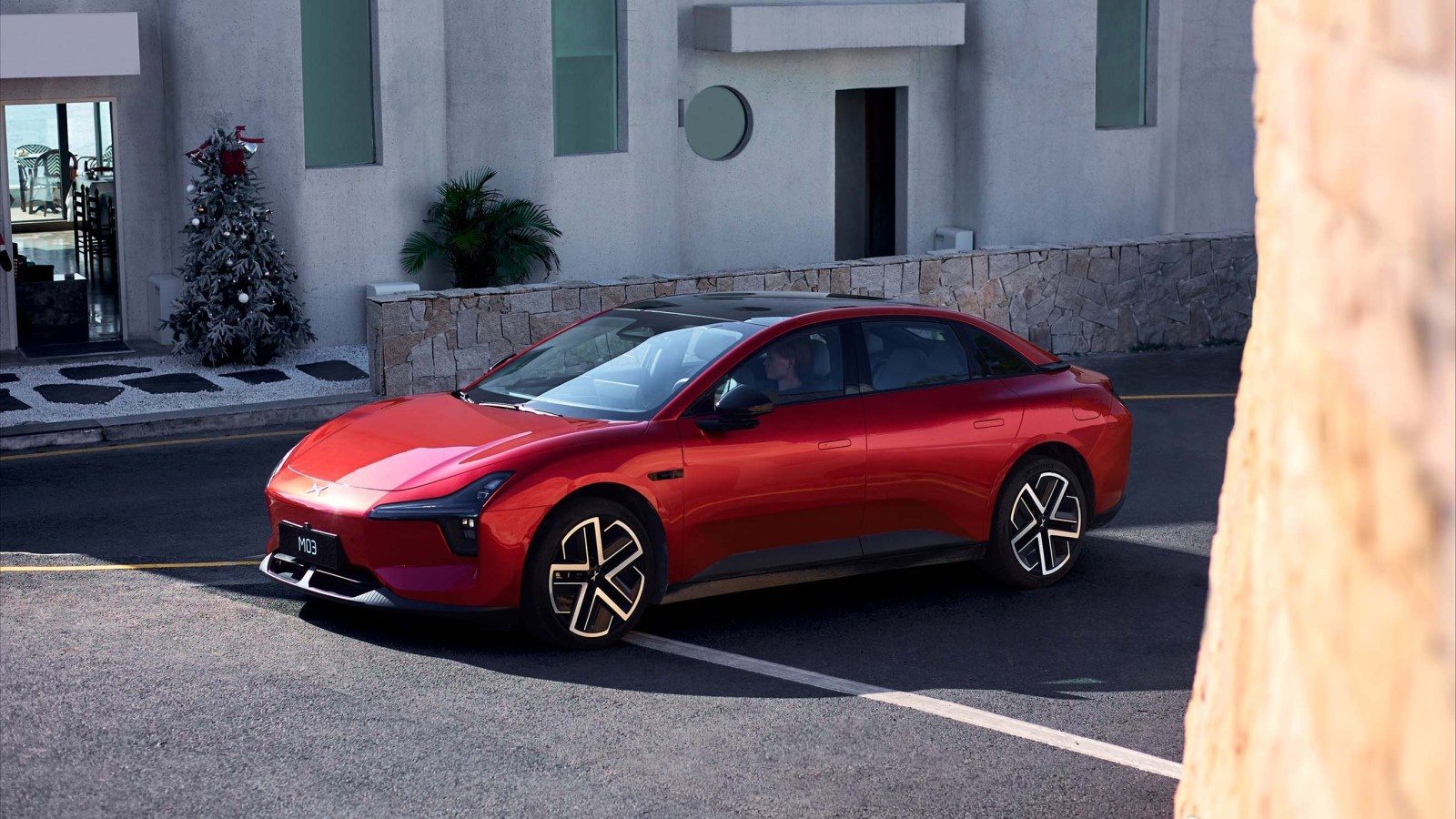

When XPeng unveiled the Mona M03 in Guangzhou on August 28, 2024, the all-electric hatchback coupe arrived with a starting price of 119,800 yuan (about $16,800) and a job to match.
The Mona M03 delivered the volume needed. More than a year later, the car’s monthly swings move XPeng‘s numbers, a measure of how much the brand has come to lean on a single low-priced model.
EV attended the launch, where XPeng staged the reveal at its 10th-anniversary gala alongside a self-developed artificial-intelligence chip and a new smart-driving vision system.
The 119,800-Yuan Launch
XPeng priced the Mona M03 in three versions between 119,800 and 155,800 yuan (about $16,800 to $21,800), with deliveries set to begin in September 2024.
Chief Executive Officer and Chairman He Xiaopeng framed the car as the product of a decade of in-house smart-driving work.
He said the company had always aimed to build an easy-to-drive smart car for China’s technology enthusiasts, and set a goal for its next decade: “to become a global technology company centered on AI-powered vehicles.”
He Xiaopeng also offered three predictions for the years ahead, forecasting that only seven mainstream Chinese car brands would survive, that XPeng‘s annual sales of AI-powered vehicles would reach one million units, and that half of its sales would eventually come from overseas markets.
A Coupe Built to Undercut
The Mona M03 is an all-electric hatchback coupe measuring 4,780 millimeters long with a 2,815-millimeter wheelbase.
XPeng said the car offered the largest trunk in its class at 621 liters and the only standard electric hatchback tailgate among its rivals.
Its design, which XPeng said was shaped by AI-driven aesthetic analysis, was pitched as comparable to coupes costing around 200,000 yuan.
A drag coefficient of 0.194 gave the car what XPeng called world-leading wind resistance among mass-produced all-electric hatchbacks.
The pitch was straightforward, offering a sporty, spacious electric coupe at a price that started below 120,000 yuan.
Smart Driving Under 200,000 Yuan
Where the Mona M03 broke from its price class was assisted driving.
XPeng offered two versions, the standard M03 and the M03 Max, with full-scenario smart parking and more than 20 pieces of smart hardware fitted as standard across the lineup.
The M03 Max went further, carrying XPeng‘s full-scenario XNGP system, which the company said covered all public roads in China.
XPeng called it the industry’s only urban smart-driving solution priced under 200,000 yuan, a claim that placed advanced autonomy in a segment that had never offered it.
Deliveries of the M03 Max were scheduled to begin after the Chinese New Year in 2025, a few months behind the standard car.
For a brand that sold only battery-electric cars, the message was that volume and AI ambition would advance together, with the Mona M03 supplying the volume.
A Volume Engine in 2025
The Mona M03 became exactly that.
Domestic sales held in a steady band through 2025, running from 15,225 units in January to a peak of 16,593 in March, easing to a low of 10,900 in May, then climbing back above 14,000 for most of the second half and reaching 16,309 in October.
For the full year, the car sold about 175,345 units in China, averaging roughly 14,600 a month.
That consistency made the Mona M03 a dependable source of volume for XPeng at the affordable end of its range, and the engine behind much of the brand’s expansion since launch.
The Dependence and the 2026 Slump
Then the floor gave way.
Mona M03 sales in China fell to 6,718 units in January 2026, down 56% from a year earlier, and to 4,373 in February, a 71% drop.
March brought 9,306 units, still down 44%, before the decline narrowed to 13,595 in April, off just 4%.
May returned the car to growth, with 14,160 units, up 30% year over year, though that gain leaned on a soft comparison, since May 2025 had been the model’s weakest month at 10,900 units.
Through the first five months of 2026, the Mona M03 sold about 48,152 units domestically.
The scale of that reliance was clear in May 2026 itself.
Of XPeng‘s 25,655 sales in China that month, the Mona M03 accounted for 14,160, or roughly 55%, more than the brand’s other seven models sold combined.
Behind it, the P7+ managed 3,677, followed by the G6 at 2,164, the P7 at 1,896, the G7 at 1,672 and the X9 at 1,557, while the newer GX and the G9 trailed at 270 and 259.
Measured against XPeng‘s total deliveries, which include exports, the share is lower but still substantial, at 34.05% of the 27,415 vehicles delivered in March, 44.17% of the 31,011 in April, and 36.43% over the first four months of 2026, according to CPCA data compiled by CnEVPost.
That the domestic figure sits higher reflects how concentrated the model is at home, since the M03 sells almost entirely in China while exports pad the rest of the range.
Since its launch, the Mona M03, now priced from 119,800 to 151,800 yuan, has delivered 258,429 units.
The swing exposed the cost of relying on one inexpensive model.
When the Mona M03 stumbles, as it did in early 2026, the drop flows through to XPeng‘s volume, because few other models in its range sell in the same numbers at the same price.
Other Models
The company began delivering the GX, a premium SUV, in late May, though the model contributed just 270 units as deliveries were only starting.
XPeng is also taking the Mona series abroad.
The company will bring the Mona line to Europe in July, led by the upcoming L03 SUV and followed by a new premium SUV, XPeng‘s managing director for the UK and Europe, Elvis Cheng, said at the Financial Times Future of the Car summit in London.
Cheng made the comments in response to a question from EV about whether limited assembly capacity at Magna Steyr’s Graz plant, which he had flagged earlier in the same session, would delay the European rollout.
He said XPeng would host a brand event in Munich in July to announce the models for the region, and that the company was in parallel talks with shareholder Volkswagen Group and other potential partners about additional European manufacturing.