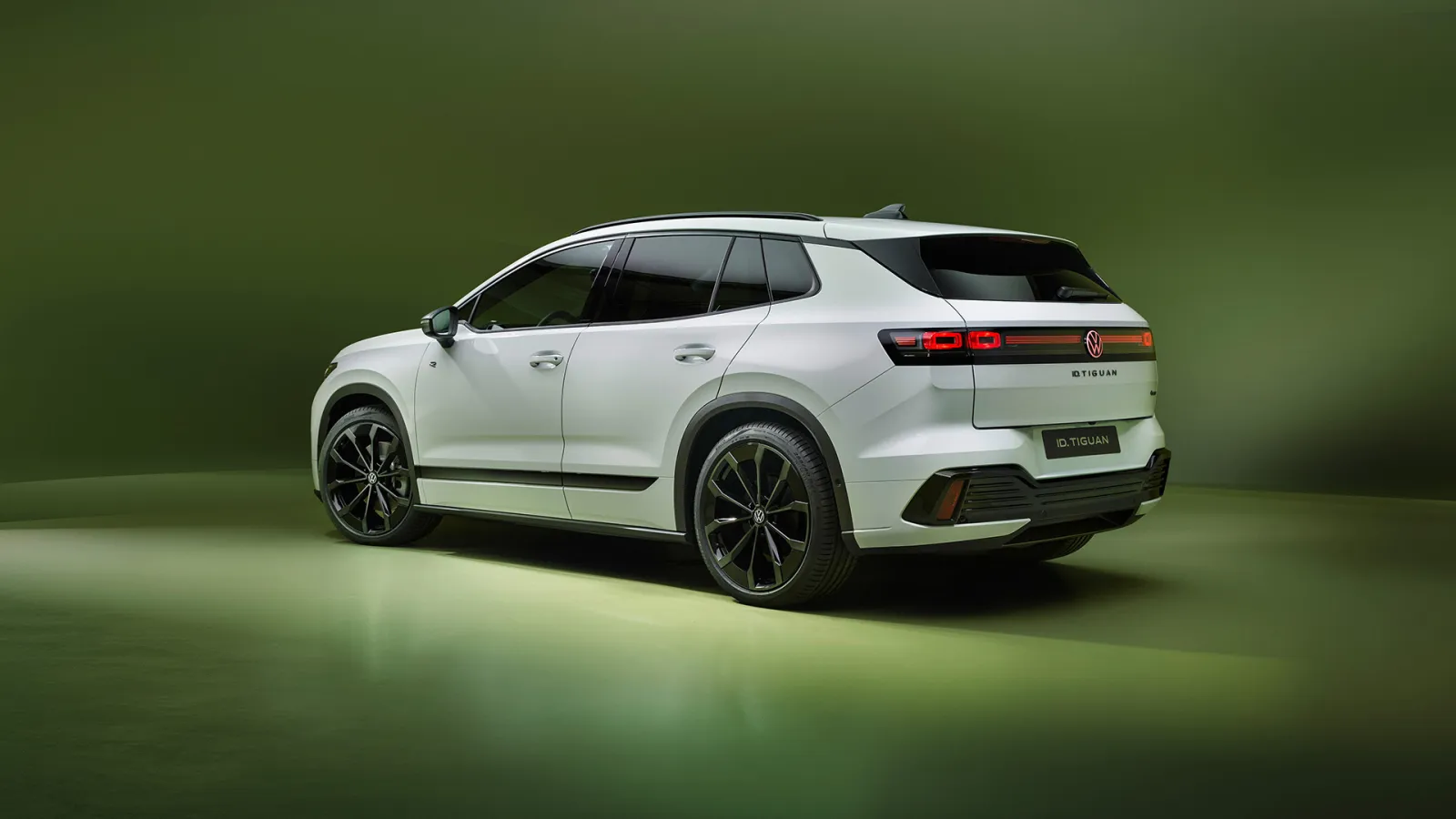
Volkswagen revealed the ID.3 GTI on Wednesday, its second electric GTI after the ID. Polo GTI shown in May, and claimed the title of most powerful series-production GTI in the nameplate’s 50-year history.
Pre-sales open in early 2027, with no price announced.
Volkswagen describes the car as a near-production concept; range, acceleration and consumption figures remain preliminary.
The reveal comes in a crowded week for the brand.
Volkswagen on Monday claimed three world drag-coefficient records with a concept built on ID.Polo hardware, the same day reports surfaced that the group had earmarked €16 billion for job cuts and plant closures.
Separately, its robotaxi investor search collapsed after Uber and Lyft pulled out on Wednesday.
Same Motor, New Badge
Mechanically, the ID.3 GTI is a recalibration of the outgoing ID.3 GTX Performance rather than a new powertrain.
Both use the APP550 permanent-magnet synchronous motor on the rear axle, producing 240 kW (326 PS) and 545 Nm of torque, and both draw from a 79 kWh lithium-ion battery with a WLTP range of up to 601 km.
Rear-wheel drive is standard — a first for any GTI. Differences are marginal.
Volkswagen quotes a 0–100 km/h time of 5.6 seconds for the GTI, one-tenth quicker than the GTX Performance’s 5.7 seconds, a gap the company attributes to Launch Control being standard and to revised software calibration.
Charging goes the other way. DC charging peaks at 183 kW against the GTX Performance’s 185 kW, and the 10 to 80% time rises from about 26 to 27 minutes to around 29. The most powerful GTI Volkswagen has built charges more slowly than the model it replaces.
Top speed remains electronically limited at 200 km/h.
Preliminary combined consumption is forecast at 14.5 kWh/100 km.
The 326 PS figure edges the combustion Golf GTI Edition 50 — which Volkswagen released earlier this year to mark the anniversary — by a single horsepower.
A Cupra Born VZ, which shares the same APP550 motor and 79 kWh battery, matches the sprint time and lists at €50,990 in Germany.
Volkswagen has not disclosed where the ID.3 GTI will be priced relative to either car.
Chassis and GTI Mode
Where the GTX Performance already fitted adaptive DCC sports dampers, the GTI adds a dedicated drive mode, GTI-specific damper, spring and anti-roll-bar tuning, and direct progressive steering as standard.
A button at the six o’clock position on the new multifunction sports steering wheel activates GTI mode, which sharpens throttle mapping, steering weight and chassis response while enabling Launch Control.
Ambient lighting switches to red, the digital cockpit adopts a GTI-specific layout, and a synthetic combustion-engine soundtrack plays through the cabin speakers.
Eco, Comfort, Sport and Individual profiles remain alongside the new mode.
Design Departs from GTX
The ID.3 GTI is built on the refreshed ID.3 Neo body, not the outgoing GTX shell, and the design philosophy diverges in one visible way.
The GTX used a contrast black roof, spoiler and tailgate.
Volkswagen finishes all three in body colour on the GTI, creating a longer silhouette.
Standard 20-inch Wörthersee alloy wheels — named after the Austrian lake that has hosted the annual GTI enthusiast meet for decades — replace the GTX’s wheel design.
A red horizontal stripe sits above the LED light bar between the IQ.LIGHT LED matrix headlights, referencing the red radiator grille frame of the original 1976 Golf GTI.
Vertical red bumper elements and a high-gloss black honeycomb air intake sit lower in the front fascia.
Five exterior colours are offered: Tornado Red (colour code LY3D, first used on the facelifted Mk1 Golf GTI), Moonstone Grey, Scale Silver, Grenadilla Black and Glacier White.
Interior Draws on 1976 Original
Inside, the GTI cabin follows the ID.3 Neo’s redesigned architecture, which brings a larger Digital Cockpit, a 12.9-inch Innovision infotainment display, a physical button strip for climate controls and a rotary volume knob, features absent from the older GTX interior.
Premium sport seats wear a new GTI tartan derived from the 1976 Golf GTI’s check upholstery, with red topstitching and a red 12 o’clock marking on the steering wheel. A red stripe runs across the full width of the dashboard.
Options carried over from the ID.3 Neo are expected to include a panoramic sunroof, massage and memory functions for the front seats, a 480-watt Harman Kardon sound system, an augmented-reality head-up display and a removable bicycle-carrier bracket rated at 75 kg. Vehicle-to-load charging is available through an adapter called PowerSocket, connected at the car’s charge port, and Travel Assist gains the ability to respond to red traffic lights.
The ID.3 GTI is built at Volkswagen’s Zwickau plant in Saxony, where all ID.3 variants are produced.
Volkswagen has not confirmed whether the GTI badge will extend to the ID.4 or ID.7, which currently use the GTX designation.
A Difficult Week
The reveal lands in a crowded fortnight for the group.
Volkswagen presented a near-production concept called Mission Efficiency on Monday, built on ID. Polo hardware, claiming three world drag-coefficient records including a figure of 0.158.
Reuters and Spiegel reported on September 10 that the group had earmarked €16 billion ($18.7 billion) for job cuts and plant closures.
And Manager Magazin reported on Wednesday, citing people involved, that Uber and Lyft had both walked away from talks to take a stake in Volkswagen’s autonomous driving unit, ending its first attempt to find outside investors for the Moia robotaxi programme. Volkswagen has not confirmed the report.