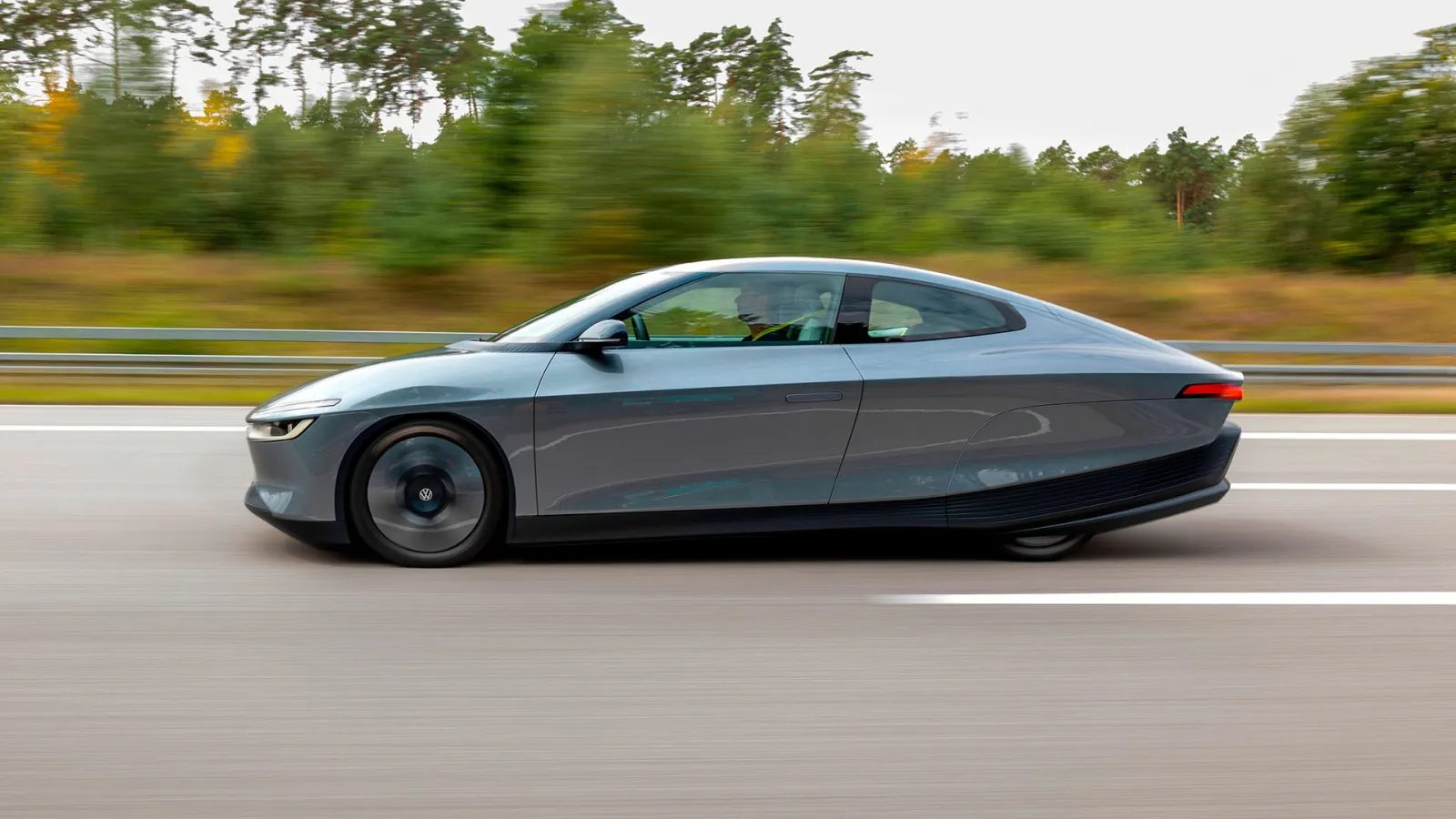

Volkswagen claimed three world records on Monday with a concept car called Mission Efficiency, including a drag coefficient of 0.158 that it says is the lowest of any road-approved vehicle, and said it achieved them using the motor and battery family from the ID. Polo.
The vehicle has European road approval and was certified by Germany’s Record Institute in the category of a near-production four-seat electric vehicle suitable for everyday use.
Volkswagen set the three out in its release.
“Record number one: the vehicle achieves a Cd value of 0.158, a new record for road-approved cars. Record number two: consumption of 6.48 kWh/100 km during a so-called ‘ideal trip’, during which the speed, in this case 68 km/h, remains constant, there are no uphill slopes and peripheral consumers such as the air conditioning system are deactivated,” the company said in the release. “Record number three: thanks to its aerodynamics and a highly efficient electric drive from the ID. Polo, the Mission Efficiency is also the most economical near-production electric car in its class.”
On a documented drive of 1,278.36km from Volkswagen’s development centre at Wolfsburg to Vienna via Poznań and Olomouc, the car used 6.89 kWh/100km at the battery and 7.51 kWh/100km counting charging losses.
It averaged 67.72 km/h, reached a top speed of 138 km/h, charged once and arrived with 164km of range left in a 54.9kWh net battery.
Thomas Schäfer, the Volkswagen brand chief and Head of the group’s core brands, framed it as a statement about the company rather than the car.
“Mission Efficiency is the ideal way to demonstrate what distinguishes Volkswagen in the electric age: technology for the masses, not just for the few,” he said. “Rather than using specialist technology, the vehicle set its three world records using affordable production technology from the ID. Polo and ID. Cross, based on the MEB+ platform with front-wheel drive. This shows how much potential efficiency we can add to the latest generation of our electric cars […].”
The car is not for sale.
Volkswagen labels it a concept vehicle and lists it under studies on its own newsroom, alongside a link to the XL1, the two-seat diesel hybrid it built between 2014 and 2016 at a drag coefficient of 0.189.
How It Was Done
The body is a teardrop, 4,775mm long and 1,392mm high, with a frontal area of 2.08 square metres and a long tapering tail.
The rear wheels are clad, the underbody is clad, the windows are frameless and the door handles are flush. Active cooling flaps at the front admit only as much air as the car needs.
The wheels got particular attention because they account for roughly a quarter to 30% of a car’s aerodynamic drag. Volkswagen fitted patented rim deflectors designed to stop air circulating inside them.
Continental supplied a concept tyre based on the EcoContact 7 with rolling resistance of 4.9 kilograms per tonne, which Volkswagen says is about 25% below the threshold for the European Union’s best tyre label.
The front axle and hydraulic front brakes come from the ID. Polo. At the rear, Volkswagen and the supplier AUMOVIO fitted an electromechanical brake, which the company says cuts friction losses, removes the rear brake fluid lines and improves recuperation.
A photovoltaic system rated at 370W is built into the glass roof and boot lid. It powers the car’s electrical systems rather than charging the battery, and Volkswagen says that depending on season, region and weather it can add up to 30km of real range a day.
That is an energy input the consumption figures do not net out.
Weight came out of the cabin. Lightweight panelling, a portable Bluetooth box in place of a speaker system, and what Volkswagen calls a bring-your-own-device layout, in which a phone or tablet on a rail replaces the infotainment screen.
The rear seats are described as suitable for passengers up to about 1.6 metres. The boot holds 481 litres, more than an ID. Polo’s.
Volkswagen says consumption above 80 km/h is more than 30% lower than an ID. Polo’s, and that at 140 km/h the concept uses about as much energy as an ID. Polo at 100.
The Shape
The proportions will look familiar to anyone who saw Tesla’s Cybercab, unveiled in October 2024 and now carrying passengers in Austin. Both are low teardrops with covered rear wheels, minimal ornament, a long tapering tail and a small frontal area, because that is what a car optimised for drag above all else ends up looking like.
The resemblance stops at the door. The Cybercab is a two-seat robotaxi with butterfly doors, no steering wheel, no pedals and inductive charging, built to minimise cost per autonomous mile.
Mission Efficiency has a steering wheel, pedals, four seats and a conventional plug, and Volkswagen’s stated lineage is its own XL1 rather than anything from Tesla.
The numbers are not comparable either, though they are worth knowing. The Cybercab is certified by the US Environmental Protection Agency at 165 Wh per mile, which is 10.25 kWh/100km and makes it the most efficient production electric car on the agency’s list.
Volkswagen’s concept ran at 6.89 on the Vienna drive, about a third less, on a hypermiling route rather than a regulatory cycle.
Reading the Numbers
The three consumption figures measure different things and the gap between them is 16%.
The 6.48 came at a constant speed with the climate control off. The 6.89 is the Vienna drive measured at the battery. The 7.51 is the same drive counting the energy that went into the charger. Only the last of those is what a driver would pay for.
The Vienna average of 67.72 km/h over 1,278km is a hypermiling pace rather than normal motorway driving. Volkswagen publishes the figure and the 138 km/h top speed alongside it.
The comparison with production cars has the same problem in reverse. The ID. Polo at 155kW is rated at 14.6 to 13.3 kWh/100km on the WLTP cycle and the ID. Cross, which arrives in autumn from about €28,000, at 16.9 to 14.3. Those are regulatory laboratory figures.
The concept’s road figure of 6.89 is about half the Polo’s WLTP combined rating, which is a comparison between two different kinds of measurement rather than between two cars driven the same way.
The Wider Argument
The claim Volkswagen is making is not about the concept. It is that the hardware in a €24,995 car has headroom that bodywork alone can unlock, which is the opposite of the industry’s usual answer of a bigger battery.
Mercedes-Benz made the same case with the Vision EQXX in 2022, at a drag coefficient of 0.17, and never built it.
The demonstration lands eleven days after Volkswagen’s supervisory board approved a plan that sets capital and research spending at €135 billion for 2027 to 2031, halves the model range by 2035 and leaves four German plants without confirmed production after 2031.
Two of those four, Emden and Zwickau, build the company’s current electric cars.
The cars that will actually move Volkswagen’s European electric sales arrived this year on the same MEB+ platform.
The ID. Polo from €24,995, the ID. Cross from about €28,000, and a reworked ID.3, alongside the Cupra Raval and Škoda Epiq.