
Porsche has begun taking orders for its inductive home charging system, a year after demonstrating it at the IAA Mobility show in Germany, making the Cayenne Electric the only model in its range that is offered.
“All components of Porsche Wireless Charging are now available to order in Germany and other European markets,” the company said on Wednesday, in a release covering options for the new model year. The system is being rolled out worldwide in stages.
The offer is planned in all countries with Porsche Connect, and it is not available in China.
How It Works
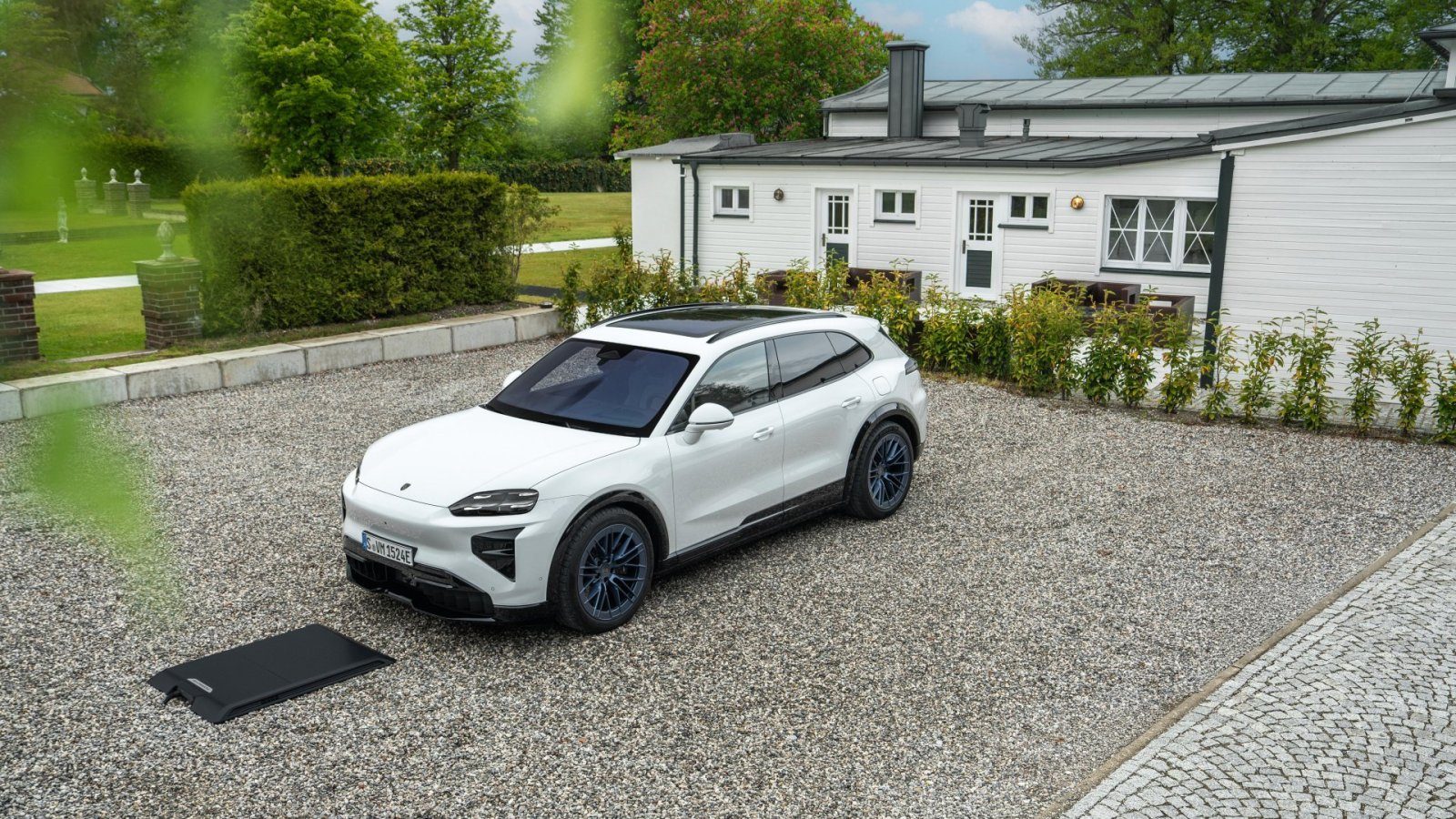
The system has three parts: preparation built into the vehicle at the factory, a pad on the underbody, and a ground pad installed in the parking space.
The driver parks over the ground pad and charging begins automatically. Power transfers at up to 11 kilowatts, at about 90% efficiency.
The ground pad is weatherproof and can be installed outdoors. Motion sensors stop charging if a living creature approaches the vehicle or the pad, and foreign object detection cuts power if a metallic object on the pad heats up.
Porsche demonstrated the system on a camouflaged Cayenne Electric at the IAA Mobility show on September 4 last year, and said then that about 75% of charging on its electric cars happens at home.
The Speed
The wireless system matches the standard cable. It is slower than the 22 kilowatt cable Porsche offers as an option, and far slower than direct current charging, which the car takes at up to about 400 kilowatts.
Porsche has said the contactless system reaches the level of wired alternating current charging at the same 11 kilowatts.
The company’s case is convenience rather than speed, and the release makes no claim otherwise.
Wednesday’s release contains no pricing.
Figures reported since the system was announced put the German hardware at about 2,000 euros for the vehicle side and 5,000 for the ground pad. American estimates have been around $1,650 and $6,500, with installation by a qualified electrician adding $1,000 to $2,000.
None of those is a Porsche figure.
One Model Line
The system is not offered on the Macan Electric or the Taycan, Porsche’s two other fully electric models.
Maximilian Müller, the company’s High-Voltage Engineering Lead, has been quoted saying the receiver cannot physically fit between the front suspension of those cars, and that later models are under discussion.
The Cayenne is wider, and the pad sits under the front motor between the front wheels.
That confines the system to the newest of Porsche’s three electric lines. The Macan Electric delivered 15,620 units in the first half of this year and the Taycan 6,219, while customer deliveries of the Cayenne Electric began only at the end of June.
It also cannot be retrofitted. Without the factory preparation package, a car cannot take the system later.
The Wider Position
Porsche has said it is the first manufacturer to bring an 11 kilowatt one-box inductive system for battery-electric vehicles to market, meaning all components other than the supply cable sit inside the floor plate, with no wall box or separate control unit.
It is not the first wireless charging offered on a car. BMW sold the option on the 530e plug-in hybrid in 2018, at about 3.2 kilowatts, and Mercedes-Benz has offered it on a plug-in hybrid S-Class.
Those were low-power systems on plug-in hybrids rather than one-box units for battery-electric cars. Genesis has tested similar systems.
The announcement arrives with Porsche’s electric share moving backwards. Fully electric vehicles accounted for 19.4% of deliveries in the first half, down from 23.5% a year earlier, against unchanged full-year guidance of 24% to 26%.
Total deliveries fell 16% to 122,306, with China down 32%.
Wednesday’s release also added electrically operated doors, a massage function with 4D audio, and the Paint to Sample programme, which takes the Cayenne Electric’s colour choices to 105.