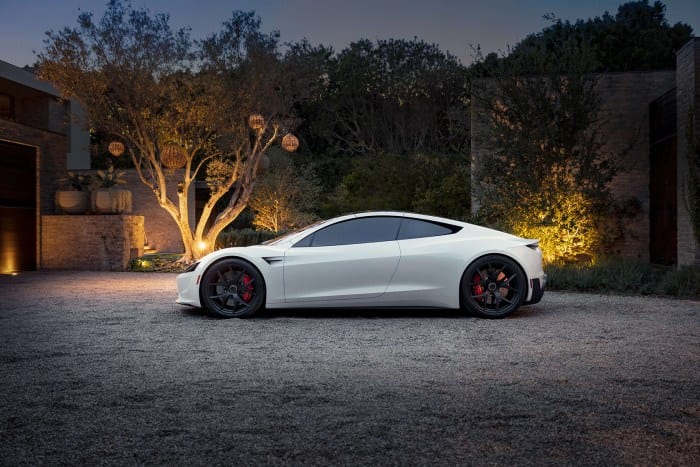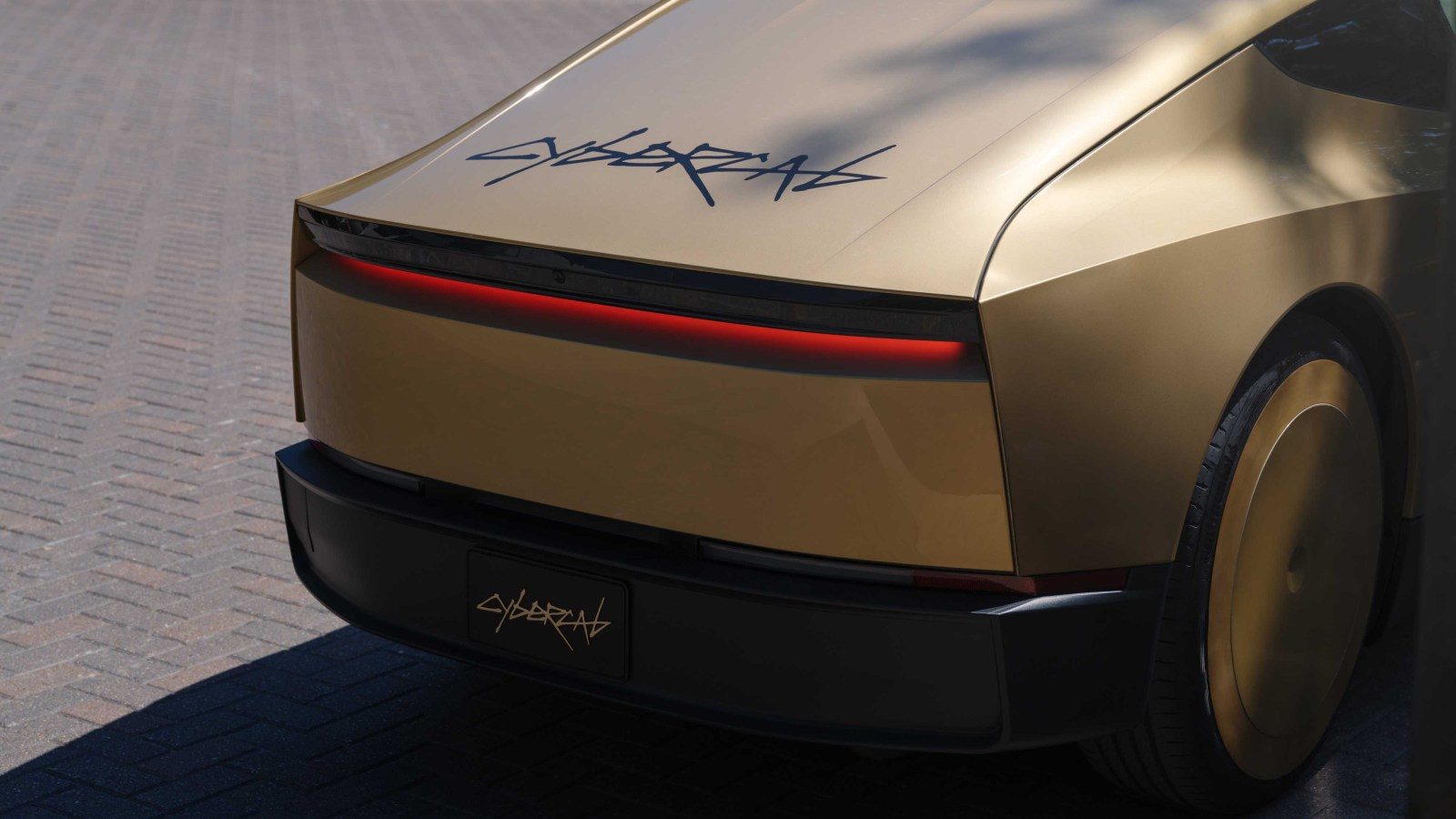

Tesla‘s Cybercab has no onboard charger and cannot take alternating current from a wall connector, a public Level 2 station or a household outlet, leaving the vehicle dependent on DC fast charging through a concealed port until Tesla’s wireless system arrives.
“Yes to confirm it does not support AC charging,” Kyle Conner, founder of the Out of Spec channel, wrote on X on September 4, the first public statement of the limitation.
“Perhaps if they ever sell a consumer version it would be needed but for fleet only, there’s no OBC — which is kind of cool for cost / durability optimization,” he added after attending last week’s private launch event.
An onboard charger converts AC from the grid into the DC a battery stores.
Without one, a vehicle can charge only from equipment that does the conversion externally, meaning DC fast chargers or, in the Cybercab’s case, the inductive pads Tesla has promised but not yet deployed.
Tesla has not commented on the matter as of Monday morning, and the company’s Cybercab pages do not describe the charging hardware.
At the October 2024 unveiling, CEO Elon Musk said the car would have no plug at all.
The Port
“Something we’re also doing is, and it’s really high time we did this, is inductive charging,” Musk said at the ‘We, Robot’ event on October 10, 2024. “So, the robotaxi has no plug. It just goes over the inductive charger and charges.”
Production cars carry a NACS port low on the rear bumper, behind a manual flap with a rubber weather seal, a location Tesla’s first-responder guide, published in June, describes along with a manual emergency cable release hidden behind the rear wheel-well liner for use if the connector locks during charging.
The port was confirmed on January 29 by video of an employee plugging a Cybercab into a Supercharger.
Last week, Tesla added the Cybercab to the 3D vehicle models in its Supercharger site maps.
Tesla has not said whether the port is permanent.
The Wireless Plan
Tesla showed the Cybercab charging inductively at the 2024 event, at 19 kW and posted a clip a week later showing 25 kW;
When tech reviewer Marques Brownlee questioned the efficiency of wireless transfer, Tesla’s account replied that it was “well above 90%,” and Musk wrote that a properly designed system had “no meaningful efficiency difference” from a cable.
The technology descends from Wiferion, a German industrial wireless-charging firm Tesla bought in 2023 for a price reported as $76 million but never confirmed by the company, and later sold on while retaining its intellectual property and engineers.
Wiferion’s systems ran at 22 kW with efficiency up to 92%.
In February the Federal Communications Commission granted Tesla a waiver for a low-power ultra-wideband transceiver that centers the car over a pad, with Bluetooth used to locate the pad on approach and power transfer beginning once the vehicle is aligned, as Not a Tesla App reported.
Permit filings found in August by Supercharger tracker MarcoRPi1 for a fleet hub at 405 E. St. Elmo Road in Austin, across from Tesla’s St. Elmo service center, show 48 V4 Supercharger posts in a first phase and, in a second, two V4 cabinets “capable of supporting 80 wireless chargers” on an 82,107-square-foot lot with gates, bollards and a carwash but no lounge or retail.
Tesla has planned further robotaxi charging hubs in Phoenix, San Antonio, Las Vegas and Irving, Texas.
The gap matters for Musk’s promise to sell the Cybercab to consumers for under $30,000 before 2027.
If Tesla maintains the technology for individual Cybercabs, a private buyer could charge it only at a Supercharger or on a home pad that Tesla does not yet sell.
The Spec Sheet
Conner’s post came alongside a technical summary he published last week: usable capacity of about 47.6 kWh, curb weight 3,113 lb, gross vehicle weight rating 3,730 lb, payload 617 lb, a 163 kW (219 hp) motor and an unadjusted EPA multi-cycle test result of 418.2 miles, which at the standard 0.7 correction factor yields 293 miles and 6.16 miles per kWh.
Every figure except one matches the EPA Certificate of Conformity that EV reported: test group TTSLV00.0L1A, a 326-volt, 146 Ah pack, a single 163 kW permanent-magnet motor on the front axle, certified May 26.
The arithmetic holds: 326 volts times 146 Ah is 47.6 kWh, 3,730 minus 3,113 is 617, 418.2 times 0.7 is 292.7, and 293 miles over 47.6 kWh is 6.16 miles per kWh, about 162 Wh per mile.
Tesla has published no official range, and 293 miles is a derived figure, not a window-sticker rating; the filing’s recharge energy of 53.365 kWh from the wall implies about 182 Wh per mile on the wall-to-wheel basis used for consumer ratings, a gap of about 12% from charging losses.
Tesla VP of Vehicle Engineering Lars Moravy said in May that the car had been certified at 165 Wh per mile.
The Motor
The exception in Conner’s list is the motor: he described it as a “rare-earth free PM motor,” and Musk confirmed on X after the event that the permanent-magnet unit contains no rare-earth metals, calling the achievement “extremely hard.”
Tesla showed the drive unit at the September 3 event, describing it as 18% smaller and 25% lighter than comparable units, according to The Electric Viking‘s account of the presentation, which was not livestreamed; the company has not said what magnet material replaces the neodymium-based alloys in conventional motors.
Tesla first announced plans for a rare-earth-free permanent-magnet drive unit at its investor day in March 2023, and the Cybercab is the first production vehicle in which it has confirmed one; rare-earth magnet processing is concentrated in China and has been subject to export controls.
The Pack
A photograph of the battery’s compliance label, taken at the event and circulated by Out of Spec, shows a lithium NMC chemistry, a rated capacity of 146 Ah, a minimum pack voltage of 255.2 V, a minimum cell voltage of 2.9 V and a “Made in USA” marking; the first-responder guide lists a 400-volt-class high-voltage battery alongside a 48-volt low-voltage system.
Conner said the pack is 88 cells in series and six in parallel, about 325 V nominal and “just about 50 kWh”; 88 cells at 2.9 V is 255.2 V, matching the label, and 88 cells at 3.7 V is 325.6 V, matching the EPA’s 326 V.
Where the Cybercab Stands
Last Thursday’s event was the first time Tesla let people outside the company ride in a production Cybercab, though it was not livestreamed and Musk did not attend.
The National Highway Traffic Safety Administration opened an audit query on Friday, September 4, into Tesla’s self-certification of a vehicle with no steering wheel, pedals or mirrors against federal safety standards that assume all three.
Tesla registered the cars for commercial use under Texas’s separate state authorization law rather than seeking a federal exemption.
Texas records showed 45 Cybercabs registered to Tesla’s robotaxi entity as of September 2, and Tesla investor Sawyer Merritt counted about 35 more in a staging lot beside Miami International Airport on Saturday, where scene photographs on Sunday showed an Amazon cargo jet that had overrun a runway resting within yards of the parked cars.
Neither Tesla nor Miami-Dade Fire Rescue has said whether any of them was damaged.
The first production Cybercab left the Gigafactory Texas line on February 17, volume production followed in April, and the company lists installed capacity above 125,000 units a year.