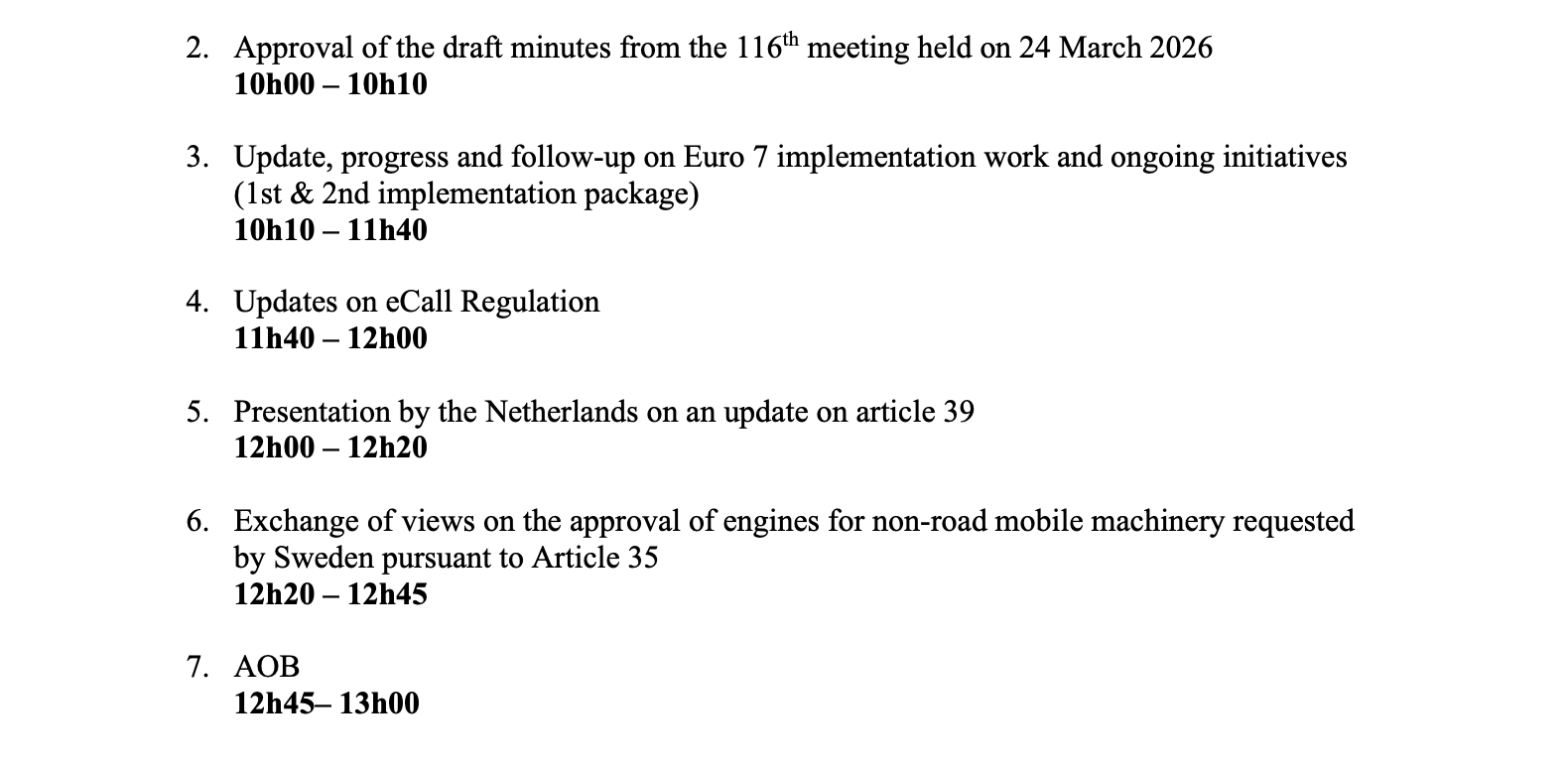

The European Commission has published the draft agenda for the 117th meeting of the Technical Committee on Motor Vehicles (TCMV).
The document confirms that the Dutch regulator RDW will present Tesla‘s Full Self-Driving (Supervised) approval under Article 39 on May 5.
The presentation is listed as agenda item five — “Presentation by the Netherlands on an update on article 39” — and has been allocated a 20-minute slot between 12:00 and 12:20, within a three-hour session covering seven items.
There is no mention of a vote, which could suggest that the May session will serve as an informational briefing for the 27 member states rather than a decision point.
The earliest realistic opportunity for a formal vote would be the next scheduled TCMV session on June 30.
The timeline could, however, extend further if member states raise questions that require additional documentation or review.
Tesla‘s public statements in the past few months target EU-wide availability “during the summer.”
Netherlands Approval
The RDW approved Tesla’s FSD (Supervised) on April 10, granting the software provisional type-approval under UN Regulation 171. It has since begun rolling out to Dutch owners.
The Dutch authority has since notified the Commission and submitted Tesla‘s Article 39 file for EU-wide consideration.
Article 39 of EU Regulation 2018/858 allows national authorities to grant provisional type-approval to vehicles using new technologies that do not fit existing rules, provided the manufacturer can demonstrate equivalent safety standards.
Norway
Norway’s Public Roads Administration (Statens vegvesen) published one of the most detailed responses to date, replying to an inquiry by X user ‘svennpetter’ about what the Dutch approval means for the country.
The agency said it is “receiving many inquiries from the public” following the RDW decision, acknowledging that “many Tesla owners who have been misled by the manufacturer’s marketing are impatient and want clear information.”
As an EEA member, Norway does not have voting rights in the TCMV process but can submit questions.
The administration said it plans to “ask specific questions about how typical Nordic conditions have been taken into account.”
Additionally, it will inquire about what is being done to prevent confusion between a driver-assistance system and a self-driving system, how reporting requirements for incidents will be handled, and what is the system’s robustness against manipulation and other security aspects.
The agency referenced the precedent set by Ford‘s BlueCruise — a driver-assistance system previously approved through the same Article 39 mechanism, promoted by Germany’s KBA.
In that case, the administration “had a special review for Ford Norway, which made some adjustments to its customer information” before accepting the system.
“We expect a similar process with Tesla,” the agency added, noting it has “no basis to give a timeline for this, as it will depend on the response from Tesla Norway.”
Tesla was the best-selling automaker in Norway in the first quarter of 2026, registering 7,443 vehicles. Toyota came in second with 2,728 vehicles — less than half Tesla’s total.
Norway remains a global leader in EV adoption, with over 98% of new monthly vehicle registrations being fully electric.
Contrast with Sweden
On the question of whether existing vehicles can receive the software, the Norwegian authority offered a clearer path than Sweden’s Transportstyrelsen — which flagged that existing vehicles may not be covered by the EU approval process.
The Swedish Transport Agency said this week it will follow the EU decision, but flagged a more restrictive interpretation than other member states — suggesting the Article 39 process covers only newly manufactured vehicles and that updating existing vehicles “is something that falls under national regulations in each EU country.”
The agency confirmed that analysis “is ongoing from a Swedish perspective” but said it is too early to comment on timelines.
Norway’s position is that, “based on an application and proper documentation from the manufacturer regarding the compatibility between the old and the new models,” the administration “can allow this in a supplementary decision.”
Italy
Italy’s Transport Ministry told a Tesla owner on Tuesday that it is not taking any decision on FSD until the EU-level discussions have concluded.
In an e-mail reply, the Ministry said that “provisional type-approval has national validity and it is at the discretion of each individual Member State to decide whether to accept such type-approval on its own territory.”
An executive at the government body added that “no decision has yet been taken at the European level as provided for in the month of May, when a joint analysis of the proposed solution will be carried out by the Commission and the Member States.”
The ministry’s wait-and-see stance comes despite the well-documented relationship between Tesla CEO Elon Musk and Italian Prime Minister Giorgia Meloni, which dates back to her election in 2022.
Italy was one of the first European markets where Tesla offered FSD test rides with safety drivers in late 2025, alongside France and Germany.
The company has also published footage of FSD testing on the streets of Rome.
France
France’s Centre National de Réception des Véhicules (CNRV) sent a detailed reply to multiple Tesla owners — including X users ‘Eymeric63974’ and ‘TeslaStars’ — who inquired about recognising the Dutch approval.
The authority confirmed that the RDW issued “only a provisional EU type-approval valid only in the Netherlands under Article 39 — not a full European homologation.”
The CNRV noted that FSD (Supervised) does not comply with UN Regulation No. 171, specifically because the system allows system-initiated manoeuvres such as lane changes in any environment, including urban areas — a capability that goes beyond what the regulation currently permits.
France said it will not authorize the software before the European Commission’s Article 39 examination procedure and vote.
“The Ministry of Transport’s primary concern is your safety, based on neutral and reliable criteria and data,” the authority wrote.
Belgium
In Belgium, X user ‘dm_jns’ contacted the cabinet of Flemish Minister-President Matthias Diependaele urging fast recognition of the Dutch approval.
The cabinet responded the same day, thanking the owner for his “insights and for the initiative” and confirming that the message was being “reviewed internally.”
The message suggests that Tesla‘s FSD could be regionally approved in the country, even before the EU meeting takes place.
“Others whom you contacted are better placed to answer you substantively,” the adviser wrote, while noting the cabinet would follow up “if additional clarification is needed.”