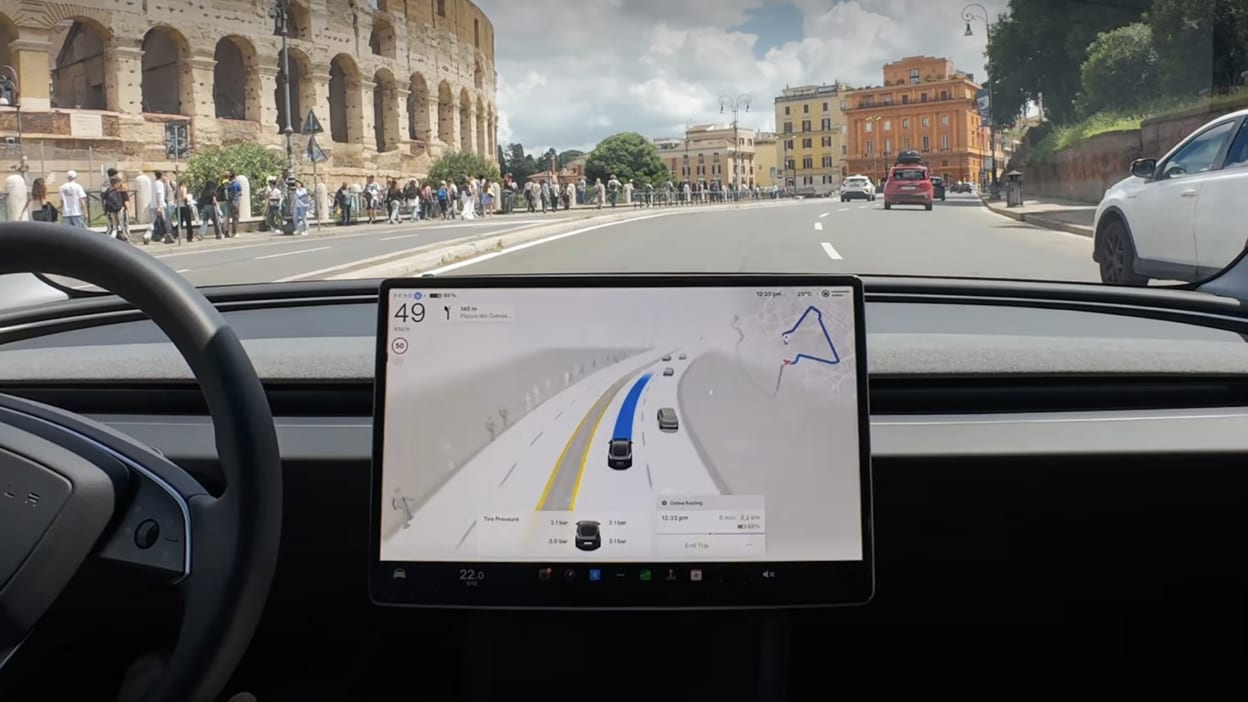

Italian Senator Carlo Calenda has filed a formal parliamentary question directed at the Minister of Infrastructure and Transport, asking whether the government intends to prioritize the approval of Tesla‘s Full-Self Driving (Supervised) system in Italy.
The Senator asked the minister to evaluate direct technical engagement with Tesla and with the Dutch vehicle authority RDW to accelerate the authorization process — ahead of the European-level meeting scheduled for next week.
Calenda also asked the government to indicate the expected timeline for approval in Italy.
The filing was first reported by X user ‘FSD_Italy,’ after being published on Tuesday regarding session No. 415 of the 19th legislature.
The Senator noted that the Netherlands became the first EU country to approve FSD Supervised in April 2026 and that Spain’s Directorate General for Traffic has already received a formal request to fast-track its own process on the back of the Dutch decision.
He also pointed to the tens of thousands of Tesla vehicles already circulating on Italian roads equipped with the hardware necessary to run the system.
Italy’s Transport Ministry told a Tesla owner earlier this month that “no decision has yet been taken at the European level.”
The ministry added that provisional type-approval “has national validity and it is at the discretion of each individual Member State to decide whether to accept such type-approval on its own territory.”
Calenda’s question marks a formal political push in Italy to accelerate FSD’s arrival.
FSD Approval
The Dutch RDW granted provisional type-approval for FSD (Supervised) on April 10 under UN Regulation 171.
Tesla pushed the software to customer vehicles via update 2026.3.6 less than 24 hours later.
Early Dutch reviews were positive, with owners praising performance on Amsterdam’s narrow streets and dense cycling infrastructure.
The RDW has since notified the European Commission and submitted Tesla‘s file for EU-wide consideration under Article 39.
The Commission extended the session dedicated to the Dutch presentation at the Technical Committee on Motor Vehicles (TCMV) meeting on May 5, but no vote is scheduled.
The earliest realistic opportunity for a formal decision could be the next TCMV session on June 30.
France said it will not authorise the software before the EU-level examination concludes, while Sweden’s transport regulator flagged a more restrictive interpretation, suggesting the Article 39 process may cover only newly manufactured vehicles.
Norway’s road authority said it is receiving many public inquiries and plans to ask how Nordic conditions have been taken into account.
Belgium’s path runs through three regional governments rather than a single national authority.
HW3 Users Backlash
The Dutch approval covers only vehicles equipped with Tesla‘s AI4 (Hardware 4) computer — similarly to other countries.
Owners of older Hardware 3 vehicles — produced between approximately 2019 and late 2023 — cannot activate the approved version of FSD. Around four million vehicles worldwide are affected.
The exclusion triggered a collective claim from Dutch owner Mischa Sigtermans, who paid €6,400 for Full Self-Driving in 2019.
“I waited 7 years. SEVEN years! Last week the RDW finally approved FSD here. And for HW3 owners? Nothing. Radio silence,” Sigtermans wrote on X, as EV reported.
The Tesla owner built a website — hw3claim.nl — to organise affected owners across Europe. The platform has since surpassed 5,400 registrations.
The claim rests on Tesla‘s original marketing language to Dutch buyers.
Archived content cited on the initiative’s evidence page shows Tesla‘s Dutch product page in 2019 stated that every vehicle was equipped with the hardware needed to achieve full self-driving in the future.
FSD for HW3
Tesla first announced in October that it would develop a “lite” version of FSD V14 specifically for Hardware 3 vehicles, with a release targeted for the second quarter of 2026.
The company’s VP of AI Software Ashok Elluswamy said at the time that “once the V14 release series is fully done,” the team was “planning on working on a V14 Lite version.”
The US rollout of V14 Lite has not yet begun, however.
During Tesla‘s first-quarter earnings call last week, Elluswamy said the update is now targeted for the end of June.
“We are going to also release a V14 version for Hardware 3,” he said. “This will be a distilled version of the same V14 software that we released for Hardware 4, and people should be able to start the drive from park state and basically have all the features that V14 for Hardware 4 has. And that’s expected to come end of June.”
On the same call, CEO Elon Musk was unambiguous about HW3’s ceiling.
“Unfortunately, Hardware 3 — I wish it were otherwise, but Hardware 3 simply does not have the capability to achieve unsupervised FSD,” the CEO noted. “We did think at one point it would have that, but relative to Hardware 4, it has only 1/8 of the memory bandwidth.”
Musk outlined two paths for HW3 owners: discounted trade-ins for AI4-equipped vehicles and a hardware upgrade replacing the computer and cameras.
He said efficient execution would require new infrastructure.
“We’re going to have to set up like kind of micro factories or small factories in major metropolitan areas in order to do it efficiently,” Musk admitted. “Because if it’s done just at the service center, it is extremely slow to do so and inefficient.”
He added that he expects all HW3 vehicles to eventually make the switch.
“I do think, over time, it’s going to make sense for us to convert all Hardware 3 cars to Hardware 4, because that’s what enables them to enter the Robotaxi fleet and have unsupervised FSD.”
Rollout in Europe
Tesla further responded to international HW3 owners on Monday, writing on X that “following future rollout of FSD V14 Lite for HW3 vehicles in the US, we plan on expanding V14 Lite to additional international markets.”
“This update ensures that HW3 vehicle owners will continue to benefit from ongoing software updates,” the company added.
Tesla acknowledged that “since international rollout is subject to several factors (completion of technical verification, regional adaptation & relevant regulatory approvals), we can’t provide definitive dates at the moment, but will provide updates on a rolling basis.”