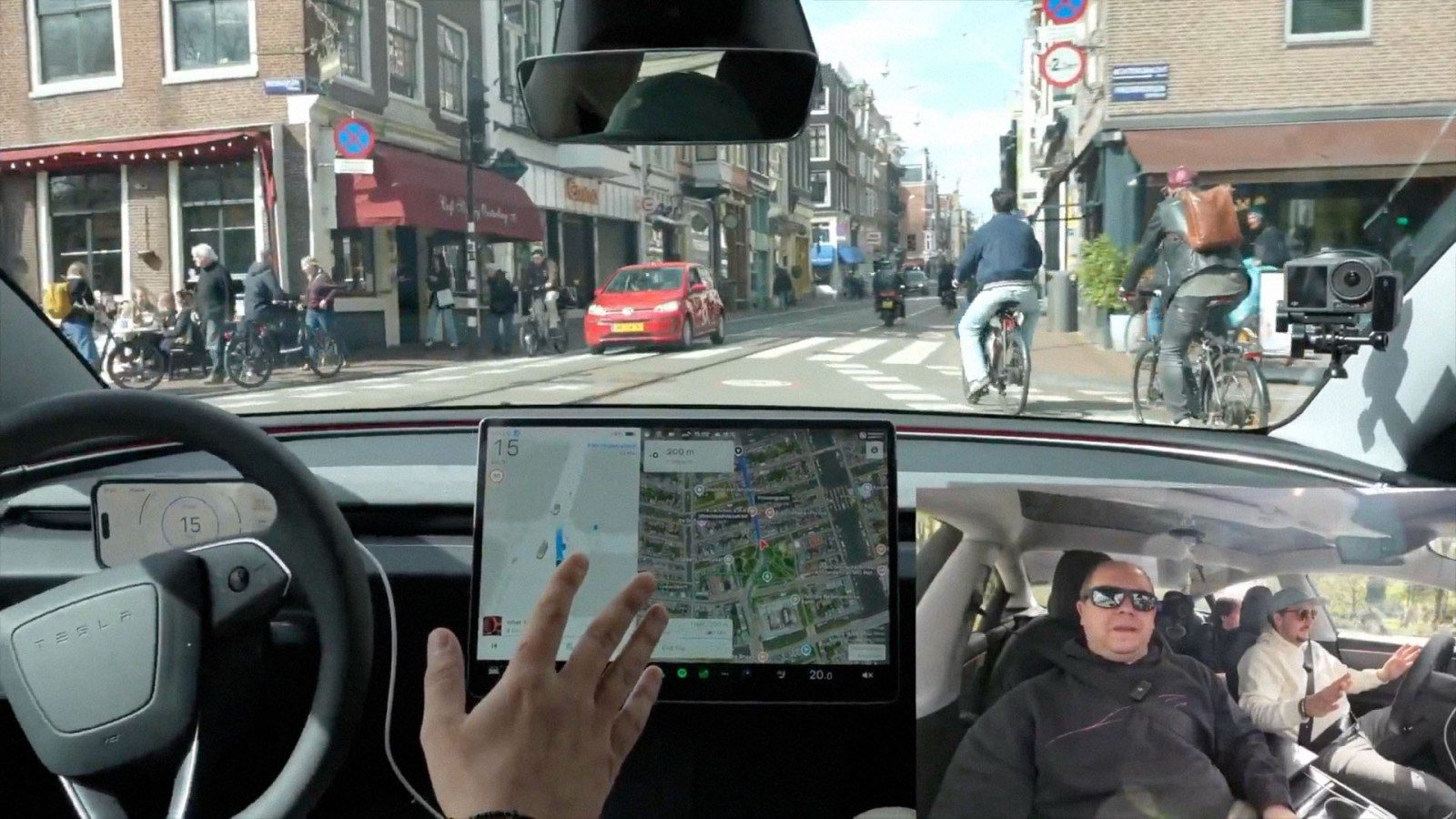

Tesla owners in the Netherlands have surpassed 10 million kilometres (6.2 million miles) driven on Full Self-Driving (Supervised) less than a month after the software became available in the country.
The company announced the milestone on Monday, thanking owners on X “for making Dutch roads safer.”
The milestone comes as RDW is scheduled to present Tesla’s FSD approval to the European Commission’s Technical Committee on Motor Vehicles (TCMV) this Tuesday (May 5) — a meeting that could shape the timeline for the software’s availability across the rest of Europe.
The RDW granted type approval for FSD (Supervised) on April 10, and Tesla began pushing the software to customer vehicles via update 2026.3.6 within 24 hours.
The company’s VP of AI Software Ashok Elluswamy confirmed the rollout the following day.
With the software first reaching Dutch owners on April 11, the 10 million kilometre figure implies an average of approximately 526,300 km driven daily using FSD in the Netherlands — spread across an active user base that has been growing since the initial rollout.
The Dutch milestone adds to a broader acceleration in FSD data collection globally.
The global FSD fleet crossed 10 billion cumulative miles last week, with users now adding approximately 28.8 million miles per day.
The most recent billion miles were accumulated in just 31 days — the shortest interval to date.
Netherlands Approval
The approval in the Netherlands followed more than 18 months of testing between Tesla and the RDW.
The process included over 1.6 million kilometres of test drives on EU roads, more than 13,000 customer ride-alongs, 4,500 track test scenarios, and documentation covering over 400 compliance requirements under UN Regulation 171.
Tesla had initially claimed in November 2025 that the RDW had committed to granting approval by February 2026.
The RDW publicly denied this days later, clarifying that no commitment had been made and that the February session was only for Tesla to demonstrate whether the system met the required standards.
At the World Economic Forum in Davos in January, CEO Elon Musk said he hoped for European approval “next month.”
In March, the comapany announced that it had completed the final vehicle testing phase and submitted all documentation to the RDW for review.
The approval came on April 10, about two months after the CEO’s stated target.
The rollout is limited to vehicles equipped with Tesla‘s Hardware 4 (AI4) computer.
Owners of older Hardware 3 vehicles are not eligible, a restriction that has triggered a collective claim from Dutch owner Mischa Sigtermans, who paid €6,400 for FSD in 2019.
Early reviews from Dutch owners were positive, with drivers praising the system’s ability to handle Amsterdam’s narrow streets and dense cycling infrastructure — an environment widely considered more challenging for driver-assistance software than typical North American roads.
EU Meeting
The RDW has notified the European Commission and submitted Tesla‘s Article 39 file for EU-wide consideration.
Article 39 of EU Regulation 2018/858 allows national authorities to grant provisional type-approval for new technologies that do not fit existing rules, provided the manufacturer can demonstrate equivalent safety standards.
The TCMV’s 117th meeting takes place on Tuesday, with the RDW’s presentation on FSD listed as agenda item five and being scheduled within a one-hour afternoon session starting at 13:30.
Initially, the European Commission had allocated a 20-minute slot within a three-hour morning session before expanding the allocation.
The session is anticipated to serve as an informational briefing for the 27 member states, with the earliest realistic opportunity for a formal decision at the next TCMV session on June 30.
Tesla has stated it expects EU-wide approval “during the summer.”
Reaching the 10 million kilometre milestone in the Netherlands could provide Tesla and the RDW with a fresh set of safety data to present to the committee on Monday, strengthening the case for broader EU adoption.
European Availability
Several countries have already responded to the Dutch decision.
France said it will not authorise FSD before the EU-level examination concludes.
Italy’s Transport Ministry said no decision would be taken until the EU-level discussions conclude, though Italian Senator Carlo Calenda has since filed a parliamentary question pushing the government to accelerate the process.
Sweden has flagged a more restrictive interpretation, suggesting the Article 39 process may only cover newly manufactured vehicles.
Tesla Sales in the Netherlands
Tesla registered 469 vehicles in the Netherlands in April, a 23% increase year over year, according to data from industry association BOVAG.
The result marks the second consecutive month of year-over-year growth — a reversal after a period in which sales in the country had been declining throughout 2025 due to changed incentive conditions.
The motor vehicle tax exemption for zero-emission passenger cars in the Netherlands was replaced with a 30% discount effective January 2026, dropping to 25% in 2029 before ending entirely in 2030.
Tesla sold 30,066 vehicles in the Netherlands in 2024 and 18,684 in 2025, according to BOVAG data.
In the first four months of 2026, 3,134 vehicles have been registered.
The company began installing its HW4 computer in new vehicles in late 2023.
Considering cumulative sales since then — across 2024, 2025, and the first four months of 2026 — the figures suggest that there could be around 50,000 Tesla vehicles in the Netherlands equipped with the hardware required to run FSD (Supervised).
Not all of those owners will have subscribed or activated the software.
FSD (Supervised) is priced at €99 per month in the Netherlands, with a reduced rate of €49 per month for owners who previously purchased Enhanced Autopilot.
A one-time purchase option is currently listed at €7,500 but is set to be discontinued on May 15, after which the subscription model will be the only option available.