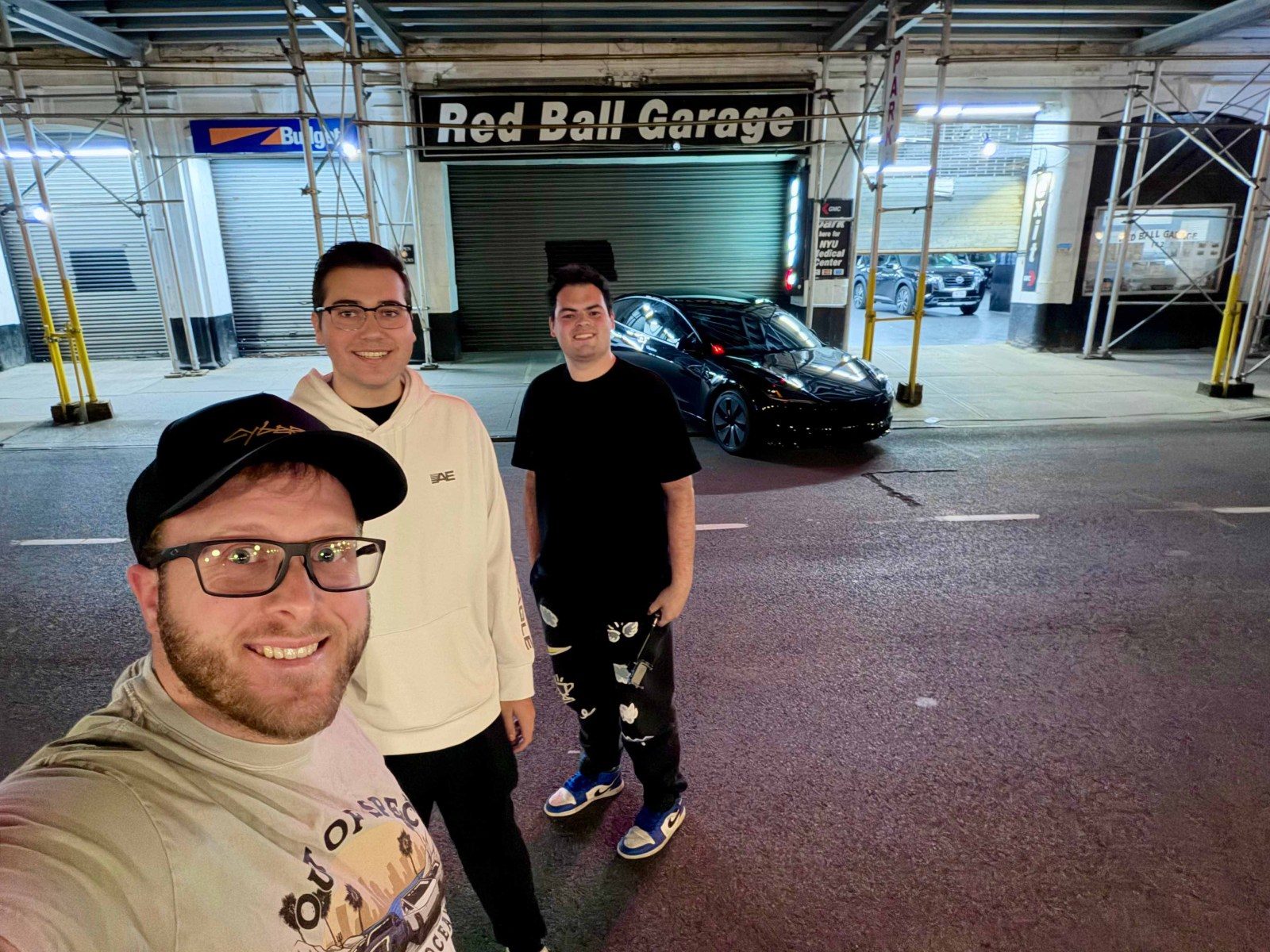

A Tesla Model 3 has completed the New York City to Los Angeles Cannonball Run on the company’s latest Full Self-Driving (Supervised) software with zero human interventions.
The trip covered 2,833 miles in 49 hours, 55 minutes between Red Ball Garage in Manhattan and the Portofino Inn in Redondo Beach, California.
The run — completed on Saturday by Zack (X handle @BLKMDL3) with co-pilots Dan Burkland (@DBurkland) and Aaron (@AaronS5_) — used FSD version 14.3.2 throughout the entire trip, including autonomous parking at every Supercharger stop.
Tesla’s official X account reposted the announcement, framing it as: “Tesla on FSD Supervised drives itself from NYC to LA with zero interventions.”
The run starts and ends at the traditional Cannonball Run terminals — the Red Ball Garage in Manhattan, the historical Cannonball departure point, and the Portofino Inn in Redondo Beach, the route’s traditional finish line.
The claimed record beats the previous zero-intervention coast-to-coast benchmark by approximately 8 hours and 26 minutes.
“We leveraged FSD v14.3.2 for the ENTIRE trip, including parking at every charging stop, all without a SINGLE disengagement or intervention,” Burkland wrote.
Telemetry data and full video footage will be released “over the next couple of days,” he added.
The Previous Record
The benchmark Saturday’s run beats was set by Alex Roy and a small team on January 22, 2026, completing the reverse Los Angeles-to-New York City Cannonball route in 58 hours and 22 minutes.
Roy’s run used a 2024 Tesla Model S equipped with AI4 hardware running FSD version 14.2.2.3, covered 3,081 miles, and averaged 64 mph including approximately 10 hours of charging time.
The Roy team — Roy, Warren Ahner, and Paul Pham — became the first to complete the iconic Cannonball route end-to-end with zero interventions during winter conditions including snow, ice, slush, and rain.
Roy responded publicly to Saturday’s record, noting that FSD records are now following the same pioneer-to-optimization pattern as classic Cannonball runs and that Tesla is currently the only platform capable.
The earlier zero-intervention milestone in the autonomous Cannonball lineage was set by Tesla owner David Moss in December last year, who covered 2,732 miles from Los Angeles to Myrtle Beach, South Carolina, in 2 days and 20 hours using FSD version 14.2.1.25 on a Model 3 with AI4 hardware.
FSD v14.3.2
Saturday’s record run was made possible by the FSD update Tesla released in late April 2026.
Version 14.3.2 introduced upgraded reinforcement learning training for broader driving scenarios, an improved neural network vision encoder for low-visibility conditions, 3D geometry, and traffic sign recognition, and a completely rewritten AI compiler and runtime that delivers approximately 20% faster reaction times.
The update also reduced unnecessary lane biasing and minor tailgating behaviour, and increased decisiveness in parking spot selection — a critical capability for the autonomous parking at Supercharger stops that distinguishes the Saturday run from prior records.
Version 14.3.2 also unifies Tesla’s FSD model across consumer FSD, Actually Smart Summon, and Robotaxi deployments, producing more consistent behaviour across modes.
The autonomous parking element is significant because Roy’s January run did not include autonomous parking at chargers — drivers manually positioned the vehicle at Superchargers between FSD highway segments.
The Saturday run handled the entire charging stop sequence — including alignment, parking, and exit — without driver input.
What’s Notable About the Saturday Run
Three elements of Saturday’s record stand out beyond the headline time.
First, the FSD version progression: version 14.3.2 is newer than the 14.2.2.3 Roy used in January and the 14.2.1.25 Moss used in December — consistent with a roughly four-month iteration cadence on the FSD software stack.
Second, the time delta: 49 hours 55 minutes versus Roy’s 58 hours 22 minutes — an improvement of roughly 14.5%.
Third, the 248-mile route variance: Saturday’s run covered 2,833 miles, while Roy’s drive covered 3,081 miles. The two runs took different routes and starting points, with Saturday’s path optimised for shorter distance.
10 Billion miles
CEO Elon Musk has cited 10 billion cumulative FSD miles as the data threshold needed for safe unsupervised self-driving.
The Saturday repost coincides with Tesla’s ongoing European regulatory push, including the Flemish administration’s screening of FSD that recommended limited additional testing before homologation, announced on Friday.
The European Commission’s Technical Committee on Motor Vehicles is scheduled to review the Dutch RDW’s Article 39 file at its next session on June 30.