
Tesla Canada has notified the Manitoba government that it intends to seek a judicial review of the province’s decision to exclude the automaker from its electric vehicle rebate program, escalating a dispute rooted in the broader Canada-U.S. trade conflict.
Lawyers for the Elon Musk-led company sent a two-page letter to Manitoba’s ministers of justice, environment, finance, and Manitoba Public Insurance on May 22, warning that Tesla planned to file an application with the Manitoba Court of King’s Bench to overturn the exclusion.
“It is Tesla Canada’s position that the government’s exclusion of Tesla Canada from the EV rebate program has and will continue to cause harm to Tesla Canada and its Manitoba customers,” according to a copy shared with media by the governing New Democratic Party on Thursday.
The letter described the province’s decision as “procedurally unfair and undertaken for an improper purpose,” and noted that Manitoba had never formally provided a reason for cutting the company out.
“While the government has never formally identified any reason for Tesla Canada’s exclusion, the exclusion appears to be unrelated to, and inconsistent with, the stated objectives of the EV rebate program,” the document reads.
Before the exclusion, Tesla had been the most popular brand among Manitoba rebate applicants.
Between August 2024 and February 2025, the Elon Musk-led company’s EVs accounted for more than 20% of all approved rebates — 337 vehicles totaling just under C$1.3 million, according to documents obtained under provincial freedom of information law.
Manitoba’s ‘Elbows Up’ Commitment
Manitoba introduced its EV rebate program in 2024, with retroactive eligibility stretching back to August 2023.
The program offers C$4,000 on new eligible electric vehicles priced below C$70,000, C$2,500 on pre-owned EVs, and between C$1,000 and C$4,000 on leased EVs depending on the lease term.
The province allocated C$25 million in total funding, available on a first-come, first-served basis through March 31, 2026.
In 2025, Finance Minister Adrien Sala said removing Tesla from the program was about “Trump-proofing our economy” and reflected a “commitment to be elbows-up.”
The province also excluded Chinese-manufactured EVs from eligibility. British Columbia had made a similar move shortly before Manitoba.
Tesla‘s legal team pointed to a 2018 case in Ontario as precedent to go forward with this case.
In that ruling, an Ontario Superior Court justice found the province had acted arbitrarily in excluding Tesla from a similar EV rebate program and that the decision had unfairly targeted the company.
Ontario eventually added Tesla back to the program before shutting it down altogether.
Opposition Criticism
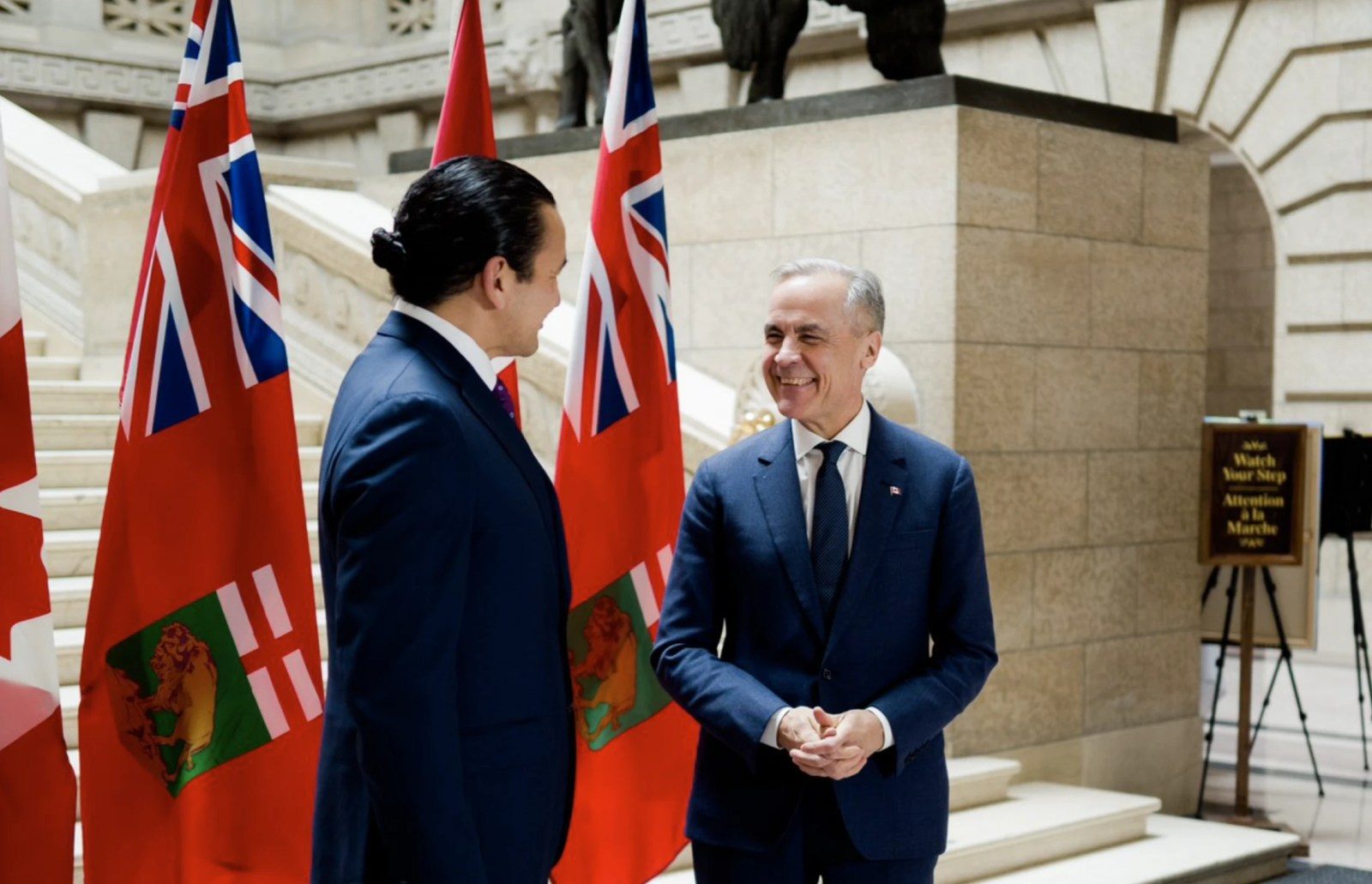
Manitoba Premier Wab Kinew disclosed the legal threat during question period on Thursday and was direct in his response.
“When it comes to Elon Musk and his affinity for supporting Donald Trump’s attacks on Canada, we cut him off, we ended the subsidies for Tesla vehicles,” Kinew said. “Tesla Canada intends to file legal action against us for cutting off Elon and we have a simple message to them: Elon, get Donald Trump to stop the tariffs and then we can talk about the EV rebate.”
Progressive Conservative Leader Obby Khan criticized the NDP’s handling of the situation, however.
“He is celebrating getting sued,” Khan told reporters after question period, referring to Kinew. “He wants that splashy headline to be sued by Elon Musk and Tesla, I guess.”
The opposition produced documents showing Manitoba itself held contracts with SpaceX for Starlink telecommunications hardware.
Those contracts grew from approximately C$24,000 in 2023-24 and 2024-25 to just under C$122,000 in 2025-26 — an increase of more than 400%.
The province justified the increase on emergency communication needs during Manitoba’s unprecedented wildfire season last year.
Tesla’s Canadian Landscape
The Manitoba dispute adds another layer to Tesla‘s complex and evolving rebate picture across Canada.
As trade tensions with the United States escalated, the company shifted its Canadian Model Y supply from the US to Giga Berlin last year to bypass tariffs.
The sourcing change allowed Tesla to price its entry-level RWD variant from C$49,990 — just below the C$50,000 cap for Canada’s federal EV Affordability Program.
The Model Y qualifies for the recently introduced C$5,000 federal rebate, bringing its effective starting price to under C$45,000.
Tesla then moved to capitalize on the Canada-China EV quota deal struck earlier this year, which allows up to 49,000 Chinese-built EVs annually into Canada at a 6.1% tariff — well below the 25 percent levied on US-built vehicles.
The company pulled its remaining American-made Model 3 inventory, replaced it with Shanghai-built units, and became the first automaker to deliver vehicles under the arrangement.
Tesla‘s Shanghai-built Model 3 Premium RWD launched at C$39,490, the cheapest model ever sold in North America under the brand.
The first China-made Model 3s have already arrived at Canadian delivery centers.
Quebec recently added the variant to its Roulez Vert program, making it eligible for a C$2,000 provincial rebate — the first vehicle imported under the Chinese quota to qualify for a provincial incentive.
The sedan does not, however, qualify for the C$5,000 federal rebate, which is restricted to vehicles built in free-trade partner countries.
The aggressive pricing has not come without trade-offs.
Tesla has repeatedly revised the Canadian Model 3 Premium RWD’s specifications downward since orders opened in early May.
The advertised 0–100 km/h time went from 4.2 seconds to 5.2 and then to 6.2 seconds, peak Supercharging speed dropped from 250 kW to 175 kW, and the battery and drivetrain warranty was shortened.
The variant uses lithium iron phosphate battery chemistry and is now the slowest Model 3 Premium sold in any market.