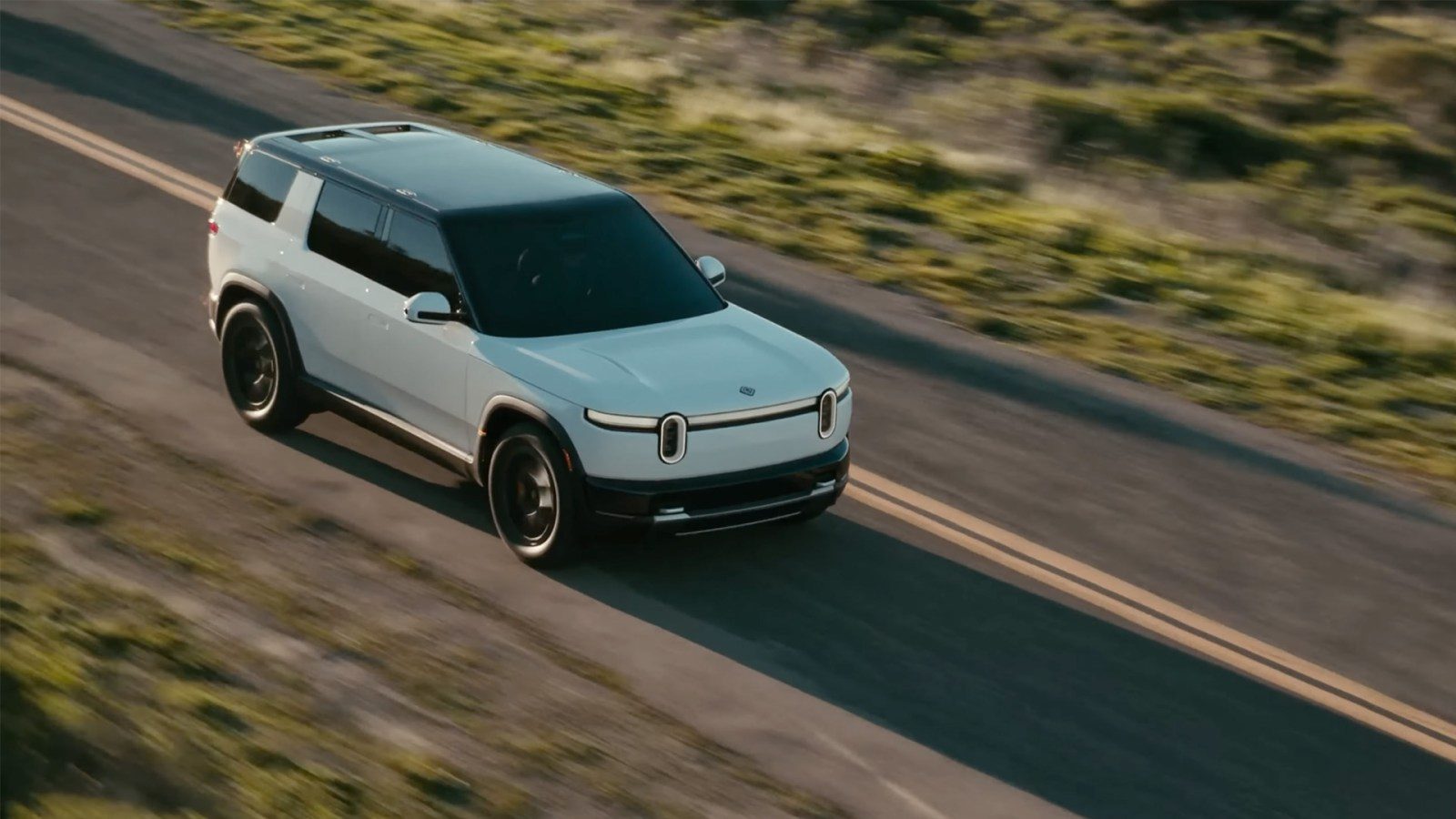

Rivian‘s R2 Performance — for which the EV maker entered saleable production in late April — matches the 2026 Tesla Model Y Performance on energy consumption while delivering a higher range.
On standard 21-inch all-season wheels, the R2 Performance is rated at 105 MPGe combined (114 city, 96 highway) and 32 kWh per 100 miles.
The final ratings, published by the US Department of Energy (DOE) and the Environmental Protection Agency (EPA), put its range at 330 miles.
Tesla‘s Model Y Performance posts identical combined efficiency — 105 MPGe and 32 kWh per 100 miles — but returns 306 miles of range.
The Rivian goes 24 miles farther on equivalent energy consumption, despite carrying significantly more weight and pushing a larger profile through the air.
The Weight and Aerodynamics Gap
EPA certification documents filed by Rivian list the R2 Performance’s curb weight at 4,998 pounds on 21-inch wheels.
The Model Y Performance weighs 4,466 pounds, according to Tesla‘s specifications. That is a gap of over 530 pounds.
Aerodynamics tell a similarly lopsided story.
The Rivian is a boxier vehicle by a significant margin, and its squared-off shoulders and off-road-oriented ground clearance give it a meaningfully larger frontal area.
The 2026 Model Y carries a drag coefficient (Cd) of 0.22, achieved through the Juniper refresh’s redesigned front fascia, slimmer headlight housings and revised air curtains.
Rivian‘s R2 has not had its Cd officially confirmed, but estimates based on its form factor place it between 0.28 and 0.29.
For comparison, Rivian‘s debut R1S has a Cd of 0.29, while the R1T pickup carries an officially claimed 0.30 — a figure that was considered exceptional for a truck when it launched. The Ford F-150 Lightning sits at approximately 0.44.
Rivian’s Charging
The R2 Performance is powered by two AC permanent magnet motors — a 219 kW front unit and a 270 kW rear unit — producing a combined 489 kW, or roughly 656 horsepower.
The battery pack provides 87.9 kWh of usable energy, according to Rivian‘s official specifications.
EPA certification documents recorded a slightly higher 88.67 kWh depleted during testing. The pack operates at a nominal voltage of 353 volts and weighs 541 kilograms.
Several engineering decisions contributed to the efficiency figure.
The model features a redesigned heat pump system that consolidates valves, sensors, heat exchangers, and the refrigerant bottle into a single enclosure.
All R2 trims will include the heat pump, the company confirmed to EV.
Rivian said the unit is smaller, more efficient and quieter than the system used on the R1 vehicles.
CEO RJ Scaringe told Out of Spec Reviews that the R2 uses an “energy cell centric approach” — the same general strategy Tesla employs — prioritising range over peak charging speed.
DC fast charging peaks at 210 kW, with a 10-to-80 percent charge time of 29 minutes.
A native NACS charging port provides access to Tesla‘s Supercharger network, as the company transitions from CCS ports in the R1 models.
The R2 Performance starts at $57,990 excluding destination fees.
The initial production run ships with the Launch Package, which adds a lifetime Autonomy+ subscription, exclusive Launch Green paint option, tow package rated for 4,400 pounds and a Rivian Green anodised key fob.
The All-Terrain Tire Penalty
Buyers who opt for 20-inch all-terrain tires will see a measurable efficiency hit.
The R2 Performance on AT rubber is rated at 99 MPGe combined (109 city, 89 highway) and 34 kWh per 100 miles, with range falling to 307 miles.
That is a six-point drop in combined MPGe and a 23-mile reduction in range compared to the 21-inch all-season configuration.
The annual fuel cost estimate rises from $700 to $750. Curb weight also increases slightly to 5,016 pounds.
The penalty is concentrated on highway driving — the AT tires post 89 MPGe highway versus 96 on the all-season setup. City efficiency drops from 114 to 109 MPGe.
For context, 307 miles on all-terrain tires still places the R2 within one mile of the Model Y Performance’s 306-mile range.
Lucid Gravity Leads the Group
The two SUVS rank below the larger 2026 Lucid Gravity Touring equipped with 20-inch front and 21-inch rear wheels, however.
The Gravity Touring is rated at 111 MPGe combined (115 city, 106 highway) and 30 kWh per 100 miles, with a range of 337 miles.
Lucid‘s Gravity achieves this with an 89 kWh battery pack and a dual-motor all-wheel-drive powertrain rated at up to 560 horsepower and 811 lb-ft of torque.
The company rates the 0-60 time at 4.0 seconds. Curb weight sits at approximately 5,794 pounds — roughly 800 pounds heavier than the R2 Performance.
The Gravity Touring’s cost to drive 25 miles comes in lowest at $1.14, versus $1.20 for the Model Y Performance and $1.21 for the Rivian on 21-inch wheels.
Lucid‘s advantage traces directly to aerodynamics and drivetrain engineering.
The Gravity carries a drag coefficient of 0.24, achieved through a low, swept roofline developed under a chief aerodynamicist who previously worked at Red Bull Racing.
The company’s 900-volt-plus electrical architecture and in-house motor design are central to its efficiency strategy.
Lucid has built its brand around efficiency as a core differentiator.
VP of Comms Nick Twork has pushed back on the notion that fast charging alone defines the EV experience, arguing that energy efficiency is the more fundamental metric.
The company has also claimed that Tesla could need up to seven years to match the efficiency of its Air sedan platform.
The Lucid Air sedan remains the most efficient EV in EPA ratings.
Lucid’s Drag Coefficiency
The Lucid Gravity sits at 0.24 Cd — slightly higher versus the Model Y, but offset by Lucid‘s more efficient drivetrain.
Looking ahead, Lucid‘s upcoming Cosmos midsize crossover — the company’s direct competitor to both the R2 and the Model Y — will target a drag coefficient below 0.22, according to design chief Derek Jenkins.
The Cosmos rides on the new 800-volt midsize platform with the next-generation Atlas drive unit, which the company says is 23 percent lighter and 37 percent less expensive to produce than its current Zeus powertrain.
Lucid has said the Cosmos will need just 69 kWh of battery capacity to achieve 300 miles of range.
The vehicle is expected to start under $50,000. Production is scheduled for the year-end at the company’s Saudi Arabia plant.